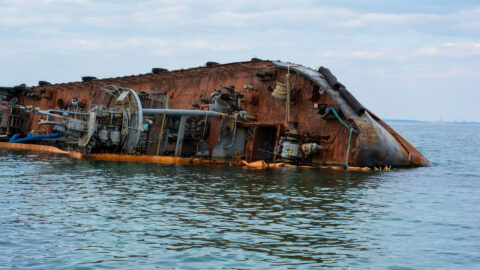

The first of Russia and Iran’s aging shadow fleet is sinking. The tanker is carrying ~1 million barrels of crude bound for India, but that oil is already leaking into the water off the Omani coast.
Beyond the environmental disaster, the next question is that of insurance. Since the shadow fleet is “covered” by Russia’s state-backed insurance system, whether they pay out or not will determine just how much longer the decrepit shadow fleet can operate.
Transcript
Hey everybody. Peter Zeihan here, coming to you from the peak of Sheridan. But today we’re going to talk about the Russian and Iranian shadow fleets and a ship that is in the process of sinking off the Omani coast in the Middle East. If you remember, we’ve got sanctions on Iran, we’ve got sanctions on Russia. And so both countries have turned to what are called shadow fleets, unregistered vessels that are old and were destined to be scrapped, that take out insurance from the Russian government. And the first one of them is now actually sinking. And we’re honestly pretty lucky here. It’s been four years since the Ukraine war got going, and in that time you would expect more of these things to go down. But it wasn’t until recently that Ukraine just started to openly attack the shadow fleet in the Black Sea, and so far they haven’t actually tried to sink anything. Now we’ve got one that is on its own, that is taking Russian crude to India. It is now sinking. Its the Caroline Bezengi, I believe is the name. Carries about a million barrels a day or carries about a million barrels. And it is now sinking off the coast of Oman, already in oil spill, it’s about 400km², and we’re already seeing oil starting to make landfall on some of the Omani islands.
It’s in the last 48 hours, it’s condition has deteriorated significantly and it is very clearly taking on water. I can’t tell you when it’s going to sink, but there’s really no hope that it’s going to make it to its destination at this point. And so we’re talking about an ecological disaster that is at least three times as bad as what happened with the Exxon Valdez.
It’s an open question whether anyone will let this thing dock because it’s just going to leak in port then. But at least one of the compartments is damaged to the point that the ship going down. Anyway, a couple of things to keep in mind moving forward. Number one, since this is the first real incident with a shadow fleet vessel, we don’t know how the insurance system is going to work. Normally, if you had a fleet of vessels in this sort of condition and one of them then sunk on its own without getting shot at, you would see an explosion in insurance rates that would probably lead to the decommissioning of every ship of its class. That’s not going to happen this time, because these are ships that should have been decommissioned already. So it’s an open question how Russian insurance is going to pay out because the state created the insurance policy specifically to evade what everybody else normally does on the high seas. And it will be interesting to see if the Russian government actually pays out to cover the environmental solution that will be required for example, for the Omanis. The second thing to watch is the degree to which the Russians do or do not act, will shape what the Ukrainians do and do not do.
Because if the Russians do not honor their own insurance policy at all, then it’s up to the Ukrainians to probably sink a couple directly. And when that happens, no one’s going to allow these ships anywhere near any of their ports. So we’ve been talking about since the early part of this year how countries are getting more and more aggressive with the shadow fleet. Now we’re seeing the decrepit nature of the vessels probably being their own worst enemy. And as the shadow fleet gets retired, we’re looking at another couple million barrels a day just disappearing. It’s really hard to get a grip on Russian exports right now because the Ukrainians are attacking so much energy infrastructure. But at its peak it was about 5 million barrels a day of raw crude, plus another 2 million barrels a day from Iran.
We’re looking at losing all of that as this year draws on. So, you know, exciting times. Take care.