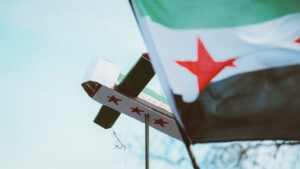

Russia’s strongest military foothold and gateway in the Middle East is now gone. Russia has agreed to end its presence at the Latakia airport and Tartous port, as it hands over the reins to Syria’s transitional government.
Tartous was Russia’s primary hub for projecting power into the Middle East and Africa, and without it, Moscow will struggle to do much in the region. This is part of a broader trend of Russia scaling back positions and focusing its military capacity on the Ukraine War.
Transcript
Hey, all, Peter Zeihan here, coming to you from Colorado. And the news is that on August 9th, that was this past Sunday. We have a new agreement between the transitional Syrian government, which is led by Sunni jihadist, formerly allied with Al-Qaeda and the Russian government, to basically end Russia’s military position in Syria. For the last 15 years, the Russians have maintained a strong military presence in two locations in Syria: the Latakia airport and the Tartous port, both of which have been under direct Russian military control the entire time, and the Russians have used both positions, both to intervene forcefully in the Syrian war, which ultimately ended up on the losing side, and then second, to protect naval and air power throughout the Mediterranean. That now comes to a close. The day that the agreement was signed, the 9th of August, the civilian administration in Syria took formal control of the airport again, and within three months they will take control of the Tartous port as well. Technically, there’s a face saving measure here that these will be joint training centers, but there’s really not a lot that the Russians bring to the table here. In addition to the fact that there are well among 90% of the Syrian population that used to be the target of Russian attacks, the idea of joint training with the Russians is a little, let’s just call it galling. So I expect the Russian position to be nominal. They might maintain a bit of an intelligence outpost, maybe a little observation, but that’s it.
So we’re talking in excess of a 90% reduction in what the Russians used to get out of these bases within a very short period of time. And this marks the end of the Russian high water mark in the Middle East in the post-Soviet era. It’s not that they don’t have ties. They work with the Houthis, they work with the Iranians. They even have decent relations with the Israelis most days. But these were the only two military facilities that Russia has outside of the former Soviet Union, and it was the only way that they could reliably project power into the Mediterranean. And because the Turks control the straits that connect the Black Sea to the Mediterranean, and now that these ships that the Russians used to keep at Tartous have to go home or go somewhere. The ability of the Russians to even have the range that is necessary to protect power doesn’t exist. So we’re looking at the entire southwestern arc of the former Soviet space, basically becoming a no go zone for Russia. We’re seeing some color of this in many other operations around the world, as the Ukraine war basically sucks up more and more Russian military bandwidth.
They still have things like the Russian Legion that are running around in Africa, causing coups or preventing them based on the day, but without the ability to reliably resupply their forces through Tartous, the ability of the Russians to even maintain those positions is going to be shriveling. So it’s a good day if you’re anybody but Russian, and if you’re Russian, you now have to focus almost exclusively on the Ukraine war, which I would argue was always how it was going to go.
We’ll save the Ukraine war itself and the long term prospects there for another day.