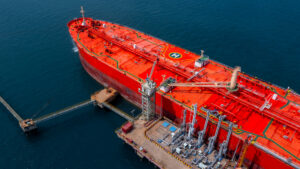


Global oil markets are beginning to fragment, and with each added layer, the likelihood of returning to a global unitary price for crude gets further away. But this oil split isn’t hitting everyone the same…
As tanker shortages and security risks make long-distance crude shipping increasingly expensive, regions like Europe and Northeast Asia will be forced to pay whatever they must since they have limited alternatives. However, North America will likely benefit from a surplus of cheaper energy since the crude can’t make it anywhere else.
Transcript
Hey everybody. Peter Zeihan here, coming to you from a drippy, foggy Colorado. And today we’re gonna talk about the oil markets. Specifically, we are seeing ever widening spreads between the prices of different crude grades. Specifically, you’re looking at things like Canadian crudes all of a sudden trading at a significant discount to everything else. You’re also seeing similar things like that in smaller, crude grades that come out of places like Africa, whether it’s North or sub-Saharan. And the problem is transport. You see, under normal circumstances, when you have a wide spread between prices in one continent versus another. Tankers show up to take the crude from places where it’s cheaper to deliver to places where it’s more expensive. And that ensures a certain degree of balance in the market and keeps global energy prices more or less unitary. That is now ending with huge implications for the sector.
So we’ve got three big things going on. First of all, of course, is the Iran war and what’s going on in Persian Gulf. In order to get crude out of the Persian Gulf and not get hit by Iranian attacks with the Saudis and the Emirates and the Kuwaitis and the Qataris and the Iraqis are doing is using their own internally owned tankers to load up, turning the transponders off, sailing out of the Gulf, dark, and then doing a ship to ship transfer on the other side. What this means is it basically almost doubles the amount of time that it takes to get a tanker from the point of supply to the point of demand, because you have to do a transfer along the way, which means you need twice as many tankers to service the same route. And with the Iranians now expanding their attacks to areas that are not necessarily in the Strait of Hormuz, they’re going to have to go further in order to do the ship to ship transfer, which is going to require even more tanker days in order to compensate. And that’s before you consider what’s going on in the Red Sea with the Houthis, which is generally a somewhat similar problem. So, number one, it’s hard to get the crude out in this environment. And number two, getting it out requires an additional 10 to 15 to maybe even $20 a barrel in order to compensate for this last step. And all of that is absorbed with more risk and especially more tankers.
The second one, of course, is the Ukraine war. The Russians under sanctions that used to send most of their crude to Europe by pipe that has now stopped, which means they have to load up in places like the Baltic and the Black Sea with tankers, and then ship them around Africa or through Suez all the way to East Asia or South Asia, basically required a huge number of tankers to handle something that used to not even be done by tankers as well. And that is driving up the split.
And then third, because the shadow fleet exists and now it’s probably one fifth of all tankers out there. People haven’t been investing in new tankers because there’s a huge volume. But all of these issues are now kind of coming to a head.
The biggest one, of course, is in the Russian space. The Ukrainians have now demonstrated a capacity to hit tankers and ports and critical nodes, like pumping stations, with such alacrity that we’re seeing the Russian crude, the Urals blend, basically disappear from the market. That opens up a problem because all of a sudden, with that crude gone, those tankers have to do something else. Or more likely the Ukrainians are now starting to damage them and remove them from the fleet completely. You remove the tankers and then all of a sudden it’s not an issue of high versus low prices, it’s can you get a tanker or not? And the Persian Gulf, with the Iranians now going further abroad, similar sort of problem, but with more legality. And if you want to start building a tanker today, you’re not going to get it before the end of the year after next.
So what we’re seeing is long haul shipping not disappearing, becoming so expensive that these spreads are getting wider and wider and wider. It doesn’t affect everyone equally, and it really depends upon what your destination market happens to be. So if you’re, say, in Africa and you’re trying to just get your crude to Europe, that’s not a big haul. If you’re trying to get from Venezuela or Colombia to the United States, same thing. So you’re not seeing the spreads open up with those crude grades as much as you are, say, with Canadian Select, which all of a sudden only can be shipped by pipe to the United States. And this has got to be frustrating. They spent a decade trying to get a pipeline to the Pacific. It’s finally open, and all of a sudden the tanker rakes means it’s not viable to ship the stuff to Asia. Some of it has to go anyway. So, for example, if you’re Persian Gulf crude going to Northeast Asia, I mean, the Northeast Asians don’t have any other alternatives really, so they have to pay whatever they have to pay.
What we’re seeing is the early stages of some very, very hard splits in the markets, with the United States basically trading in a situation where it’s either domestically supplied. The Canadian crude has nowhere to go, so it’s sold at a big discount in the United States. The Venezuelan and the Colombian crude has nowhere else to go. So it’s being sold at a slight discount to the United States. And then the Eastern hemisphere just kind of implodes, because if you can’t get the crude from supply to demand, and if you don’t have an alternative for that crude, which for most products there just isn’t one, then you’ve got to pay whatever you have to pay. So the long term forecast here is something I’ve been talking about for the better part of the last decade, with the United States basically having a functional ceiling on its energy prices of around $70 because all of its fields are viable at that level. And globally, you probably have a double the North American price in places like Europe and triple or more in places like Northeast Asia, because there just aren’t any alternatives, whether it was war that was destroying the production sites or now disruptions in the tanker market that is getting us there, it really doesn’t matter because all of this is going to happen more or less at the same time.
Remember that the Iranians have demonstrated they can shut down the Persian Gulf energy complex very easily, and the Ukrainians are demonstrating that they can shut down the shadow fleet in the Russian energy complex a little bit more difficult, but well on its way. So we’re looking already conservatively at over half of the world’s globally traded crude vanishing. At the same time, we have a tanker crisis. We’re only at the beginning of this, and this is going to be the norm for the bulk of the next 20 years.