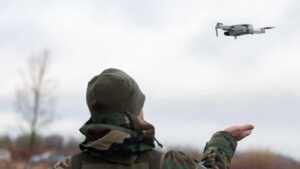
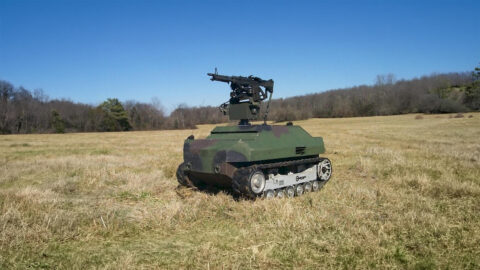

The Ukrainians have introduced ground drones to the battlefield, attacking Russian positions and disrupting logistics. This is yet another innovation emerging from this war that is shaking up how wars will be fought.
These ground drones have been used in frontline attacks via fiber-optic cables, as well as being dropped behind Russian lines by aerial drones. These ground drones offer new ways of targeting vehicles, supply depots, and other logistical targets.
Like all wartime innovations, it won’t be long before the Russians and others replicate this tech. And the prospect of having to deal with mobile IEDs is pretty damn scary.
Transcript
Hey everybody. Good morning from Colorado. Peter Zeihan here. And today we’re going to chat about a new innovation that the Ukrainians are using on the front in the war ground drones. Now when people think about ground drones, they naturally think of some sort of early version of The Terminator, you know, a giant track thing with giant machine guns that just plows through human formations. That’s not what’s in play here. These things at max are about 90 pounds, usually about half that. And they look honestly a little bit like some of the little off road radio controlled toys that you might have used as a kid. You got a photo of a couple of the models here.
They’re used at the moment, it seems, in two different ways. The first one is for direct assaults on Russian positions, and basically they just drive up and explode. So, you know, think of tremors if you remember that movie. Alternatively, a heavy bomber drone, which the fact that heavy bomber drones even exist, heavy bomber drones can carry 90 pounds, ergo the limit, and they drop them behind enemy lines to attack vehicles and logistical support. Now I’m reading between the lines here, because the Ukrainians are not talking a lot about the details of these, because it’s a new weapon and it’s in operational use. And every place they’ve used it, they’ve surprised the hell out of the Russians. But it appears that the ones that are used for the direct ground assault on the front itself generally have fiber optic cables trailing behind them. And by doing that, they can’t be jammed. But it also means that their range is very, very limited and their maneuver is limited. Because once you start dropping a cable behind you, too much maneuvering and you’re going to get tangled up and it become useless. The big advantage of ground drones over air drones in this sort of operation is they can park and wait for hours, for days. Normally, an air drone is only going to be aloft for a few minutes, maybe as much as an hour. When you talk about the ones that are targeted to the front, but this way you can position things slowly ahead of time and then come back and activate a whole slew of them and just obliterate the Russian position in concordance with direct aerial attack and humans and maybe even tanks.
The ones that are dropped behind enemy lines are really interesting though. Remember, the Russians are the best in the world at electronic warfare. And so one of the problems the Ukrainians have, especially on the front line, is getting through that. And that’s why those tethered drones, the fiber optic drones, exist both for ground and air units. But once you drop it off behind enemy lines, there is no way that you can have a digital tether to it. You’re talking about 5 to 15km behind enemy lines. A couple of things they have going for them. Number one, E-W is normally directed forward and up because they’re worried about communications and the worry about aerial attacks. It’s not necessarily going backwards and down. And so it is possible for the Ukrainian ground drones if they’re dropped behind enemy lines, literally sneak up behind the Russian positions in places where there’s more powerful EM, where it’s really more of a dome. However, that still won’t work, and you still need to control this thing. There is no sign at present that some of the memory drones that are capable of limited decision making are implanted into the ground units, because there just isn’t enough pilot data to really work with. So you do have to have a communications. So it does have to be outside of the EM bubble. That suggests that they’re using another aerial drone as a relay when they activate these things, but then they’re going after trucks on roads and tanks and depots and things like that that are well behind where you could reach with front line drones or artillery. And in doing so, it appears over the last several weeks, the Ukrainians have just completely gutted the Russians ability to supply parts of the front.
So you can combine that with deeper strike drones, air drones, that are hitting things 100 and 200km behind enemy lines and basically the entire front section of the Russian front, the last 100-150km has become a no go zone for anyone who doesn’t have strong EM, and that has made resupply impossible. And that in at least in part, explains why the Ukrainians have made so much progress actually retaking territory throughout September.
As with all technologies like this that are really just based on putting old parts together in new ways, you shouldn’t expect this to be a perennial Ukrainian advantage. Probably by this time next year the Russians will be using them. But you also have to consider that the technologies here are not going to be limited to the Ukraine front of the war between Russia and Ukraine. We’ve already seen some of those memory drones leak out and be used by the Iranians. And probably very soon the Houthis. You start applying the same logic to the ground drones, and we’re talking about a new sort of warfare emerging that is going to make it very difficult for any sort of projection based military to push force somewhere else. So just to pick a topic, the US Army, the hardest thing they do is the logistical supply to keep their forces operating. In Afghanistan, that required daily convoys of diesel trucks going through Pakistan, for example. In an area that is saturated with aerial drones, especially now ground drones, that becomes impossible because it used to be that they would have to worry about things like IEDs on the roadside, and that required certain techniques in certain vehicles and certain detection methods. If you’re dealing with a ground drone, it’s an IED that can move, and all of a sudden the entire supply system for what the US did throughout the war on terror just isn’t viable. And we’ve got to find a new way to do everything. We’re not going to figure that out in six months.