
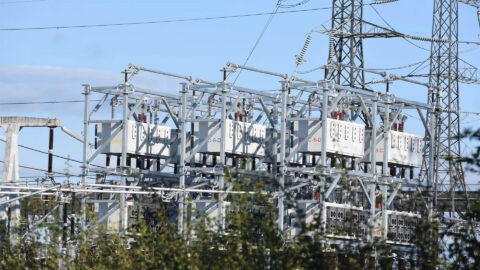

There are three major obstacles to expanding the U.S. electrical grid: generation capacity, permitting, and large power transformers (LPTs). Let’s focus on LPTs today.
Reindustrialization will require a massive expansion of electricity generation (and that’s without further data-center growth). Large power transformers are essential for transmitting and distributing electricity, and most of the existing LPTs have already hit their expected lifespan. So, if the U.S. has any kind of shot at reindustrialization, it needs to replace all the aging equipment and add more LPTs, despite years of backlogs.
Transcript
Hey, everybody. Coming to you from my tent in Yosemite. It’s raining outside. So I decided that discretion being the better part of valor, I’d take a nap. But first, I want to talk to you about the American grid. As you all know, we need to build out the grid as quickly as possible, as large as possible. And as I’m sure most of you have heard, a lot of people are unsure of how we’re going to do that.
We’ve got three primary obstacles. The first is generation capacity. Assuming for the moment that the data center boom ends today. The United States needs to expand its grid by approximately 50%. And that’s obviously a lot. It took a half century for us to do the last 50% expansion. So to do that in a short period of time is going to be very, very difficult.
With the data center expansion. You’re talking about a doubling or tripling or a quadrupling. And so anyone who tells you that data centers are the wave of the future clearly hasn’t done the math. There is no version of physics or the United States where that is possible. So this idea that this data center boom is not near its peak and is not a bubble.
You know, regardless of what you think about the financing for data centers and the profit centers for data centers and the applicability of data centers, there just is nowhere near enough power, and there won’t be without a significant change in their design. Okay. All of that’s one. The number two problem permitting, it’s difficult to build large industrial infrastructure in a first world country because lots of people already have interests and they sue to protect them.
But one of the real problems we have in the United States is permitting is that the local, state and federal level for power generation and any asset is typically managed at the local level within a specific electric district. Unless you’re in a place like say, oh, I don’t know, North Carolina, where I believe it’s Duke energy is really big.
Most of these districts are like at the county level, maybe even smaller. And getting everything through, getting the capital lined up and getting all the permits, just taxes, staff that in many cases doesn’t exist in number. Keep in mind that U.S. electricity generation in the last couple of years had been stagnant since the late 80s. So a lot of the institutional knowledge has been lost, or very, very few people alive today that were proving data centers that last go around.
But the third problem is probably the most significant, because if you decide that you really need something, you know, money can solve a lot of problems. And if you decide you need something, you can always speed the permitting by various means. But the third problem is something really can’t be rushed, and that is the presence of large Transformers large power Transformers LPTs, if you want to use the acronym. An LPT is basically something that is on the grid rather than in the power plant, and it steps up and steps down the electricity for transmission and distribution.
They weigh 100 to 400 tons. And it’s a perfect example of one of those mid tech but high skill industries and products that the United States is basically outsourced. Very, very few of them are made in the United States at all. We import about 80% of what we use and get this. The average transformer, the average LPT in the United States right now that’s operational is about 40 years old.
And these things typically last about 40 years. So not only do we need at least 50% more, probably more than that. We also have to overhaul and replace the entire grid supply of LPTs. The volume required here is immense. And the problem is that not a lot of places make these things at scale.
And right now, there’s a backlog of 3 to 5 years based on which model you’re looking for. Even distribution transformers now have a backlog of over a year. So the real decision here to expand the grid should have been made five years ago. But, you know, here we are. Anyway. Most of the Transformers the United States imports comes from four places Mexico, Germany, Japan and China.
And the Trump administration has picked trade fights with all of them. Although at the moment relations with the Mexicans are probably the best among the four. And that’s great. So if anyone is looking for a just brilliant lever to use against the United States and trade talks, LPTs are an excellent choice because we’re entering a stage where not just the United States is going to be unable to expand its grid unless it really gets some things moving.
It’s not going to be able to maintain the grid it has. And that has horrible implications for absolutely everything. Remember, 50% increase is what we need. If we’re going to reindustrialize in a way that prepares us for deglobalization. So this is banded right together with all of those other issues that I follow that suggest that without some significant change in federal policy, we are simply not going to have the products we’re used to.
The United States is a services economy. It’s a brain economy, and it relies on imports for a lot of its manufactured products. Now, you can argue whether that was smart or stupid to do in the first place. That’s where we are now. And now that deglobalization is here, we absolutely need to reindustrialize and you can’t do any of that work without power.