


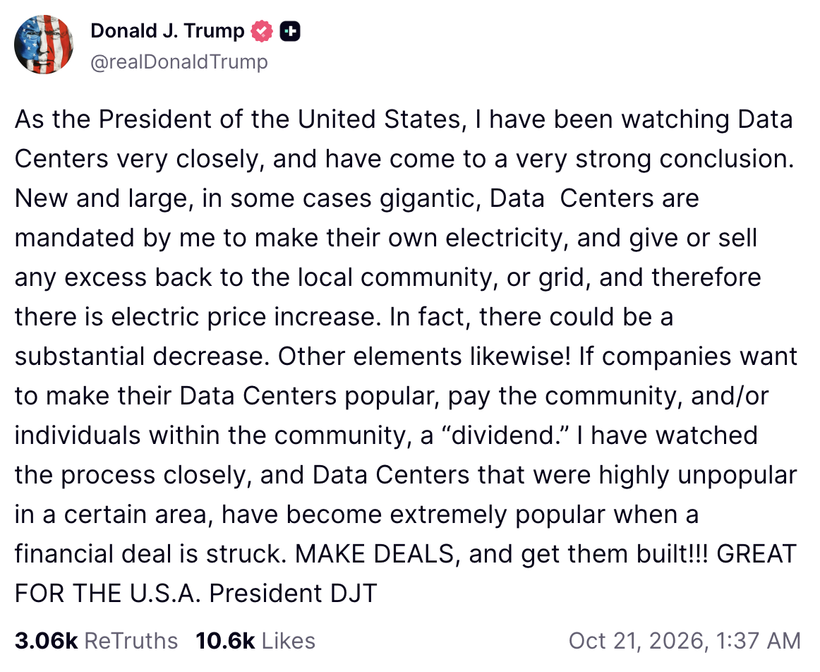
We’re back to Trump operating as if 1:37 AM Truth Social posts are policy, but this latest one might actually be worth discussing in the daylight…in front of actual decision-makers.
Trump’s post would require data centers to generate their own electricity and supply any surplus power back to the grid. This could address some of the major hurdles facing the U.S. reindustrialization process, mainly energy demands.
Transcript
Hey everybody. Peter Zeihan here, coming to you from Colorado. Good morning. Today we’re going to talk about…I try not to do this because there’s so much to deal with. But at 1:37 a.m. eastern time Donald Trump got on to Truth Social, and in this, let’s just call it, dump. He said a lot about data centers that I actually think is worthy commenting on. A lot of his midnight ramblings are less worthy, but this one is on topic. He says that any large data center is going to have to provide its own power and supply whatever surplus it has back to the grid. And I think it’s worth talking about how that might happen. At the moment, it’s just a truth social posting. There’s no regulatory structure. It’s just him signaling what he wants. But considering where we’re going with the data center industry and how public outcry has risen, I think it’s not a horrible idea. It doesn’t mean that there aren’t some problems.
So, you know, obviously this is going to have to go through a regulatory issue. There’s probably going to have to be an act of Congress, in fact, there absolutely has to be an act of Congress. So this is not something that’s going to take effect this year. But if Trump does push this, and I honestly think that any president would probably push things in this direction, it indicates that we’re going to have significant changes. Let’s talk scale conservatively. If you look at the AI data centers that currently are on the books to be built, not the ones that have been approved, but you know, everything that everybody says that they want and they’re trying to line up. You’re talking about needing to expand the American power grid by about 25%. That’s assuming no new data centers are designed or implemented or initiated, and there will be more. So we’re talking about a significant amount of power generation. And normally it would take the United States best case scenario, 30 years to expand its power grid by that volume. We haven’t had to expand the power grid in a meaningful way since the 70s, because in the 80s, the 90s, the 2000, the 2010s. We got out of a lot of heavy industry. We moved to less power intensive sectors like services and technology, and we just haven’t had to build things out. Now we do. And that requires a whole new industrial space.
Now you take a large data center, especially some of these ones that are more than 100MW. Some of the new ones are a full gigawatt. And the idea that the local communities can just hook up a power cord and suddenly just supply these data centers is ridiculous. You’re talking about massive volumes of new infrastructure. And wherever the data center has to be, it has to be relatively close to the power plant. So that limits siting. By saying that a power plant has to be joined to the data center, you’re also limiting where the data center can be, but you’re actually guaranteeing it’s going to be a little bit further away from a population center, which overall is probably a very good thing because these things are fairly noisy. You have to basically cool a huge amount of territory, and that means, for lack of a better phrase, in HVAC system that has fans going 24/7. Also, keep in mind that the power that a data center needs has to be provided 24/7, which largely rules out most solar and even wind. You can put in battery systems. But if you want to go 100% green with a data center, you’re talking about needing an input system that is six and seven times the nameplate of the data center, because you can’t always rely on the sun to be out, especially at night. And then you have to pair that with a massive battery system. So you’re really talking about baseload power generation, which means nuclear, natural gas, or coal. And as a rule, you just don’t put those in populated centers. That’s one problem.
Next problem. This will undoubtedly evolve into a direction where the mandate requires the data center produce more power than it needs and feeds it back into the grid, basically placing the tech center at the center of a electricity buildout, which is also smart. But now you need an interconnection between the data center and the rest of the system. And that’s a whole level of infrastructure to this point that the data center industry has just ignored and loaded onto whatever the local community is that they happen to be in.
So think about this. Siting restrictions are now different. If you have a green mandate for your city or state, you’re never going to get a data center. And considering how central it is to the American economy these days, that’s kind of a big deal even before you consider artificial intelligence. And then third, you now need a power system that can flow both ways. That gets to another level of regulation. Because right now, most power in the United States is provided by a local company designed for their specific city or county or a rural region. There aren’t a lot of broad zones like, say, Duke Energy or Southern Company that provide multiple states, which means now we have to have a regulatory shift at the federal level to break down those different districts so that power can flow from the data center into the normal grid. That absolutely requires an act of Congress.
Now, all of this banded together is still absolutely a net gain for the United States by almost any measure. But it challenges some interests. It breaks down local autonomy on some issues while elevating it on other issues. And that means it’s all going to be very political at the state, the local and the federal level. So I appreciate the out of box thinking, and I wish it had come out something other than 1:37 a.m. in a truth social rant. But if this is something that is actually put in front of Congress, it’s going to get some serious looks because this is a potential solution to a lot of the problems out there. It’ll generate its own new ones. If you start having an economic entity, a specific subsector that is allowed to generate its own power because the United States can’t do that right now. That is also going to generate concerns of oligarchy, which are reasonable. So the whole question is how is this going to be banded together? And it has to be banded together at the federal level, which again whole new series of challenges and arguments. Anyway, we’ll see where it goes. And we’ll see if Trump remembers that he said it when he wakes up.