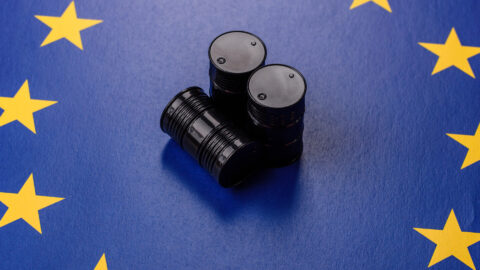

As Europe shifts away from Russian natural gas, they have turned to LNG from Qatar to fill the void. Unfortunately, that pivot has brought on its own set of problems.
The Iran War has impacted Qatari exports, leaving the Europeans in a sticky situation. With current storage levels well below average for Europe and Qatar’s force majeure extended to September, the winter months could bring a harsh energy shortage for Europe.
Transcript
Okay, still in bison, peaking on the upper ramparts. That is a McCurdy peak. The double one over there, and I’m now above above Devil’s Playground in just a bunch of really big rocks. Phase two, let’s talk neutral gas, specifically Europe. The Europeans used to get the plurality of their natural gas in piped form from the Russian Federation.
And over the course of the last five years, they’ve been phasing that down to zero. And with a couple of exceptions, they’ve been successful. But that comes at a cost. Not just financial but also security, because things have been so disruptive with the Iran war that the normal path that they had developed to survive in the post Ukraine war environment has been to tap liquefied natural gas from the Persian Gulf, specifically from Qatar.
And Qatar is having some problems. So normally most natural gas in the world, something like 85-90% of it is shipped by pipe. Because it’s a gas, you have to compress it, and it’s difficult to put that into any other form of transport. The one exception, which can get a little ugly from a logistics point of view, by the way, that’s Bison Peak. That’s where we’ll do part three.
A little messy from a logistical point of view is to liquefy it, which basically means you get a metric but ton of electricity, and you operate what is, in essence, a cryogenic freezer and freeze the gas down to something like -270, -300 based on which scale you’re using. And if you do that, it will condense into a liquid.
And then you can put that onto specially designed tankers and send it to any facility that has the technology necessary to regasify it, which isn’t too hard. And then you can treat it like any other normal piped gas within your system. So the Europeans have basically cut Russian pipe gas out and gotten Qatari liquefied natural gas in. One of the reasons this worked is they basically shut down everything in their economy that used natural gas for anything but electricity.
So, for example, the German chemicals industry is basically nosedived, and the combination of switching out supplies and reducing their demand has succeeded. The problem is with Persian Gulf close Qatar’s offline. Qatar got hit very, very hard in the war by Iranian attacks. The specific facility Ras Laffan, that does the natural gas condensation and liquefaction got hit hard. And when the Qataris tried to turn things back on in June, there were several explosions and a lot of people died.
Natural gas is naturally flammable and explosive, and you can imagine what happens with this sort of industrial infrastructure that’s required to turn billions and billions of cubic meters of the stuff into something that you can pour. Since the war began in February, exactly one cargo of Qatari LNG has made it out of the Persian Gulf. That was about three
weeks ago, when we had this nice little moment when traffic in and out of the Gulf reached something like three quarters of what had been pre-war.
We’ve never reached that number again. Most days were less than 10%, with single digits of ships coming or going. There’s no reason to expect that to change anytime soon. It’s going to take a lot more than a cease fire for that to pick back up. And unlike oil, which is relatively easy to produce and store in basically a tank.
Liquefied natural gas, you really can’t do that, especially when there’s a chance that missiles or cruise missiles might hit your storage facility. So Ras Laffan, for all intents and purposes, remains offline. The Qatari this week this, past week declared force majeure extended their force majeure through the end of September. And now we’re talking winter. And right now the winter storage for the Europeans for gas is less than half the normal. It’s the lowest it’s ever been going into a winter. Russian gas is gone, Qatari gas is gone. And as we will talk about in part three, the United States cannot ride to the rescue on this one.