
Fiber-optic-controlled first-person drones are the star of the conflict between Israel and Hezbollah. As Hezbollah deploys more of these drones, holes in Israel’s Iron Dome defense network are beginning to appear.
Iron Dome was designed to intercept rockets and missiles traveling in visible ballistic arcs. These drones use completely different attack approaches; they fly low and are connected via fiber-optic cables, so jamming won’t work either. You couple that with widely available components, and it becomes clear that Israel can’t defend against these drones on its own.
The other major player in drone-tech and defense is Ukraine, so I wouldn’t be surprised if we saw closer cooperation between these two countries soon. We’ll continue this discussion on the future of drone tech tomorrow.
Transcript
Peter Zeihan here, coming to you from Saint Peter’s. Feels weird to do a video in here. So we’re just going to do the opener. I’m obviously in Vatican City, and today we’re going to talk about some new things in the world of military technology. All right. Continuing. Oh yeah Swiss Guard back there. Anyway, the news is over the course of the last month, we’ve seen some significant shifts in terms of the technologies used in the Lebanon War.
Now, for those of you who have forgotten, Israel launched an invasion of Lebanon at the same time that the Iraq war started with the airstrikes by Israel and the United States against Iran. And it’s been continuing, it’s turned into a long term occupation, with the Israelis indicating they really never planned to leave at all anyway. What’s changed in the last few weeks is that we’ve started to see first person drone.
This place is pretty cool. We’ve seen first person drone attacks. Now those are the ones where you have a pilot with a unit who’s controlling a specific drone, and they’ve got a live telemetry feed that allows them to make decisions in real time. The drone itself has no intelligence or strike capability independent of the pilot. What’s unique about what we’ve seen recently is that we’ve seen now at least a dozen situations where Hezbollah has used these first person drones, but has used them with fiber optic cables, with at least one of them confirmed it would be at least ten kilometers long.
So with some hints indicating there’s been a couple with fiber optic cables that are about 20km long. Now, a few things to keep in mind about this. Number one, Israel arguably has the absolute best theater missile defense in the world with its Iron Dome system. And lots of folks think that the United States should at least partially copy it.
And there’s something to be said for that. But keep in mind that Israel is a very small place. So the missile defense you’re going to do in a place like Israel is very different for what you do in the United States. Second, the nature of Iron Dome is primarily designed to intercept short term rockets and maybe some short to mid-term missiles.
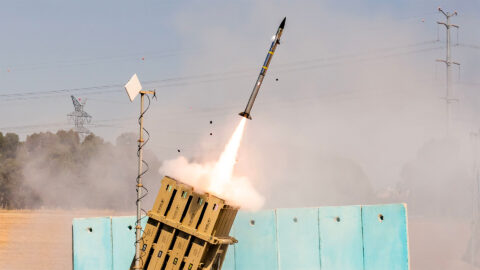
Every time Israel comes under attack, you get some really dramatic visuals, different kind from here, where you can see ballistic arcs that are pretty clean on one side of the photo, and on the other side, you’ll have a swirl of intersecting and spiraling threads, and then they meet. The swirling and intersecting ones are the Iron Dome system. Basically, they fire interceptors into the air.
They don’t know how many things are going to come in, and then the interceptors lock on to those ballistic arcs and take them out. That really doesn’t work for low level drones at all, because you’ve got a fiber optic around this just flying a few feet to, or maybe a few hundred feet off the ground. They don’t get high enough to be registered by radar, even if they had the components to be detected by a radar.
A lot of these things are plastic or carbon fiber. That’s real problem, because it means that the entire Iron Dome system has been designed now for a weapon system that is starting to be used against Israel, and there’s very little of the technology that goes into these things that is restricted at all when it comes to suppliers. You really have to.
You then have the Russians who have contacts with militant groups throughout the Middle East. Hezbollah is no exception. And when you come to the fiber optic spooling, most of that is made in China. So we’re having this really fun intersection of technical overlap, skill overlap, and increasingly geopolitical overlap among countries and forces that have been general been anti a lot of things American for a very, very, very long time.
There’s not a lot that Israel can do in the short term to counter the sort of activity. Their radars and their interceptors right now are woefully ill designed to deal with this sort of threat. And because of the fiber optics, jamming doesn’t work either. So really, all you can do is kinetic intervention. And at the moment, the Israelis don’t have enough skills in that set to make a meaningful difference.
The one exception, the one thing that might be coming, is partnership with Ukrainians, who have been developing a lot of models to intercept exactly this sort of drone and have had a fair amount of success. But that also means stationing things at dozens, hundreds of points in order to get it wherever it happens to be launched from. So it’s changing the nature of what it means for Israel to be in a war.
And it’s dramatically shifting the power balance between the Israeli military, which is one of the best in the world, and Hezbollah, which we thought had largely been shattered as of just a year ago. One more thing. A high end fiber optic spool that a drone can carry today has a range of up to 50km. So with something half that just a mid-range quality, somebody launching a drone from the Hezbollah Lebanese side of the Israeli Lebanon border could strike anywhere in Haifa and with a significant margin.
So you can go after anything you can see can’t be jammed with a that’s physical infrastructure, vehicles, soldiers or the components that allow the Iron Dome to do Iron Dome things. So big game changer. All right. That’s it by.