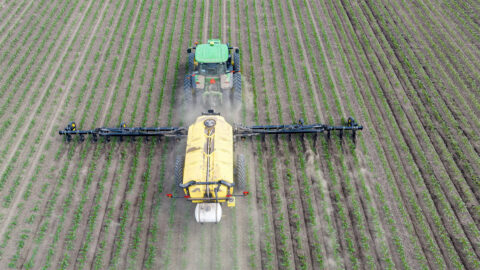

Now that the Strait of Hormuz is shut down due to the Iran war, the impact is beginning to hit global food systems. This is coming in the form of fertilizer production disruptions in the Persian Gulf.
Potash and phosphate-based fertilizers remain mostly unaffected, but nitrogen-based fertilizers that rely on natural gas are the problem. Global urea and ammonia supplies are already being hit hard.
Prices will begin to rise, and places like China and India will face chronic fertilizer shortages. This will reduce global food production, and I think you can guess what happens after that…
Transcript
Hey everybody Peter Zeihan here. Coming to you from Colorado, where we are getting a significant, unexpected storm. Anyway, obviously we’re going to talk about the Persian Gulf today. Ever since the Straits closed, it’s been a question of how soon before things get really nasty. And now we’re there.
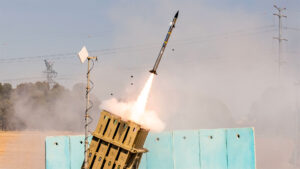
We’ve got, missile and drone attacks that are regularly punching through the defensive envelope on the western side of the Persian Gulf with Kuwait and the United Arab Emirates, clearly, if not out, almost, very nearly out of interceptors.
And things are getting through into those two countries regularly attacking strategic things like airports, and energy infrastructure. Today we’re going to talk about the impact this is going to have on global food supplies, which is pretty, pretty fucking damning. So there’s three types of fertilizer. There is something called potash, which is potassium based fertilizer that is primarily mined.
Most of that comes from either the Canadian province of Saskatchewan. So, you know, don’t mess up NAFTA talks. Belarus in the former Soviet Union and a little bit more from Russia.
Those three places are the vast majority of what is produced on the planet. That is, thank God, not affected. Number two is phosphate, which is basically fossilized bird poop.
The big producers there are a little bit from Saudi Arabia, a bit of a problem. There’s a lot in Morocco that seems fine at the moment. Peru has some. Florida has some for the moment. The Saudi part was just single digit percentages of global supply. It’s probably going to be impacted, but not critically, because they can always truck it out or to the west.
It’s not ideal, but it can be done. The third one is where the real problem is nitrogen based fertilizers, which are, as a rule, a derivative of an oil based naphtha product or natural gas. And here the big player is gutter, that little thumb in the middle of the west side of the Persian Gulf. Qatar, for those of you who like to pronounce it the anglicized way. In what they call the South Pars natural gas field is one of the largest in the world, and they produce condensate there, which is kind of a hybrid oil natural gas product. But, as a byproduct, they get all the natural gas they could ever use. So it’s actually the lifting cost for that stuff is negative and it’s just offshore.
So getting it to something to process is very, very easy. They use this to do liquefied natural gas, of which they provide 10% of the global total. That’s obviously gone. the facility that produces it has already been hit. So even if the war were to end tomorrow, I doubt it would be back online within six months.
But today we’re going to talk about what they do with fertilizer, because They use that natural gas in order to make ammonia, and then they convert the ammonia to something called urea. And urea is natural gas based fertilizer made out of primarily nitrogen that you can spread in physical form, whether pellets or ground powder or whatever.
And this one facility and gutter is responsible for about 11% of global urea production and that is the primary method that people apply nitrogen. There are other ways, those other ways are all ammonia based. And collectively, the Persian Gulf is responsible for between 30 and 35% of global ammonia production. And all of that has now gone to zero.
Now, of the three nutrients, this is the one I am least concerned with in the short term, because it can be derived from either natural gas itself or oil, which can then be refined into something called naphtha, and that naphtha can go on to make nitrogen based, fertilizers. The problem, of course, is that 20% of global oil is off line because of the Persian Gulf.
So while here in the United States, where we are a net oil exporter and just have scads of natural gas and produce pretty much all the nitrogen we need ourselves and can produce more if the market pushes us in that direction, which it absolutely will from now until the end of my life. At this point, most of the rest of the world cannot do that.
So in the short term, because of the United States, we’re probably not going to have massive shortages of nitrogen based fertilizers. Prices will go up, but we won’t have actual shortages. But if you fast forward one, two, three, ten, 20, 30, 50 years, the rest of the world is going to be in chronic nitrogen deficit pretty much from now on.
That’s before you consider shortages of the other materials that are likely to manifest in the years to come. So prepare for an environment where food production on a global basis stalls and then crashes. With some areas affected far more than others, the one that should be at the top of your list for not being able to maintain output is going to be China, because they import pretty much all of the inputs that they need to either make their own fertilizer, or they just import the fertilizer directly. South Asia, India also looks like it’s going to be significantly under pressure, unless they can find a way to manage access direct to the Persian Gulf themselves, which is a feasible option for them. But it requires them thinking significantly different about their security policy. But now they absolutely have the impetus to do so.