
Latvia’s government is in flux following the firing of the defense minister, his party leaving the coalition, and the prime minister resigning. All of this was caused by some Ukrainian drones being electronically redirected by Russian countermeasures and striking Latvian infrastructure.
This specific event involving Latvia highlights just how quickly drone technology is evolving. The Ukraine War has been a testing ground for all of it, and several countries are now partnering with Ukraine to mass-produce Ukrainian drone technology. The U.S. is not on that list of countries and will likely fall behind the eight ball on the drone front.
Transcript
Hey all, Peter Zeihan here, coming to you from Umbria in Italy. Olives. Because, you know, Italy today we’re talking about a little nonstandard thing about a government falling in Europe. Now, there’s 30 odd governments in Europe, and one of them is always in crisis. So I usually don’t follow the blow by blow. But this one’s really interesting, Prime Minister.
Let’s see if I get this right. You silly. Is the Prime Minister was the Prime minister of Latvia, which is one of the three Baltic countries population of about 2.5 million. She resigned this past week over a defense crisis. The situation has to do with drone technology and the Ukraine war. So specifically the Ukrainians have been using drones more recently, new types of drones to attack various chunks of Russia’s energy sector and trying to destroy the logistics support that makes Russia’s participation in the Ukraine war possible.
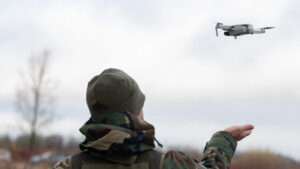
So they’ve been very active around places like Mariupol in going after logistics. They’ve been very active in places like the Black Sea and the Baltic Sea in going after energy assets. Now there are multiple types of drones, but let’s talk about two. So in the first one you’ve got something called an FPG first person visual. And that’s your typical drone that you might buy from a company like say DJI in in China you have a controller.
Sometimes it’s on your phone, you require a digital tether to it and you send it off. And if something interrupts that tether, the drone just goes in a straight line or crashes or returns to you based on its programing. Option number two is something called a GPS drone, for lack of a better phrase. There’s lots of subtypes here, and it follows GPS coordinates that you kind of lay down like a breadcrumb.
And it goes from point to point to point to point to point. And then when it gets to its end destination, it either crashes into the last point you gave it. It takes a quick glance around and makes a decision as to what to hit. Now, with this second type of drone, you don’t need a digital tether to it, but it does need to be able to receive a signal from a satellite or some other sort of signal that allows it to know where it is.
So cell towers, for example, work. So if you can jam that signal, the drone then flies off into the night or crashes or return homes based on its programing, what it’s capable of doing. And it might have a little bit of buffer, so you might have to jam it for more than, say, 30 to 60s in order to make sure you really wreck it.
But within this type of drones, that requires on external signals for guidance, not from the controller, from something else. With good enough electronic warfare, you can convince it that it’s somewhere else and flying somewhere else and basically give it new targeting instructions. And that appears to be what has happened in the Latvian situation. So last week, well, last month actually, what went down is the Ukrainians started doing more and more and more attacks that the Russians were starting to twist the instructions.
And some of these drones were bent back into the Baltic states and at least on two occasions, were actually able to successfully target Latvian energy infrastructure, specifically fuel tanks. And so there was a spat among the coalition partners in the Latvian government. The prime minister is from one party, the defense minister is from another party. The defense minister was fired, the Defense Ministers Party pulled out of the coalition that kept the prime minister in office.
It’s a whole to do in Latvia with, you know, 2.5 million people. Doesn’t take much people to have a whole to do. And now the government is in flux and were trying to figure it out. They need to have a new government or just have new elections. They were already scheduled for October. So from a big point of view, it’s not really there from a political issue, but from a military issue.
It shows the ongoing evolution of drones, because if the Russians can somewhat reliably undermine this class of drones, then the Ukrainians have no choice but to stop using them. Now, I would argue that Ukrainians are well on their way to that point. Remember I mentioned that one of the subsets of these drones are ones that when they reach their final target coordinates, they can look around and make a decision that is already a significant step up from what the Russians can do.
And if you just up the amount of memory you have in the drone that’s capable of doing that just a little bit, then all of a sudden it doesn’t need that external signal. It can follow geographic landmarks like mountains or buildings or roads, and then it doesn’t have to have a signal. And so there’s nothing to jam. And we’ve already seen the Ukrainians start to introduce drones like that, just not across the board.
So as with everything with Ukraine war, there is an ongoing tug and war between attack and defense and attack and defense and attack and defense. It’s way too early to know how it’s going to turn out. But what I can tell you two things. Number one, in the last two and a half months, the Ukrainians have introduced more models of drones with more active internal decision making capacity than the Russians have in the entirety of the war.
To this point. They’re also have launched more drones day on day for the last two months than the Russians have, even though the Russians have bottomless supplies of Chinese parts. So we really have turned the corner where the Ukrainian pre-war defense base, which is where the Soviet Union got its rocketry and its aerospace stuff, has really come into its own and now surpassed what the Russians can do.
Number two, the Ukrainians are no longer alone because the Trump administration is looking for fresh ways to shit the bed. With all of the allies in Europe and the Middle East, we now have a dozen countries, ranging from Poland and Sweden and Germany, the United Emirates and Qatar and Saudi Arabia, who are actively building out physical infrastructure in partnership with Ukrainians to mass produce Ukrainian drones for their own use and for Ukraine as well.
So if you fast forward this to the end of the summer, the volume of drones at the Ukrainians are likely to be able to bring to bear is just going to dwarf what the Russians can do, and they will be more technologically advanced. Now, under normal circumstances, I would say that’s going to change the nature of the war.
Of course, it’s going to change the nature of the war, but it would probably turn the tide. But keep in mind that this is a fresh technological revolution. I didn’t see this coming three months ago to project three months for and say, this is how it’s going to go. It would be really stupid of me. All I can tell you is that the pace of this is overwhelming.
What we understand aerospace, what we understand, automation, what we understand war to be. And we’re about to have some crazy stuff happen in calendar year 2026, as all of this comes to a head in multiple theaters. Because keep in mind, just because the Ukrainians are succeeding at this doesn’t mean the Russians can’t try. And we’ve already seen some kernels of this sort of technology in play in Iran recently.
This technology will go global, and at the moment, the country that’s at the back of the line to kind of play with the technologies, the United States, because the Trump administration doesn’t like the president of Ukraine.