
Despite the large rolodex of U.S. allies, nobody has pulled up to the Persian Gulf to support the U.S. There are several reasons for this, though.
Part of the post-WWII deal was that the U.S. would provide global maritime protection, so nobody else had to; as a result, few powers could help out, even if they wanted to (like Japan, the UK, and France). It doesn’t help that the U.S. launched this operation without consulting anybody, but even if they had, most allies wouldn’t touch a Persian Gulf conflict with a ten-foot pole.
Transcript
Hey everybody. Peter Zeihan here coming to you from Colorado. Today we’re taking a question from the Patreon crowd, specifically considering how dependent countries like to Pan and the countries of Europe are upon energy imports, specifically from the Persian Gulf. How come they haven’t been helping out with the conflict? Well, let’s look at it. First of all, not a lot of countries maintain naval forces that are capable of rapid projection.
You basically have them on a degree of standby until something big happens and then everything has to be spun up. So, for example, unless you’re the United States very special case, everybody’s navies are pretty much limited to coastal patrol. So if you do have a long range ship, it’s probably just sitting in dock until it’s needed. And then it’s going to take a few weeks to a few months to get it ready to go.
That’s one. Number two. The deal that we struck with everybody at the end of World War two was that we will patrol the global oceans and keep the ceilings open for everyone. If in exchange, you allow us to control your security policies. And part of us controlling your security policies is we don’t want you to have any long range power projection, because if you have a long range power projection, you’re going to use your long range power projection.
You might use it in ways that we don’t want. So with the exception of Japan, which is an island nation and has the second largest navy in the world, and the United Kingdom, which has a bit of an imperial hangover, the only other country in the world that maintains really any long range capability that’s independent is France, and that specifically.
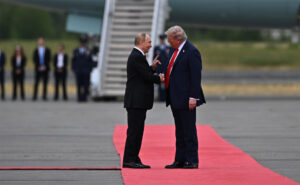
So it has an independent capacity. So really we’re talking here about three countries. No one else could have even helped if they had wanted to. Which brings us to number three a burden sharing intelligence, sharing whatever you want to call it on February 11th. Netanyahu, Benjamin Netanyahu, the prime minister of Israel, came to the white House, made a pitch to Trump for the United States and Israel to jointly attack Iran.
He said the war would be over in four days. We can kill the leadership because you know where they are. There will be a revolution. They’ll probably rename the capital to Trump Obelisk, and you will go down as the bravest and most capable American president in history, and you will do something that all the cowards before you refused to do.
And Trump looked around the room and everyone who knew something about foreign policy, for example, Secretary of State Rubio and the Joint Chiefs of Staff Dean Cain said, Mr. President, this is an horrible idea. We’ve been hearing some version of this for 30 years, specifically from Netanyahu, who has tried to convince multiple American presidents to fight his war.
For him, the math never checks out. The Strait of Hormuz will be wrecked. But, Mr. President, it’s your call. And then the people who knew nothing about foreign policy, notably Pete Hegseth at defense, said, do it.
The carrier sailed later that day. So normally when the United States goes to war, we compare intelligence with our allies. That never happened this time. And we now know, even from within the white House four months later, that there wasn’t any intelligence. This was just a pitch deck from Netanyahu, who has been chomping at the bit to get the United States to fight his war for a long time.
So normally we’d like consult with NATO, especially with the Japanese and the Brits, and we’d arrange for a coalition to put at least a veneer of internationalism on top of whatever it was that we felt we needed to do. None of that happened. So the war began a couple of weeks later. Just just the amount of time that it took to sail to get there.
And then about in week four of the war, when the Trump administration realized it wasn’t going well, which was difficult because DoD was only showing him like strike footage, because any time they tried to give him an accurate assessment of how this was not going well, he’d kick him out of the room. Well, by four weeks on, it was starting to come at him from all angles that it wasn’t going well.
And that is when he started yelling at the allies to send forces. But as I’ve mentioned, no one else has forces to send, and the few that might certainly in a hot situation are not going to be sending things through Suez. So even if like, say, the French and the Brits had snapped to at that instant, unlikely they would have needed a month or two to get their forces ready to deploy, and it would have been over another month before they would have actually arrived.
And in the meantime, you know, Iran went the way Iran did. And we’re now in a situation where we get final point is that nobody outside of Trump and Netanyahu wanted this war in the first place. We now know unequivocally that Iran’s drones are more than capable of taking out every piece of physical infrastructure throughout the Persian Gulf, which can trigger a global energy induced depression.
We now know that their monitoring of the entirety of the Strait of Hormuz is strong enough that they can even take occasional shots at ships that are hugging Omani waters on the southern side of the strait. And really, even with the US Navy concentrated on the Strait of Hormuz in the Persian Gulf, there’s not a lot it can do, because if those ships stay still, then they become targets to.
So we’re in this never ending negotiation where negotiations aren’t actually happening. Because this is just horrible. Normally when you’re having a real negotiation, you have your headliners who do the real talks and what are called technical folks do the technical talks so that when the headliners show up, there are only real things to discuss.
Well, Trump has shut the Department of State to the side and refuses to deal with that at all. Even that’s where most of the policy experts are.
He made Secretary of State Rubio be in charge of all that because he doesn’t like Rubio either. So all you Rubio fans who think that he might be the successor to MAGA, think again. He also doesn’t like the National Security Council. That does kind of have all the deep thinking as opposed to the diplomacy.
Not so it could be more efficient in the way that Kissinger did it, but to shove it all to the side. So there were no negotiations with the allies on the front end, and there’s no technical talks happening with the Iranians on the back end. So the last time that Trump’s preferred negotiators, Jared Kushner and Steve Whitcomb, went to Doha this past week, they got to Doha and the Iranians like, yeah, not this week.
We have technical talks to do. And so there’s still nothing happening. There have been no technical talks since this whole thing started in February. Anyway. If you’re an ally and you’re looking at this, you’re like, why would I develop a military capability that the United States has until now, said I should not have in order to use it to prosecute a war that hurts my economy.
And then we are at the mercy of a diplomatic situation that doesn’t have diplomats. So, yeah, no, the allies haven’t done anything here that is untoward. We’re just in a bit of a trap caused by a man who refuses to surround himself with anyone but sycophants and is very, very easy to manipulate so long as you’re willing to lie to him, which is not what a good ally does.
All right, that’s it for me. Until next time.