
Despite the ongoing conflict in the Persian Gulf, shipping in the Strait of Hormuz remains open…sort of. The Iranians have taken control, requiring ships to get clearance for safe passage.
Basically, Iran has set up a protection racket. They’re earning more from transit fees and oil exports than before the war, and all the Chinese ships carrying drone parts and components heading to Iran remain untouched. Even with the significant U.S. military presence in the region, nothing is being done to disrupt these flows.
Until that stops, Iran’s military operations and economy will continue to grow stronger.
Transcript
Hey all, Peter Zeihan here. Still sick. Coming to you from Colorado. This is Loki. You may have heard him or seen him in videos in the past. Anyway, today I wanted to let you know about a little internal investigation that we’ve been running in the ER on war.
Specifically, we’ve got questions here on our end, about why shipments are still getting through the Persian Gulf at all.
Now, international insurance has basically been canceled for all ships in the area. Basically, once somebody starts shooting civilian shipping, all bets are off and the captains are on their own and if the ship takes a hit, oftentimes it’s the captain that is legally or financially vulnerable. If not the shipping company. And there’s no way to file a claim in that circumstance.
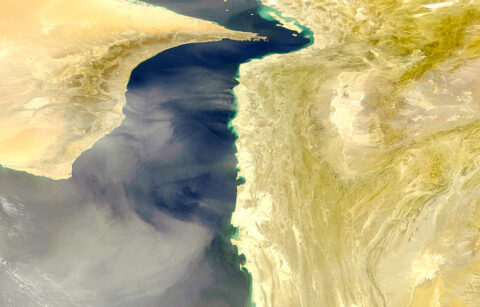
So lots of ships are trapped inside the Gulf, and there’s a couple hundred waiting outside for things to clear, which isn’t going to happen anytime soon. And yet, there are still some ships coming and going, but all of them have gotten clearance from Iran. So under normal circumstances, there’s a six mile navigable channel that’s roughly in the middle of the Strait of Hormuz.
Most of it is actually in Omani territory. Some of it does go into Iranian territory, and there’s a two mile channel for going one way, a two mile channel for going the other way, and then a two mile gap in the middle. That is not being used by anyone. That’s what’s completely shut down because of the attacks we’ve had so far.
On the other side of the equation, you’ve got Iran basically processing ships, at the Imam Khomeini port, which is way up in Khuzestan, which is on the northern extreme of the Gulf, actually in the general vicinity of Kharg Island, if you know where that is. So for ships wanting to get passage approval from Iran, they have to sail all the way to the northern end of the port, basically under all the drone and missile attacks that are going back and forth.
They have to dock at Imam Khomeini port. They have to basically get their papers, pay their bill, which comes out for a large ship to be like $2 million. And then they sail down the Iranian coast as close to the Iranian coast as they can.
And instead of using that navigable pathway through the middle of the street, they hug the Iranian coast as closely as they can and sail through that way.
And same for anyone who’s coming in. They have to sail all the way up to Khuzestan to basically get their papers stamped. So what has happened here is a clear example of the United States just being unable to process what’s going on on the front end.
United States seemed woefully unprepared for anything happening in the Strait of Hormuz, during a war with Iran, which is just beyond ludicrous, because that has been the issue since 1979, and there was no meaningful preparation of all. Second, Iran has managed to set up a basically a protection racket, and cargo is still not just coming to and from Iranian ports, including Chinese, gear that basically is full of drone parts.
They’re actually able to sail into the Strait of Hormuz all the way up and into the northern Gulf, not be molested at all. Docketed Iranian port, or take on cargo, pay their fees, and then sail all the way back down through the Persian Gulf, through the Strait of Hormuz, and out. And the United States is doing nothing.
So the idea of that, the Iranian authorities, as they are at the moment, are under pressure is just mind bogglingly stupid because the economy of Iran is largely managed by the IRGC. And we have actually, in these circumstances, seen income for the IRGC go up because the not only are they getting these transit fees, but the core issues of economic smuggling still apply.
And even though the US military is now more present in this region than it has been at any time in modern history, it is doing nothing to interrupt the commercial flows going to and from Iran, and Iran is able to increase the volumes of its exports to nearly 2 million barrels per day and garner the war surcharge. So they’re earning easily in terms of profits.
Two and three times what they were earning before the war. And the U.S. military is doing nothing. Now, under normal circumstances, there are analysts at the military and especially at the Department of Energy who would point these things out to their chain of command, and it would go up to the department heads and eventually the president. But President Trump fired all those people last year.
So it took people like me doing this little project on the side to figure out how everything is flowing. Someone please tell Trump because until this is interrupted in some way too big problems. Number one, the IRGC is giving them more money now than they did before, which reinforces all of the pillars of the Iranian structure that allows it to fight the war and encourages political cohesion.
Second, they have no problem resourcing parts for missiles, and especially drones from the Chinese, and so they’re able to maintain their current pace of fighting more or less indefinitely. So yeah, someone please pass that along. Maybe it’ll make a difference.