

Before we close out this series on military tech, let’s discuss what military advances are on the horizon (and our last episode will cover something we don’t need to worry about).
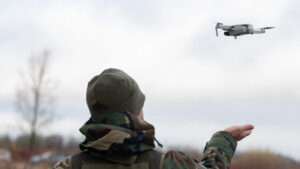
Many of the larger evolutions coming down the pike are related to drones. Whether it’s strikes, surveillance, detection, or deadly jobs…drones will likely be taking it on.
These technologies are just the beginning though. As battery science improves and more advances are made, the battlefields will be going through countless iterations.
Transcript
Peter Zeihan here coming to you from a foggy Colorado today. We’re do another in our Military Revolution series how changes in Materials Science and Data Transfer and Energy storage are shifting, the way the military works, and some of the new things that will be seen in the not too distant future. Today we’re going to talk about some edge cases that are likely to move into the mainstream in just the next few years.
And these kind of fall the two general categories. First, you’ve got the topics where humans just aren’t the best tool for the job. These are things where they’re either dangerous, or expensive, we have to train someone up to an extreme level to do a job that then has a high mortality rate.
You know, things you don’t want people doing. And the first one of those is saving other people, search and rescue in a combat environment uses a huge amount of resources to cover a large amount of land to save 1 or 2 people. It doesn’t matter if it’s a fighter pilot, it’s been shot down or someone who’s been shot out of the field having drones do this not only builds up your combat awareness for the field in general, but also allows you to provide, say, targeted supplies and of course, guide the real force in to pull the person out of trouble.
The general topic of recon, something that is starting to be called perch and stair. Basically, you have a recon drone, but rather than flying around at altitude, it finds a place at, say, a quarter of a building and just parks and stays there. Maybe it has solar panels on its back so it can extend its battery life and it just looks around.
It’s a mobile sensor that, for the most part, isn’t mobile. You know, you might call this a spotter or a spy in another condition, but if you can automate that, and instead of having one guy in one place that might be able to move around, you can have hundreds if not thousands of mobile sensors that can extend their life to span by just not flying the whole time.
And third is something called an underwater swarm. Submarines are among the most expensive things that most modern navies can float. And if you can throw a few dozen things into the water, not only do you get some excellent acoustic collection for purposes of locating them, you know, you put like a one kilogram charge on each one. It doesn’t take a lot of those to take a multimillion dollar sub completely out of action forever.
So these are technologies that you apply them to. What we know we need. And all of a sudden they really are game changers in terms of efficiency. Now the second category are things that we used to do and maybe even used to do well, but we haven’t done it for a long time. Keep in mind that the US military has not been preparing to deal with another peer adversary until just a few years ago.
And the immediate post-Soviet era. We thought of the Russians no longer as an enemy. And so we stopped preparing to fight a global conflict with them. We then spent 20 years in the war on terror, focusing on counterinsurgency. That means going against the Taliban. And that means you don’t really need air power. You really don’t need air defense.
And so certain aspects of our military were allowed to atrophy just from lack of use. And the two biggest ones are air defense suppression and hunting mines, whether land mines or sea mines. The general idea was, you know, if there is no big force out there fielding things you need to shoot through, then why would you maintain an entire arm of your force doing things that are just going to sit around?
So, for example, we really only have a couple of minesweepers left, but naval minesweepers that are drones are a great idea. In essence, you have a drone that’s hooked up to your ship as it’s puttering around at a relatively low speed doing a sonar capture. You locate the drones and you send out a suicide drone to take it out.
They’re already doing this in, say, Romania in the western part of the Black Sea. You can use aerial drones with radar to triangulate metal signatures in the soil and locate landmines before anyone can step on them.
And for air suppression. Back in Vietnam, we had this thing called a wild weasel. Basically, it was a bunch of suicidal maniacs on a plane who would fly into Vietnam ahead of the bombers to activate air defense. Well, do that with drones. Don’t do that with a manned plane. In fact, do that with drones backed up by other drones so that by the time the real bombers get in the air, defenses are already gone.
Same basic concept holds for coastal patrol. Now, the United States has never really been good at coastal patrol because we have oceans between us and everybody else. But this is one of those technologies that everyone else is going to find really useful. Again, in the post-Cold War world, everyone slimmed down their military spending, with navies seen as just something you would never need again.
History was over. It was a world of commerce. Why would anyone shoot at anyone’s commerce? Well, that’s gone, but the time it would take to build up a coastal fleet and coastal patrol capability is going to be measured not in years, but in decades. Or you can just have a fleet of drones. It basically flies patrols out on your coast and then, if necessary, a more robust naval vessel can go out to take care of whatever the issue happens to be.
So these are all things we’re going to see in probably just the next five years, certainly the next ten. And this is just the leading edge. These are things that me as a nonmilitary guy can kind of just think of based on the gaps in the system right now as the military technologies continue to evolve. We’re going to see radical applications of all of these.
And keep in mind that drones are really just the leading tip of this. We don’t know what our material science is going to be in the next five years. Maybe we’ll get a new battery chemistry that allows for longer loitering, that generates an entirely new field of military tech. We’re just at the beginning here.