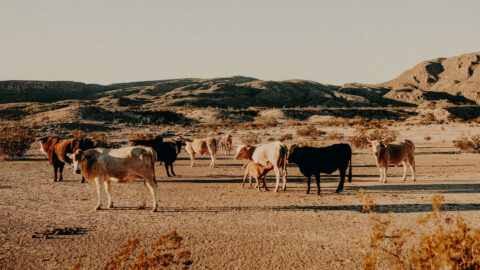

The return of the New World screwworm is threatening the U.S. cattle industry, especially in Texas. Typically, this would have been detected early on by agricultural monitoring and disease-detection programs, but those are now gone due to cuts made by the Trump Administration.
The screwworm is a parasitic blowfly whose larvae burrow into living animals. It can rapidly spread through livestock herds and requires a costly, large-scale treatment once detected in an area.
Livestock producers will incur higher costs and lose portions of their herds, meaning beef prices will continue to rise. If you’re looking for a silver lining, while this will be economically straining, it’s not inherently a food safety issue.
Transcript
Hey everybody. Peter Zeihan here, coming to you from Colorado today. We’re talking about an agricultural item that is hot screw worm. It is a blowfly that exists in tropic zones. It’s endemic in places in South America and the Caribbean. But from time to time, it manages to follow people and animals north. And we now have multiple cases reported in Texas.
from the beef industry’s point of view, this is one of the worst things that could have happened at the worst possible time. So screw worm, it’s basically the the female lays eggs in a scratch or a cut on a calf, a cow, a sheep, goat, even a dog. And then when the eggs hatch, the maggots burrow into the flesh. a lot of blow flies. Like necrotic flesh. Dead animals. These guys, they want. They want them warm and wet. Anyway. Incredibly painful for the animal. And soon as the maggots turn into flies, they’ve got a wound right there. So they tend to stick around and the whole herd can get infected very quickly.
And you can kill an animal in as little as 2 to 3 weeks. Treatment is external with a spray internal with some sort of anti bug thing. It involves information, if you remember that from the Covid days when we had so many, so many, so many, so many, so many very, very stupid people taking deworming agents because they thought it would help against the virus.
Anyway, this is what it’s actually used for. And if you have a single case in an area, that means that the blowfly is already in the environment. And so you have to treat internally and externally every single sheep, goat and cow in the entire area. Otherwise you will have explosive growth. And that’s unfortunate. Probably what we’re going to be seen in the next couple of months is explosive growth throughout the Texas cattle herd.
The only to fight it is to prevent it. So when you find an area where there are screw worms, you breed millions, billions, trillions of irradiated male screw worms or the flies and release them in the area. So when they meet with the females, the eggs can’t hatch, they’re sterile. And the last time the United States face a really, really big incidence of this, it was the 1960s.
And in current dollars that cost about a half $1 billion to fix. We’re already seeing the Texas alone has spent more than that just to address the situation as it is today, attempting to get ahead of the preventative work. But it really they’ve they’ve failed and now it is local in multiple places across South Texas. And it’s going to be spreading like wildfire in the weeks and months to come.
There’s really no good side of this, but that doesn’t mean that all effects are equal. So, for example, the Texas beef herd is primarily for consumption in the South, specifically in Texas. So while it’s really, really bad for Texas producers in Texas, consumers doesn’t really hit the export market. Most American beef exports originate in places like Nebraska or Oklahoma, where the population is lower.
It really is, though, disrupting the North American beef trade because the United States is the world’s biggest producer of a number of agricultural products, most notably including things like feed corn. And so what happens is cattle from Canada and Mexico are shipped to the United States for finishing, fattening and slaughter. That has gone to zero. When this started to boil up in Mexico as a problem, the United States closed the border to all cattle.
And now that the United States has cases itself, Canada has closed the border to all cattle transfers. So the feedlots that used to absorb all of that beef are no longer getting imports. And now because we have screw room locally, we’re going to see the beef industry producing less beef because of the cost required to treat everything. And then, of course, the preventative effort.
You put all that together. And we already have ground beef in Texas of all places. That is over $8 a pound. That is an ugly situation for a lot of people for a lot of reasons. For most Americans, beef is their primary protein. Longer term, any effort to rebuild the herd is going to have to wait until the other side of this.
That is not going to happen this year. If we are lucky, it will happen next year. And from the point that you start building out a herd now, it’s 36 months before you get an adult cow that can do adult cow things. So we’re looking at not until maybe the end of this decade, before the U.S. beef herd is back to where it might need to be, and even that requires a lot to go.
Right? So how did we get in this situation? I mean, this is a disease or infestation that we beat back in the 60s. How to get back? Well, in a word, Doge, the first thing that Doge did when it came in as it went, looking around for things that they called a waste. And if you were monitoring infestation or disease that had been wiped out 50 years ago, they’re like, we don’t need that anymore.
So in the US Department of Agriculture, all the labs who did things seasonally were cut because they could be cut and all the built in expertise on things like agricultural diseases and infestations that were not active were cut because they weren’t being used at the moment. And so our entire front line of detection for this entire topic went to zero.
And Secretary Rollins, Secretary of Agriculture, isn’t stupid, but she doesn’t have a background in the nuts and bolts of agriculture. No one on her team does, because everyone on her team is somebody who has to be politically palatable to the white House. And so there’s no skill set in USDA to deal with this. They are consulting with private sector in order to build up that capacity.
But everyone in the United States who dealt with this at volume is, you know, in their 80s. Now, there aren’t a lot of people left, and that means you have to go abroad and all of those connections reduce to zero as well. So in the best case scenario, the United States now has two of those facilities that deal with screw rooms.
One is a small one in Panama, which is a legacy from the last big infestation, and one is a new one that just came online in South Texas that can make like a million of these things a week. That needs to get up to a billion of these things per week to really have any hope of driving this back.
And so, best case scenario, this is going to spread very, very aggressively in Texas and beyond for at least the remainder of this year and probably well into the next. And then if everything absolutely goes perfectly, we’ll have it under control at some point in 2028. That’s a lot of ifs. In the meantime, America’s favorite protein, Texas’s favorite protein is only getting more expensive as the cost of keeping this at bay when it’s now endemic in parts of Texas is only going to go up.
This is going to be something that is going to be eating into literally the system for months and years to come. About the only bright spot is while these things can infect a cow, you can still eat the cow. So it’s not like it’s wiping out the herds directly. And while it can infect a person, when a maggot is chewing at your flesh, you notice.
And so it’s not like this. You’re going to die from this. You just go to the doctor and get treated and not with information. Just to be clear. there’s no direct threat to human health because the stuff is not subtle. All right. That’s it bye.