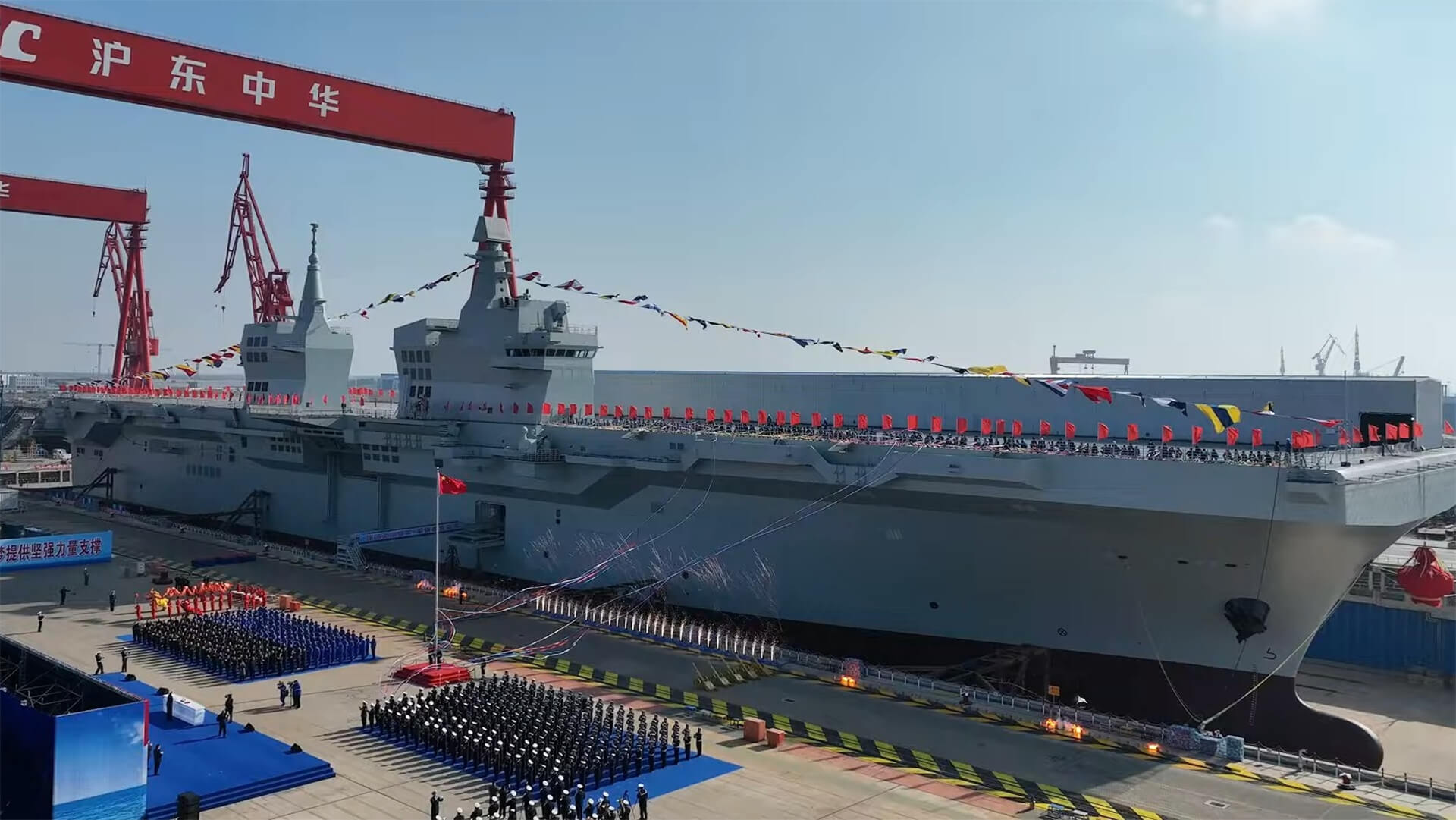

Let’s talk about the Sichuan. And no, we’re not ordering take-out. We’re talking about China’s newest Type 076 amphibious assault ship, similar to the US Wasp-class.
Through the lens of global power projection, this falls short; it doesn’t have the range or speed necessary. However, this ship isn’t meant to cover too much ground. It’s designed for near-coast, amphibious assaults within 1500 miles of China. You know what lies within that range? The first island chain.
If all China wants to do is bully its smaller neighbors, the Sichuan will do the job fine. Should it find itself caught in any real naval combat…I hope they have enough lifejackets.
Transcript
Hey all Peter Zeihan here coming to you from Colorado. Today, we are going to talk about the newest vessel in the Chinese navy, the Sichuan. It is a 40,000 45,000 ton carrier. And it’s roughly analogous to the US wasp class, which are the core of our expeditionary units. And so, of course, the core questions is, is this something from a military point of view, the United States should worry about, big problem that the Chinese have always had with all of their vessels is while they have teeth and they’ve got decent missiles, and those missiles have reasonable ranges.
The ships themselves don’t have long legs, and the Sichuan is no exception, that it’s probably maximum emergency speed is less than 25 knots, probably closer to 20, which means that even three days in full sprint, it’s just not going to go that far. From the point of view of global power projection. It does have a wet deck.
It is designed to help with amphibious landings. But it just doesn’t have the range or the speed to compete with anything that the United States has put in the water, really since the 1960s. It does that mean that it’s a pointless platform? Not what I’m saying. What I’m saying is it’s no good for power projection at distance.
It can’t operate in the Central Pacific, much less the Indian Ocean or anywhere else. But that is not the strategic environment that the Chinese would like to contest with it. They’re concerned primarily about the first island chain, which are at the line of archipelago, starting with from Japan in the north to Taiwan to Philippines, to Indonesia and Singapore.
That is the line of islands that basically block in the Chinese and mean that the Chinese are ever, ever, ever going to be a, naval superpower. They need to have a navy that’s at least five times as powerful as the US Navy, because they have to get through all these potential interdiction points or conquer them first before they can even pretend to be a global naval power.
And the situation in that context is a step in that direction. Basically, if you’re within 1000 1500 miles of the coast, the system can operate, and it’s designed for insidious assaults. So you use those against islands in particular, most notably Taiwan and the Philippines. And for that specific task, this is probably the right ship for their needs. But if it comes up against any capable naval power and I’m talking here, Australia, Japan and the United States, of course, in this theater, want to look elsewhere.
You’re looking at the United Kingdom or France or Turkey. This ship will go down fast. It’s not quick. It doesn’t have long legs. It requires a massive logistical train, which is something that the Chinese aren’t very good at at all. So in a hot war against a country that actually has a meaningful navy, this thing is almost useless.
The Chinese aren’t planning on using it against somebody who has a navy. They’re planning on using it to intimidate the weaker powers immediately in the periphery. For that, it’s okay for anything else. It’s a reef.