
We’ve got two major developments in Eurasia. We’re talking about Ukraine disabling two ships in the Caspian Sea and Poland getting EU approval to build a nuclear power plant.
Since the Caspian is landlocked, it’s difficult for Russia to reinforce. So, Ukraine could disrupt Russia-bound Iranian weapons flows with limited strikes. With two ships already disabled, the Caspian could be a success story for Ukraine.
Let’s jump over to Poland. With approval for a nuclear power plant, they will now have access to fissile material. Which means nuclear weapons could be developed at the drop of a hat (and even shared with some close friends).
As the security landscape in Europe changes, we’ll likely see the emergence of multiple new nuclear-capable countries in the coming years.
Transcript
Hey, all. Peter Zeihan here. Coming from Arizona. Today we’re talking about a couple things that have gone down in the former Soviet Union in the last couple of days. Two events. Number one, the first one is in the Caspian Sea. A couple of ships have been, disabled, blown up. Short version is that Ukraine has said that their special forces have operated in the area and disabled two vessels that were carrying military cargo from Iran to Russia.
Now, why does this matter?
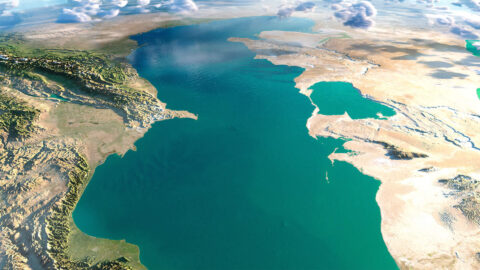
Caspian is landlocked sea, and Ukraine is not one of the littoral states. You know, you’re not going to hit it with a naval drone. But, this is well outside of the normal range of operations for anything that we’ve seen the Ukrainians do so far. Now, the Ukrainians say they did this in League with local resistance forces, completely unconfirmed.
So I don’t know if there’s anything to that, but there’s five former Soviet. I’m sorry, there’s four former Soviet states plus Iran that border the Caspian, Russia in the north, Kazakhstan and Turkmenistan in the east, Azerbaijan in the west, and Iran in the south. Like I said, it’s a landlocked body of water. So the military presence there is pretty limited because you can’t bring in ships from other places particularly easy.
You have to bring them into pieces and assemble them for use, which means it’s a largely demilitarized body of water.
There’s not a lot of cargo that gets shipped around except oil from the Kazakh portion of the northeastern part of the sea, and military and agricultural goods going back and forth between Russia and Iran. And even if the Ukrainians have no more ability than to hit the odd ship every once in a while, the Russians having to relocate military forces to something like this would be a really huge diversion, because supplying them is so difficult.
The only way that the Russians could really do it is to have a naval presence on the sea, and a naval presence on the sea to protect against the odd special forces group would just be not a very good use of the defensive capacity. So for the Ukrainians to find someplace that’s sensitive, that they can strike where the Russians can’t really compensate very easily.
You know, this is a good play. Also, Iran is where most of the Shaheen technology comes from. So anything that interrupts that flow is something that Ukraine will really feel on the battlefront. That’s peace. One peace to happen on the other side of the equation over in Poland. The polls got approval from the European Commission to use state subsidies to build their first ever nuclear power plant.
Construction is supposed to start in two years. They’re expecting, 5 to 7 years construction time. But that will probably be accelerated quickly, because in the world we’re going to where international shipping becomes more and more constrained. Nuclear power is one of those things that’ll probably continue to be a good idea, because it’s easier to fly in some nuclear fuel, once every few years, compared to the alternative of bringing in oil or natural gas by Piper by ship every single day.
So, not only is this an energy issue, it’s a military issue. You see, we’re in the process now of the United States backing away from its commitments to Europe. So the Europeans are being forced to take security matters into their own hands. And while you can, over the course of five, ten, 15, 20 years, build up fighter jets and bombers and tanks and artillery and all the rest, if you have the nuclear fuel, you can make a crude nuclear weapon in a matter of days, two weeks, or if you’ve never done it before, months.
So Poland now already has all the other pieces in place. They already have the artillery. They already have the fighter jets. They already have, basic ballistic missiles. And now they’re going to have all the inputs that they need if they want to build a nuke. Poland is one of a half a dozen countries in Europe that is considering going nuclear right now.
And the last piece they needed was the fissile material. one of the waste products from a normally operating nuclear power plant is plutonium. And the, a plant of the size that they’re going to have will generate enough waste plutonium for at least a half a dozen bombs a year.
So, over the course of the next few years, we’re going to have at least four, probably closer to eight new nuclear powers in Europe. In order to compensate from the Americans basically staying on their side of the ocean. So a lot going on in Europe and in the former Soviet Union right now. This is really just the beginning. The Americans, with the new national security strategy, basically dared the Europeans to look after their own security. And this is part of what that looks like.