
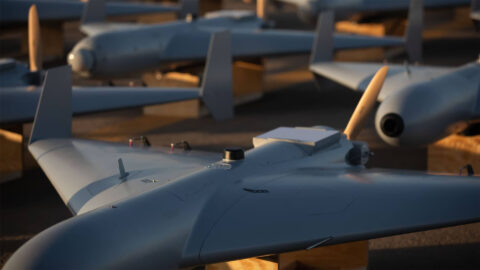

The U.S. has a drone that punches in the same (financial) weight class as the Iranian Shahed. Everybody, meet LUCAS.
With a range of ~500 miles, a price tag around $45,000, and modular capabilities, this is the U.S. military’s first step towards scalable and affordable drone warfare. This is still in early phases of production, but plans are in place to ramp that up by 2027.
These systems have already been used to strike Iranian targets, but the extent of the damage is unclear. LUCAS might not shift the trajectory of this war, but with widespread deployment over the next few years, the math of modern warfare could shift drastically.
Transcript
Hey, everybody. Peter Zeihan here. Hello from Dallas. Today we’re going to talk about drone warfare, specifically, a new weapon that the United States has introduced in the Iran war. It’s called the LUCAS, which is short for a very long item. That basically means really, really cheap drone. In fact, it’s modeled off of the Iranian Shahed, which has a cost probably in the 30 to $55,000 range.
Right now, what has been released indicates that it’s in the middle of that range, right around 40, 45,000. It’s a modular drone, so you can decide whether you want a warhead, a jamming pod control, a variety of other things. Anyway, this is the United States first entrance into low cost drone warfare. The idea is you’ve got a drone with a decent range 500 miles, which for an autonomous system is pretty good.
And because it’s made by the United States and not a country like Iran that doesn’t have much of an industrial base, things are being produced at scale. Or at least that’s the intent. And the modularity means that you can mix and match while you’re in deployment mode. So either on an aircraft carrier or by some Marines who happen to be on a beach somewhere.
You plug in what you want and then send it off. We know that they have been used already in the Iran war to ironically, target drone manufacturing capacity. The Shaheds, it’s unclear whether or not, the targeting just went after the barracks or the depots or the actual manufacturing floor. We just don’t know that. And Centcom has talked a lot about the targets they’ve taken out, but they haven’t yet to mention the manufacturing capacity at all.
So far, the estimate is that 1500 of these things have been built. And the intent is by at some point in calendar year 2027 for annual production to exceed 10,000 units. Compare that to how many patriots, the anti-missile systems that the United States is known for, can be made that comes out to about 600, maybe 700 a year right now.
They’re hoping to get that up to over a thousand over the next five years. Here’s the thing about drones. You have a couple of options. You can either have a fiber line, which means you can’t be too far away because you basically have it on a cord, or you have to realize that there’s going to be jamming. And if there’s jamming, you lose control of it, or you program in a decision tree imprinted onto something like a Nand chip, that’s, the memory in your computer that holds when your computer is off, and then it just kind of goes to that specific location, looks around for something that matches its targeting priority, and then drops.
That’s basically what the Shaheds are with the United States, though, you have a different option because the United States typically has air superiority where it operates and a satellite network. So you can put something like, say, a Starlink transceiver on it, and you can micro adjust it the entire way. And since these things have a range of 500 miles and a lot later in time, about six hours, that really expands your options.
Now, in this specific war with Iran, there just aren’t enough of them at the moment to make a difference. 1500 total. Not a big deal. The United States hit over 1200 targets in the first 48 hours of the war. But if you fast forward this 2 or 3 years, when a typical American naval asset can have a few hundred of these bad boys on station in any given time, then you’re talking about a very, very different sort of math.
One of the weapon systems that I was a big fan of that ultimately did not get built was the Arsenal ship. The idea you have something that’s smaller than a destroyer that basically carries a bunch of cruise missiles, 5000 of them, and you just send it out there and blah, blah, blah, blah, blah, blah, blah. This achieves that basic concept at a fraction of the cost, assuming it works.
Right now we know they’ve been used. We don’t know how well they’ve done, but these are exactly the sort of weapons that we need in this transition phase from going from an old, very, very high cost system to whatever the future of drone warfare happens to look like. And as soon as I find out more, I’ll let you know.