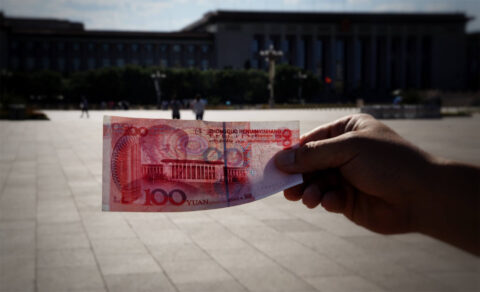

First order of business: No, this isn’t financial advice. Second order of business: taking a loan out in Yuan to profit from a Chinese collapse is a very bad idea.
Practically all yuan is locked inside mainland China, so you probably couldn’t get it out anyway. If you managed to, you would have to convert it before the collapse. The smarter move would be investing in the physical infrastructure and industrial capacity that will fill China’s shoes.
In all likelihood, a Chinese collapse will be more Venezuela-esque than Soviet…so anyone with yuan claims would be SOL.
Transcript
Hey, everybody. Peter Zeihan here, coming from Colorado. Taking a question from the Patreon page specifically, and this sounds a lot like seeking financial advice, so I’m not giving it in that way. But if the Chinese system collapses, wouldn’t it be a great idea to take out a big loan in yuan and then convert it to dollars or some other currency?
I wouldn’t recommend that. A couple things to keep in mind. Number one, over 99% of the yuan is locked within mainland China, and most of what is traded abroad is done through currency markets in Hong Kong specifically. So if you take out a yuan loan, you’re probably taking out the yuan loan in China, and the money cannot be transferred out.
The Chinese do it this way to maintain full control over the Chinese financial system, which they see as a political tool more than anything else.
So you wouldn’t be able to get the money out most likely in the first place. But, you know, if you could, then what? Well, you would definitely need to convert it out of yuan before the collapse.
One of the things that we have learned over the last 40 years from a number of countries that have collapsed is when their system breaks, their currency becomes not just soft, but nearly worthless. So in the post-Soviet system, for example, there were a fair amount of rubles out there because the, Russians, Soviets sold a lot of hydrocarbons and other materials to the wider world, some of that manifested as ruble circulating in the international system.
But it basically became worthless the next day. So you need to look at maybe not the Soviet collapse as a guide, but maybe the Venezuelan collapse. Venezuela used to be one of the richest countries in the Western Hemisphere, before Hugo Chavez took it over in the late 1990s. That was driven into the ground by the current bus driver, Nicolas Maduro. When you have a petroleum economy, you generate a lot of hard capital in hard currencies that are not your own. You can use that currency either to bring home and subsidize things to achieve whatever it is you want. You know, more roads, better education, happier people by just handing out cash.
In the case of Venezuela, AK 47 is for everybody. Or you can take some of that money that is already outside of your country and invest it outside of your country in longer term assets, whether they be financial or real estate or some sort of productive capacity. So, for example, Venezuela used a lot of their money to improve their educational system.
Preach those again. And they also built up their own oil industry at home. So they became, at the time, one of the most sophisticated energy companies in the world. And they invested in hardware in the United States that would further entrench their relationship with America, specifically buying or building refineries that were designed to process their crude oil. Well, as Chavez came in and started mismanaging everything, and eventually we had fiscal and eventually nutritional collapse in Venezuela, these assets all of a sudden were there.
And Venezuela lacked the financial capacity to service them and operate them. So eventually they kind of fell into a degree of receivership that was eventually brokered by the US government. And they either got spun off into independent firms or bought by third parties. I think some version of that is what the Chinese collapse would look like. Now. China is a lot bigger than Venezuela.
They have $10 trillion of investment in the wider world, about one third of which are foreign direct investment. So hard assets like a, say, a refinery or a farm, and so when these things go, you basically have the owning entity and the Chinese Communist Party and all their affiliated companies back in Beijing, cease to exist in some form or be denied functional ownership by the governments where the assets were held.
And at that point, typically what happens is the government nationalize it, and then auctions it off or sells it off in some way to their own domestic entities. Which means if you have a yuan loan, you would still get nothing, because your deal was with Beijing and Beijing is now gone. So if you’re looking to profit from the disintegration of the Chinese system, I know this is going to sound really boring, but it’s like just invest in the physical infrastructure and the industrial plant that will have to replace what the Chinese are doing now.
And to be perfectly blunt, doing that earlier rather than later is a lot cheaper because then you can have it up and running when the Chinese break, and then you can really rake in the cash. But it is a long term play and it is not a financial one.