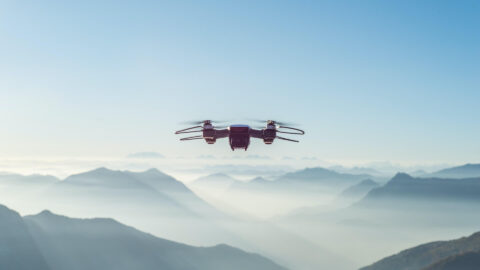

A new drone has appeared on the scene in the Ukraine War. This hybrid drone blends the precision and control of FPV quadcopters with the range and payload of fixed-wing drones.
Almost every drone style has been battle-tested in Ukraine. We’ve seen FPV drones wreak havoc on the frontlines and fixed-wing drones strike deeper inside Russian territory. However, these new hybrid drones offer the best of both worlds.
Ukraine is already seeing early success with the hybrds, meaning these drones could be a game-changer when combined with other innovations we’ve seen. Russia will develop countermeasures eventually, but we’ll see if Ukraine can capitalize on the opportunity this summer.
Transcript
Hey everybody. Hello from the Vegas airport at 0 dark 30. Today we’re going to pick up on the drone tech series and talk about different kinds of drones, specifically first person drones, which are typically quadcopters or hex copters. Verse is glide drones and flight drones, which are more fixed wing. Both of them have their own places. And one of the things we’re seeing in the Ukraine war today is that they’re starting to merge a little bit.
So first quadcopters or hex copters, you’ve seen them. These are the hobbyist ones that have been pressed into military use, with new models coming out pretty much every week. The advantage of a quadcopter is control. They can hover. They can land to conserve fuel. You have direct control over them at all times, and that means you can do really crazy things like position them above a military asset, like a tank that has a hatch open and drop something on it, or even drop the helicopter right into it.
You can fly into a hangar and look around and figure out what it is you want to go after the repair bay and aircraft, a fuel tank, whatever it happens to be. The degree of precision really is extreme, but the problem is, is these things have to have the rotors spinning all the time, so that really limits the range.
At the beginning of the Ukraine war, these things really only had a range of 2 to 3km, which is about the same as a javelin missile by the way. So the way to extend range was to fly them towards an enemy position, land a lot of nearby and then send one ahead to Scout, and then the others would spin back up. It would buy you a little bit more control and flexibility, but ultimately range was the issue. But as the batteries have gotten better, specifically lithium phosphate batteries and they’ve improved aerodynamics, the range has gone from 2km to 5km to ten kilometers, 20km to 25km.
And that has turned the entire front line into an area just littered with drones all the time. There’s also a lift issue, so their warheads generally are 10 pounds or less, with most of them being like 3 pounds or less. Fixed wing are different. They require some sort of launching system, which sometimes is no more complicated than kind of a large scale slingshot. They can carry more. They get a lot more lift because they have a wing system that gives them lifts. Quadcopters have no lift. You just have to have the rotors running. And this means that the fixed wing drones have significantly larger range, typically four and five times as long. If you’re spending the same amount of money and a significantly larger payload, because once they get up to a certain altitude, they can just kind of glide for a while and conserve fuel.
And you can also build larger models. There’s definitely an upper limit when you come to a quadcopter. As they get bigger, you the lift to weight ratio changes against you, so you can only get so big, whereas a bigger and bigger and bigger airframe for fixed wing generates more and more lift proportionally. And so it’s the fixed wing ones that are carrying the bombs that are in excess of 100 pounds, who can fly 600 to 700 miles, really without any major problem.
And those are the ones that are being used against most distant targets, and especially things like refineries and infrastructure. The advantages pretty extreme there. You can bring a lot of destructive power at significant range. The problem is control. With an FPV drone, you generally have either a digital tether from, say, satellite or cell phones or a fiber optic cable.
But when you’re starting to talk about a fixed wing drone, the further away they get, the more the chances are that they can be disrupted by electronic warfare. You never have a line of sight to them anymore, and if they fly through an zone, you probably are going to lose the drone. Although there’s certain things you can do with buffering that allows them to kind of stay the course in the hopes that they’ll emerge on the other side of it.
And you can pick up the signal again. But as a rule, the further away you go, the greater the chance you’re just going to lose control altogether. So these two broad classes have kind of defined everything with the war fees for close in and fixed wings for further destruction of infrastructure. But what we’ve seen in just the month of May is a new hybrid drone coming out that looks a little bit like a biplane, but the most of the rotors are horizontal as opposed to vertical, or the Ukrainians are starting to do is put detachable wings on the drones to get some of the best of both worlds, so you still use the horizontal rotors to achieve the thrust that’s necessary to leave the ground. But as they get going. The wing bevels into place and they can get lift from that as well. And in their first iteration of these things that have popped up in just the last few weeks, we’re already seeing the Ukrainians using these new hybrid drones to go 100km, which is double what we had before just in April.
And it’s 20 times what these sorts of drones could do at the beginning of the war for years ago. And what that means is, in one stroke, these new drones are roughly doubling the strike range of Ukrainian closing drones, increasing their weight capacity a little bit, too, because of the extra lift. That is something that the Russians are wholly unprepared for. Basically, with each stage of this war as a new weapon has been developed. There’s a period where the attacker, whoever that is, achieves local supremacy and a significant tactical advantage.
And then the other side developed countermeasures or copies of the technology, and the situation equalizes. But we’ve had so many Ukrainian innovations hit just since March that the Russians are reeling. So we now have memory drones that are hunting and self-selecting targets 50, 60, 100, 150km behind the front line, completely eviscerating the entire logistical system and now close in.
Individual Ukrainian drone operators have doubled their hunt range. So any sort of movement within 50 to 60km of the front on the Russian side is becoming a no man’s land. Russian positions are becoming isolated and without the Ukrainian suffering any blowback whatsoever. It’s not that the Russians have had to abandon all offensive capability, but they can only focus in specific points.
And that requires a degree of massing of forces. And those massing of forces usually happened more than 30km away, but less 100km away. All of a sudden, that is no longer viable. So we’re seeing a disintegration on the front right now. The question at this moment is whether or not the Ukrainians have enough offensive plunge and mine removal capacity to take advantage of that in any sort of sustained way, or we’re just waiting for the Russians to adapt these tactics adopt them to their own.
It’s just too soon to know. But considering that this is happening in the first week of June, we have all of June, all of July, all of August, all of September in the first half of October, which is kind of the ground fighting season when the climate encourages offensive activity. And the Ukrainians have now spent the last 2 to 3 months preparing the battlefield in a way that has just completely decimated the entire Russian order of battle and pre-positioned logistical caches.
At the same time, preventing troops on the front from being supplied with new men, new equipment, food, water, all the rest of the things. So I don’t want to overplay this because Russia’s defensive capabilities are immense. But it does look like this could be a summer where the Ukrainians break multiple parts of the front, and if they can get through those minefields, then we really are in a new game.