
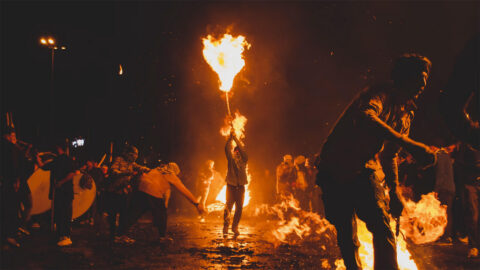

It seems that everyone is dead set on banging their drum about the French protests, but here’s what is actually happening.
Sure, the French have longstanding challenges with integrating immigrants from former colonies, but these protests are largely separate from that issue. The main driver is government cuts caused by France’s growing budget deficit and an aging population. And of course, when day turns night, these protests take on a different form, but that happens everywhere.
Transcript
Good morning from Colorado, where it’s, of course, sunny and a little foggy because mountains. Today we’re talking about what’s going down in France. We’ve had a lot of people write in with a lot of theories, and I just kind of wanted to give you an idea of what’s actually going on. One of the dominant theories is that all of the violence, and we’ve seen a lot of violence in the last couple of weeks, complete with billions of dollars of property damage, is caused by illegal migrants. That’s the preferred story among the US administration and people on the hard right in the United States. That is not correct. To be perfectly blunt. France really doesn’t have an illegal migration issue at all because it’s fairly easy to get citizenship in France if you are coming from a former French colony. So France’s problem is not an illegal migration problem. It’s a legal migration problem.
Because while the French like to think that they’re very open minded, I dare say that most of them are a lot more racist than Americans. And so they’ve basically created a system where they can bring in black Africans and Arabs, and a lot of them live as second class citizens, most notably the Arabs from Algeria. See, part of the problem is legal and structural. When the First Republic was formed in the aftermath of the revolutions of the 1700s. There was a lot of ethnic bloodshed. And so the people who came together to form the First Republic said, no more. We are going to enshrine in the Constitution that legally, everyone who is in the territory of what we recognize as France is French, regardless of your ethnic background. And for the thousand plus years before that, that is definitely not how things worked. We think of France as being populated by the French, and that is true. But it’s also full of Alsatians and Basques and Britons and so many others. So this decision was made that we are all culturally French, nationally French, regardless of what our ethnic background happens to be. And if you play that forward to the 20th century, you have to admit it’s been wildly successful. But it wasn’t updated. The strategy was not updated for the colonial era, where all of a sudden the French have far flung colonies around the world. And now all of those people are legally entitled to citizenship. So you get a huge amount of racial diversity in France that is enshrined in the Constitution is fully legal, but they’re definitely falling into the class of second class citizens if the roots of their ethnicity are not from metropolitan France. That’s problem one.
Problem two is that the French constitution actually makes it illegal to ask what your ethnic background is, because we’re all the same. So the French government doesn’t really know what the ethnic breakdown of the country is overall, or province by province or city by city. There’s a lot of educated guesses out there, probably that 15% of the population are not from ethnicities that were born in the metropolitan zone, but it’s really just a guess. Okay, so that’s two.
Third, what’s actually gone on with this protest, because it really has very little to do with any of that. I mean, there are areas in France where crime is higher. There are areas where ethnicities of various flavors are more concentrated. But that’s not what this was. There is a two part play to these protests and this violence. The first part was that the French government is now running one of the biggest budget deficits in the world as its population ages, pension costs are going through the roof, and as a rule, people who are older are more reliable voters than people who are younger. And so the state has made the decision time after time after time, to cut programs that benefited the young as opposed to the old. It’s a lot more going on than that, but that’s kind of the nut. And so young people are far more likely to protest than older people. So people who were raised on this idea that the French system has a generous social welfare model, cradle to grave, are seeing some of the earlier benefits of that cut. And they’re upset. And so whether it’s public safety or education, you have protests in the hundreds of thousands, sometimes in the millions, that from the point of view of most governments, France included, is completely legitimate as long as it’s peaceful. And then the sun goes down. And just as we’ve seen with protests in the United States, when the sun goes down, the people with kids and strollers go home and a different crowd comes up.
When you see people dressed in black with face masks, those are not illegal migrants protesting. Those are people who are going to cause some political damage and some physical damage and ransack and attack the police, as we’ve seen now multiple times, if this was in the United States, you would probably point to groups like Antifa. But this is France, and it’s not that Antifa is an alien ideology or anything like that, but that’s really not the form it takes in France. It’s anarchism which has been part of the French political order, pre-dating the time of the First Republic and the revolutions in the 1700s. Now, antifa and the anarchists do have some commonalities when it comes to rejecting state authority, but ultimately their stated games are somewhat different. Antifa says it’s anti-fascist and in their mind, justifies violence. Anarchists are opposed to government on principle. Basically, they’re libertarians. All caps, if you want to think that way. And so the concept to an anarchist that a shop owner owns, what’s in the shop is something that they ideologically reject, whereas Antifa is just kind of more thuggish.
Anyway, that’s the cause of most of the violence. These two movements have a lot in common. They certainly exchange techniques, and they certainly plan their attacks for maximum effectiveness, but they’re not quite the same. And then, of course, against that backdrop, once you have civil breakdown because of these protests, then you just get plain old looters and they can be of any flavor.
Anyway, hope that is of some use. Everyone out there is trying to beat their own ideological drum and point at France and say see, see, see, see. But for most of them the facts don’t match the ideology. But you know what’s new?