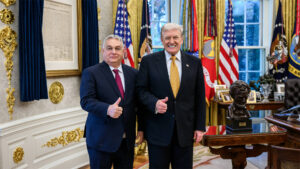
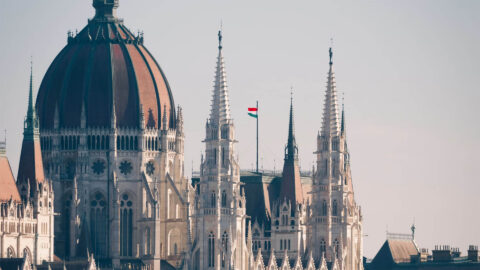

Hungary’s new Prime Minister, Peter Magyar, made his first foreign trip to Poland. This trip is not a reflection of ideological unity, but rather a rebuilding of regional cooperation within the Visegrád Group.
This group had fractured over the past decade thanks to Viktor Orbán, but with him out of the picture and a common enemy in Russia, Hungary and the rest of the Visegrád Group can begin rebuilding.
If the Visegrád Group can reestablish itself, this bloc of countries can wield significant voting power within the EU, rivaling major states like France or Italy and bringing a stronger voice to Central Europe as a whole.
Transcript
Hey everybody. Peter Zeihan here, coming to you from Italy. It’s a monastery that was built around a hermit hole, probably in the eighth century. Then it was remodeled in the 11th, and then in the 14th. You get the idea. Reused. Lots of things in Italy are like that. Anyway, that reminds me of what’s going on right now in Poland. The Hungarian prime Minister, Peter Magyar.
Peter, good name, made his first foreign trip to Warsaw to meet with the Prime Minister of Poland, Donald Tusk. Now let’s talk about what this isn’t and then talk about what it is. So what it isn’t is a political alliance that has to do with how the elections went. No no no no no no. Peter Magyar is center right, strongly right.
I might underline. And the person he kicked out of power, Viktor Orban, supposedly was also sent to. Right, but was really just breathlessly corrupt and would bow down to anyone who wasn’t Brussels. And now that he’s gone, a number of his former ministers have actually fled the country because they know they’re going to be put into jail. And we’re kind of a series of parliamentary votes in Hungary that basically strips the ones that are left of any power.
So it’s a real transition. But from corruption to conservativism, not from conservatism to liberalism. On the Polish side of the equation, Donald Tusk is an avowed pan-European list. He used to be an uppity up in European power structures before he went back home and became prime minister. He’s of the center left, and so the two of them on domestic political issues have a lot of things they argue about.
But that’s not the point, because what this is, is more of a strategic alliance. You see, Poland and Hungary, along with the Czech Republic and Slovakia, form a group called the Visegrad Group, which is for countries that tend to coordinate their operations at the EU level. But for most of the last decade they haven’t, in part because Viktor Orban became more and more and more correct and more and more and more pro-Russian and less and less and less pro-European.
And also because there were political evolutions in Poland where the nationalists were in power before Donald Tusk for quite some time, and they just found it difficult to get along. That’s probably behind us now. I don’t want to say it’s perfect, because we have a guy by the name of Robert Fico in Slovakia who’s a little a little odd, but not nearly as odd as some of the others have been in the last ten years.
Why does this matter? The European Union doesn’t necessarily work on consensus. They have a weighted majority voting system among their Council of Ministers. That’s the Council of Prime ministers. That is nauseating, complicated. But the short version is to get anything past a certain number of countries have to agree, and those countries have to represent a certain percentage of the population.
And if you take Poland and Slovakia and Hungary and Czech Republic and you bunch them together into a single voting bloc, they have actually more voting power because they’re four countries than France or Italy, two of the three big states in the EU. And they have about the same population. So this doesn’t mean that the Central Europeans are going to suddenly start getting their way on everything.
But it does mean now that they can really duke it out with the major established advanced powers on an equal basis from a decision making point of view, plenty of things to worry about. The primary one for everyone right now is, of course, Russia and the Ukraine war. And with Orban gone, there’s a lot more room for consensus.
And when you get past that and start talking about the nitty gritty things of day to day government like, say, budgets, now we’ve got the central Europeans who can actually stand up for themselves and get some things done. So all in all, reasonable first trip. Looks like it’s been a smashing success. Nobody stabbed anybody. And in Europe these days. That’s great.