The Israeli Air Force announced April 21 that it would scale back participation in the Red Flag exercises in Alaska. The joint Red Flag drills are regular events hosted by the United States, with the upcoming April 26-May 11 exercises allowing the Israelis to train in an environment they rarely experience (non-coincidentally, Alaskan terrain is somewhat similar to the Persian highlands). IDF spokespersons attributed the decision to keep Israeli F-15s at home due to the changing situation assessment of tensions along its northern border that have left everyone holding their breath.
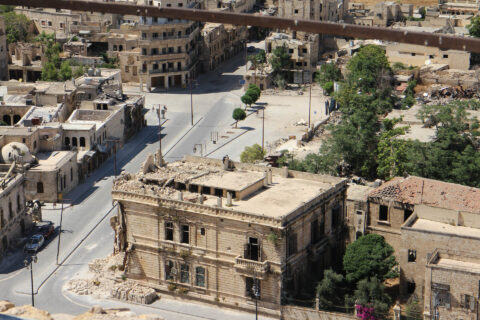
We weren’t kept waiting long. In the early morning hours of April 30, the Israelis launched a series of significant strikes throughout western Syria, targeting infrastructure that supports weapons development and distribution. A rocket factory made for some particularly impressive fireballs.
The Israelis normally hold their cards much closer to their chest than this – particularly when it involves possible actions in their close-in neighborhood. But these are not normal times. The open secret is that the United States sees almost no role for itself in Syria going forward (at least, compared to what American engagement in the Middle East typically looks like). The Americans’ primary goal in Syria has been the eradication of ISIS. With the terror group’s holdings nearly obliterated, so too goes a compelling case for extending American involvement in Syria. This is compounded by the fact that a country as broken as Syria needs the kind of costly, involved, long-term occupation and rebuilding efforts the Americans pursued in Germany and Japan after World War II – a cost the Americans were unwilling to pay in either Iraq or Afghanistan.
The pending American withdrawal evolves the Syrian War in a much fiercer direction. Initially, the primary players in the fight were domestic: the Assad government, ISIS, the Syrian Kurds, and the various collections of anti-regime elements who seemed to occupy every spot on the spectrum from wonky democrats to those who felt ISIS would have been more successful if it had just been a bit more brutal. Foreign powers used these factions as proxies to meet their tactical and strategic needs in the country without committing significant troops. It also created plausible deniability in a very volatile situation with many major actors. In exchange, these factions received intelligence, money, weapons and on-site support far superior to anything they could hope for otherwise, not to mention promises for their role in the future in Syria that may or may not be fulfilled. While those foreign players could certainly make their presence felt, using proxies inherently means the foreigners were rarely present in sufficient strength to dictate events on the ground. (The sole exception might be Iran’s proxy militant group in Lebanon, Hezbollah, which has apparently redirected nearly all its fighters into the Syrian theater to assist the Assad government. More on that exception in a moment.)
The presence of U.S. forces in Syria has limited what all the outside players could do, as well as the sorts of risks they were willing to take. The Americans may have never had more than a couple thousand troops in-country, but their vast array of naval firepower combined with the base at Incirlik, Turkey meant they could at a moment’s notice squeeze off missile and bomb barrages at any target they desired. There was no point in baiting the eagle (as Moscow discovered Feb 7 when the Americans obliterated a Russian probe attempt).
But take the Americans out of the equation, and the lid comes off the pot. And since everyone has different goals, Syria is about to get consistently lively:
Russia was an early participant in the Syrian conflict for a mix of reasons:
- Syria is one of the few of Russia’s Cold War-era proxies that is still of some use, so propping up Assad holds some slight strategic value all its own.
- Politically, being involved where the Americans were not helped burnish Russia’s credentials as a player, guaranteed it a seat at any table that discussed Syrian issues, and was an easy propaganda win back home.
- Being in Syria annoyed the crap out of the Turks, forcing Ankara to rivet its gaze to its south rather than to the north where more core Russian interests were in play.
- Being able to twist the Syrian fighting this or that way enabled the Russians to generate scads of refugees on demand. A mix of geographic, climatic and infrastructure patterns meant that most of those refugees could only go north to Turkey and Europe, enabling Moscow to scramble European politics with nothing more than a few dozen bombs.
- More recently, the Russians have turned Syria into a vast testing and training range for its forces. Russia’s military may be huge, but it hasn’t seen 1% of the sort of expeditionary combat American forces have seen since 1992. Syria let’s the Russians play catch up.
What do all these reasons have in common? Russia has a vested interest in seeing the Syrian War never end.

Iran is the closest to a strategic ally that the Assad regime has, and Syria has quite surprisingly – to Iran – become the lynchpin in Iran’s entire regional strategy. The most important tool Iran has is the militant group Hezbollah, which Iran uses not simply as a foothold in the Levant, but to threaten Israel and pressure the United States. When Saddam ran Iraq, the Iranians were able to shuttle support to Hezbollah via Iraq and Syria into Lebanon. Well, the Americans overthrew Saddam and now civil war threatens Syria. The Iranians didn’t just have no choice but to go all-in in Syria, but they are now the power seeking to maintain governments in the region rather than seeking overthrow them. That requires a degree of political, strategic, military and economic commitment that is downright… American.
Assad may have won the civil war, but now Iran has to hold the place together, and as the Americans learned in Vietnam, Afghanistan and Iraq, the second phase is far more difficult. But unlike the Americans, the Iranians can’t just go home. An ongoing Assad victory is absolutely critical to maintaining Iran’s current sphere of influence from Mesopotamia to the eastern Mediterranean. In short, the Iranians can never go home.
Directly opposite the Iranians are a series of powers that seem to be somewhat confused about what’s going on in their neighborhood: the Gulf Arab states – Saudi Arabia, the United Arab Emirates, and Qatar. Their efforts in Syria are, in a word, messy.
- Part of this is due to geography: large swathes of desert terrain separate the Gulf Arabs and Syria.
- Partly it’s a lack of experience: the Gulfies are among the most dependent countries on earth when it comes to relying on the American security blanket.
- Partly it’s ineptitude: Saudi and Emirati and Qatari-backed groups spend as much time fighting each other in Syria as they do Assad or anyone else.
- Partly it’s an issue of distraction: these same powers are also fighting a war in Yemen.
It all adds up to a lot of ammunition backed by a lot of money that’s causing a lot of deaths. And that just might be the point. For decades the Americans’ took on the mantle of preserving countries in their current form; If your job is to maintain the global system, then you want stability. But with the Americans leaving, the only power that really wants a stable Syria is… Iran. And if there is one thing the Saudis do not want, it is an Iranian-dominated anything. Better to burn the whole place down than allow the dust to settle in an arrangement that doesn’t suit Saudi preferences.
Which puts Israel and Saudi Arabia more or less on the same side, with Israel in the perfect strategic and political position. The regional powers with which the Israelis have passably good relations – Turkey, Saudi Arabia, the UAE, Qatar and Egypt – are fighting against Assad and Iranian influence, which means Israel is free to strike targets according to its own national security prerogatives with little risk of even angry tweets from regional stakeholders.
The Syrian War has quietly ushered in a new era of Israeli security relations with its neighbors: rather than relying on the Americans, Israel is aggressively, proactively and decisively pursuing its national security interests and intervening in Muslim conflicts… and no one except Syria and Iran has anything to say about it. The Israeli Air Force has attacked over 100 targets within Syrian territory since 2012, from suspected missile and arms deliveries en route to southern Lebanon to high value Hezbollah and Iranian targets. With the Iranians now the force for order in the country, the Israelis will gleefully expand their target list to anything that will cost the Iranians lives, equipment or money.
It’ll be a long list.

The role of Turkey in Syria has been… unmoored for a reinforcing pair of reasons.
- First, Turkey’s World War One defeat was so total and humiliating that Turkey in essence took a vacation from the world that lasted a century. The Turks are out of practice using the political, diplomatic, economic and military tools that are standard for pretty much everyone else. The learning curve is fairly steep, but it is still there and the Turks are starting from almost zero.
- Second is that the political situation within Turkey is flattening that learning curve. President Recep Tayyip Erdogan has largely completed the process of purging the country of, well, everyone who opposes him. That has left this very Trumpian personality with zero competent allies, which means he is running Turkey’s $900 billion economy, 80-million citizens, and 900,000-strong military all by himself. Such concentration of power makes for erratic decision-making, with Erdogan highly vulnerable to bad intelligence, fake news, Russian manipulations, personal mental blocks, and a host of other issues that would routinely be filtered out in a more decentralized system.
At the end of the day the Turks’ primary concern in Syria is the military capacity and de facto independence of the Syrian Kurds. Ankara/Erdogan fear – with significant reason – that a Syrian Kurdish statelet will provide a template that could be reproduced within Turkey’s own Kurdish regions. To that end and despite Erdogan’s best efforts, the Turkish military/intelligence apparatus is steadily constructing effective networks of military groups throughout northern Syria. When the Turks do decide to move in force, they’ll be able to.
And let’s not kid ourselves. Unlike the United States, Russia, Iran or Israel, Turkey can put troops on the ground in Syria in the hundreds of thousands if it wants to and the Turks have the motivation and staying power to see their strategy through in what will be a complex and bloody new stage in the war. It is ultimately Turkey that will decide what Syria will look like, and years from now we’ll all be looking back at the 2018 American withdrawal as the event that unleashed Turkish power in the region.
I’d like to end with one particularly dark thought. The primary reason the Americans were in Syria at all was because a militant group called ISIS was stupid enough to post the beheadings of a few American co-eds on social media. Expunging ISIS is pretty much done and so the Americans are now leaving. But look at what enabled ISIS to exist in the first place: local sectarian divisions, multiple competing power centers, an arid geography that complicates regional consolidation, meddling outside powers, and a metric butt-ton of easily attainable military-grade weapons. None of these factors have gone or are going to go away. Every power playing in the Syrian sandbox is creating, sponsoring and supporting their own constellations of mutually-antagonistic militias. It isn’t so much a petri dish from which will emerge the next ISIS as it is an ISIS factory.
Happy Monday.