Building the Anti-Russian Alliance

NATO flag with a Russian pin and ammunition

Today’s video comes to you from Doubtful Sound in Fiordland National Park.

The European space has historically been disconnected. Between geographical barriers, neutral countries, and bloody history, that shouldn’t come as a surprise. Now that central and western Europe is forming a coalition against the Russians…Putin should be shaking in his boots.

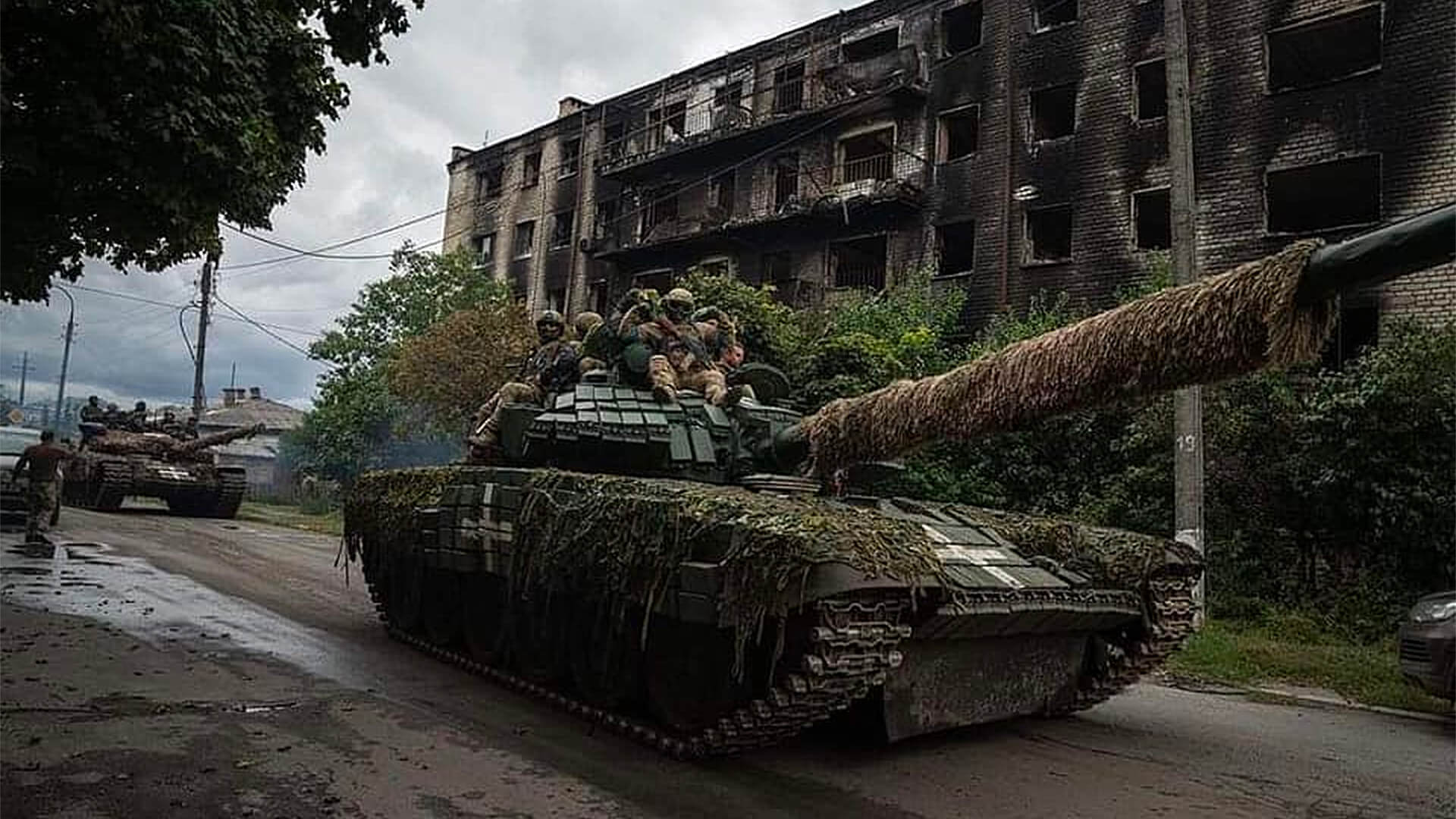
Much of core Europe has already made its stance clear, with German, Portuguese, and Spanish tanks arriving throughout the month. With NATO votes coming up, historically neutral countries like Finland and Sweden are making their alliances clear. And even Turkey can no longer straddle the line and play both sides of this ordeal.

The real kicker here is that the Americans aren’t steering the ship. This is the Europeans doing what’s best for the Europeans. We haven’t seen a coalition this large united against a single power for centuries, and the Russians are in for a rude awakening.

*At 3:50 in the video, Peter mentions that the “French are contributing (to the Ukraine War effort) in a way they haven’t done since WWII” – it’s important to note that the French had boots on the ground in both Desert Storm and Desert Shield

*At the time of posting Finland has already been added to NATO

Prefer to read the transcript of the video? Click here


Here at Zeihan On Geopolitics we select a single charity to sponsor. We have two criteria:
 
First, we look across the world and use our skill sets to identify where the needs are most acute. Second, we look for an institution with preexisting networks for both materials gathering and aid distribution. That way we know every cent of our donation is not simply going directly to where help is needed most, but our donations serve as a force multiplier for a system already in existence. Then we give what we can.
 
Today, our chosen charity is a group called Medshare, which provides emergency medical services to communities in need, with a very heavy emphasis on locations facing acute crises. Medshare operates right in the thick of it. Until future notice, every cent we earn from every book we sell in every format through every retailer is going to Medshare’s Ukraine fund.
 
And then there’s you.
 
Our newsletters and videologues are not only free, they will always be free. We also will never share your contact information with anyone. All we ask is that if you find one of our releases in any way useful, that you make a donation to Medshare. Over one third of Ukraine’s pre-war population has either been forced from their homes, kidnapped and shipped to Russia, or is trying to survive in occupied lands. This is our way to help who we can. Please, join us.

CLICK HERE TO SUPPORT MEDSHARE’S UKRAINE FUND

CLICK HERE TO SUPPORT MEDSHARE’S EFFORTS GLOBALLY


TRANSCIPT

Hey Everyone. Peter Zeihan here coming to you from Doubtful Sound in New Zealand’s Fiordland National Park. Anyway, a lot of things have gone down in the Ukraine space politically, not so much militarily. And I thought it was worth kind of looking at what the big picture is and to understand where we’re going forward, we have to go back. If you go to the world before 1945, the age of European competition, you had shifting alliances because the geography really prevented the area from coalescing into a single entity. So your northern plane, you’ve got the French, the Dutch, the Belgians, the Poles and the Germans who if you know, if there was ever going to be a zone where someone controlled everything, would be them. And so most chapters of history have been one of those powers trying to assert control over the others. You’ve got Scandinavian in the north with fjords and peninsulas and islands, so always fiercely independent and very naval oriented compared to everyone else. In the south you’ve got a more occluded coastline with very few navigable rivers of any type. And so you get regional powers who were relatively isolated from the others, but who could really punch above their weight economically because they’re all trade oriented, whether that’s in Spain or Portugal or Italy or the Balkans. It makes for a bit of a mess. And so for most of the half millennia leading up to 1945, it was kind of a war of all against all with shifting alliances here and there. Always changing texture, always changing sides. Then the Americans came in, in World War Two, and the Soviets rose during World War Two become major powers who injected themselves into this competition, encroaching into the rules of the game, because suddenly you had these two outside-ish powers who were determining all the major decisions. And we kind of forgot that Europe was the most blood soaked part of the planet until that point.

Now, with 1990 and the end of the Cold War, the Europeans have been living in a vacation from history where the security paradigms of the Cold War exist without the security threat of the Cold War. You combine that with the late globalization period and the time when pretty much all of the world was open for business and you got a very different sort of environment economically and especially politically. Well, the Russians now are kind of climbing back, clawing out of their post-Soviet hole and attempting to reassert themselves as a major regional power. Whether you believe they’re doing this out of stupid reasons or sane security reasons doesn’t really matter. They’re trying to change the nature of the system for their own long term benefit, and that is forcing countries to do something that they haven’t had to do for decades. Take a side, take a position and form an alliance to counter the Russians.

Now, from the Russian point of view, it’s all about the Americans all the time. And everything that’s going wrong for the Russian can be laid at the Americans feet. But that is to completely ignore the history of Europe, which is that of a series of independent and semi-independent primary secondary powers.

So what is kind of shaking out this week? Well, first and most importantly, the German leopard tanks, mainline battle tanks, have finally reached the war. And so now the Germans have fallen into this position of – we don’t want to be in a leadership position. We know what that has looked like in the past. We understand why everyone was nervous about it. Well, we don’t have a choice. We are the largest economic power in the northern European plain, the largest economic power in Europe. And historically speaking, we have also been the most powerful military force. We have to take a leadership position because if we don’t, this is all going to fall apart and we will be facing the Russians on the plains of Poland. And we know exactly where that leads. And we don’t want that.

This has a lot of depth because the Dutch also on the northern European plain are into the hilt. So are the Poles. The French are contributing in a way we haven’t seen the French contribute to multinational operations since World War Two and even further back technically off the plain in places like Spain and Portugal. Portugal tanks arrive with the German ones and the Spanish ones will be there within a month. So everyone in that kind of strip of what you think of as core Europe is already fully committed and back in the game. Scandinavia is a little bit different here. You’ve got mostly independent cities, states that masquerade as countries, and then Sweden, which has kind of been out of the game for three centuries. By the end of next week, Turkey will have voted on whether or not to let the Finns into NATO’s, and a vote on Sweden will probably go within a couple of months of that. And that means that these two traditionally neutral powers are going to be taking a leadership position in security policy in Europe. And the only issue they care about are the Russians. Now, the Swedes have been out of the game for three centuries after a massive military defeat in what is today’s Ukraine and in the aftermath of World War Two, the Finns were forced into a degree of neutrality where they could chart their own economic course. But on any sort of security decision making, the Soviets had full veto power. Well, that is now gone. And these two countries that have very strong militaries, relative to their size, economically or in terms of population, all of a sudden are the harbingers of the apocalypse when it comes to the Russian point of view of how European security should go, because they are extraordinarily anti-Russian. Every security question that they have ever faced has been framed in the context of what do we do the day the Russians invade? Everything else is around that, and now they’re about to be part of the decision making architecture. That also means that the Turks are coming in from the cold. They’ve been trying to kind of have their cake and eat it, too. But in the last few weeks, they’ve joined the sanctions regime relatively forthrightly and are now no longer an avenue that the Russians can use to evade the sanctions regime, especially when it comes to materials import things like semiconductors. And then finally, of course, there’s the United Kingdom. The United Kingdom was always going to be anti-Russian because it’s a naval power on an island. And any time it looks like a land power in Europe is going to become more potent. They get a little nervous and they want to make sure that the land powers are busy with land issues so they can’t float navies that can challenge London. Well, King Charles was just coronated in his first full state visit to Germany. If there are two countries in the European space that tend to be on opposite sides of all economic and security questions, it’s the United Kingdom and it’s Germany. And the fact that they’re, you know, within sight of one another is something that should turn anyone on the opposite side of that axis to turn the blood cold.

So what we’re seeing here for the first time, not in decades, but in centuries, is everyone in Central and Western Europe at the same time coming together to form a broad coalition against a single power. We haven’t had that since Napoleon, if you want to get technical, we haven’t had that since the Treaty of Westphalia. And the Americans, while they are a part of all of this, are not steering this part of the equation. This is the Europeans doing what makes sense to the Europeans. And if I were the Russians, I’d be very concerned about that.

The Russian & Chinese “Partnership”

Russia has long operated under the guise of “strategic partnerships” to keep its enemies within striking distance. Putin and Xi’s partnership is no different. However, only time will tell who will end up with the knife in their back.

For both sides, this is an alliance of convenience enabling them to get around some sanctions brought on by the war in Ukraine. But the Chinese might be looking to gain a little more from this relationship. Xi’s recent meeting with the leaders from Uzbekistan, Tajikistan, Kyrgyzstan, and Kazakhstan is indicative that a move on the Russian space could be in the cards.

One of Putin’s motivations for the war in Ukraine is to take control of the geographic access points used to launch assaults against the Russians. Can you guess where one of those access points just so happens to be? The Altai Gap…which connects Russia, Kazakhstan, and you guessed it, China.


Here at Zeihan On Geopolitics we select a single charity to sponsor. We have two criteria:
 
First, we look across the world and use our skill sets to identify where the needs are most acute. Second, we look for an institution with preexisting networks for both materials gathering and aid distribution. That way we know every cent of our donation is not simply going directly to where help is needed most, but our donations serve as a force multiplier for a system already in existence. Then we give what we can.
 
Today, our chosen charity is a group called Medshare, which provides emergency medical services to communities in need, with a very heavy emphasis on locations facing acute crises. Medshare operates right in the thick of it. Until future notice, every cent we earn from every book we sell in every format through every retailer is going to Medshare’s Ukraine fund.
 
And then there’s you.
 
Our newsletters and videologues are not only free, they will always be free. We also will never share your contact information with anyone. All we ask is that if you find one of our releases in any way useful, that you make a donation to Medshare. Over one third of Ukraine’s pre-war population has either been forced from their homes, kidnapped and shipped to Russia, or is trying to survive in occupied lands. This is our way to help who we can. Please, join us.

CLICK HERE TO SUPPORT MEDSHARE’S UKRAINE FUND

CLICK HERE TO SUPPORT MEDSHARE’S EFFORTS GLOBALLY

Russia Targets the Ukraine Grain Deal

The changing situation with the Ukraine Grain Deal has given me plenty to ponder while tromping through Fjordland in New Zealand. Due to the war, Ukrainian agricultural exports were reduced to a fraction of their pre-war numbers. The grain deal brokered by the UN was a glimmer of hope that perhaps exports wouldn’t entirely fall off the map…

With winter on the way out and summer just around the corner, the Russians are revaluating their strategy. Targeting power infrastructure may have worked during the winter, but it doesn’t make much sense for the warmer months…it appears the new target will likely be Ukrainian agriculture.

We’ve already seen the Russians change the renegotiation period of the grain deal from 120 days to 60 days, and I wouldn’t be surprised if March is the last time the Russians resign. So Ukrainian exports might fall off very soon, but can the rest of the world’s (already struggling) agriculture industry pick up the slack?

Prefer to read the transcript of the video? Click here

Here at Zeihan On Geopolitics we select a single charity to sponsor. We have two criteria:
 
First, we look across the world and use our skill sets to identify where the needs are most acute. Second, we look for an institution with preexisting networks for both materials gathering and aid distribution. That way we know every cent of our donation is not simply going directly to where help is needed most, but our donations serve as a force multiplier for a system already in existence. Then we give what we can.
 
Today, our chosen charity is a group called Medshare, which provides emergency medical services to communities in need, with a very heavy emphasis on locations facing acute crises. Medshare operates right in the thick of it. Until future notice, every cent we earn from every book we sell in every format through every retailer is going to Medshare’s Ukraine fund.
 
And then there’s you.
 
Our newsletters and videologues are not only free, they will always be free. We also will never share your contact information with anyone. All we ask is that if you find one of our releases in any way useful, that you make a donation to Medshare. Over one third of Ukraine’s pre-war population has either been forced from their homes, kidnapped and shipped to Russia, or is trying to survive in occupied lands. This is our way to help who we can. Please, join us.

CLICK HERE TO SUPPORT MEDSHARE’S UKRAINE FUND

CLICK HERE TO SUPPORT MEDSHARE’S EFFORTS GLOBALLY


TRANSCIPT

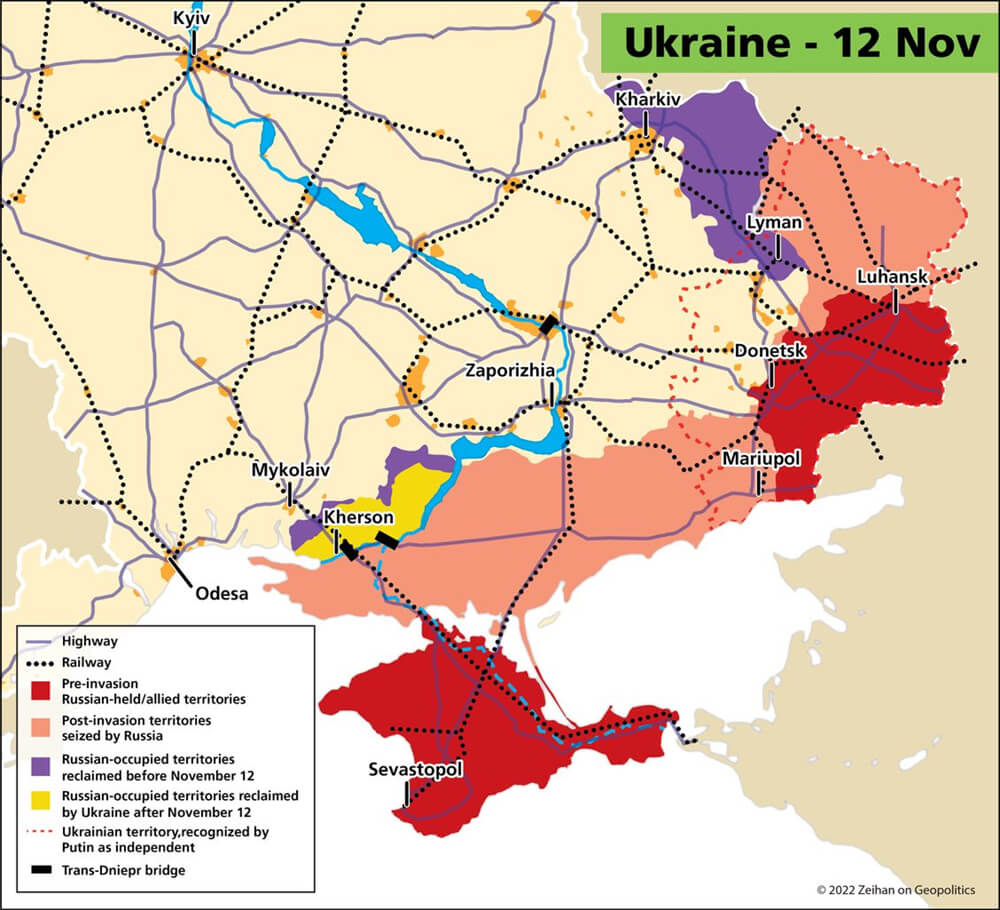
Hey everybody. Peter Zeihan coming to you from Ruby Baby in Fjordland in New Zealand. The big news that I’ve noticed is that the Russians are throwing a bit of a fit about the grain deal they have with the Ukrainians. Now Ukraine until very recently was one of the world’s five biggest agricultural exporters for wheat, number four in corn, number one in sunflower you know all important things that help prevent a lot of countries from starving to death. Well, the problem is that most of the stuff that comes out of Ukraine is shipped by water. It’s far easier to ship things by water than it is by land. In terms of rail versus water, about a 3 to 1 cost difference. And Ukraine is perfectly set up for that because they’ve got the Dnieper River that cuts right south to north through the middle of the country. And so everything just gets on a barge, goes out, eventually hits the sea cities Kherson and Odessa, then are put on the big altars and then taken out through the Black Sea, the Turkish Straits and the rest of the world. What has happened, however, is with the Russians first capturing Kherson and then putting Odessa under assault, this is all been disrupted. So the only way to move things out of Ukraine at present is by rail. And not only does Ukraine not have a well-developed rail system. It doesn’t use the same gauge as the European ports. So it’s been very, very difficult, to get much out. Really less than about one out of six vehicles that they used to ship, they can ship now.

Now, the Turks in league with the United Nations have convinced the Russians to sign on to a grain deal. And this grain deal allows ships to come into Odessa, get searched by the Russians on the way in to make sure they’re not carrying weapons and then load up with grain and they get searched on the way out to make sure that they’re not carrying anything that the Russians don’t want to get out. This has increased the volume to about 20 to 25% of the volume that the Ukrainians could do before the war. So still not great.

Now, if you’ve been following the war, you know that throughout the winter the Russians have been bombing the power grid with drones and missiles to try to kill as many Ukrainians as possible. They’ve been doing this in the winter, thinking that if you can freeze the country to death, many tens of thousands, if not hundreds of thousands of people will be injured or killed. And that might weaken the war effort. Once we get to summer that’s going to change. So what the Russians are facing here is the grain deal is normally renegotiated every 120 days they are  now insisting they only want a 60 day renewal. Well, if you fast forward from late March, 60 days, we’re getting into the beginning of summer. In the beginning of summer, the Russians won’t have a vested interest in destroying the power grid because no one’s going to freeze to death. So they’re going to go after the agricultural system, everything from fertilizer on the front end to the silos and the rail stations on the back end to try to kill as many people as possible that way.

So last year was probably the last year that Ukraine will be a significant agricultural exporter at all, and we should not expect to see the Green Deal renewed come late May. That’s just the situation we’re at. And if you throw in the problems with natural gas and nitrogen processing in Europe hitting the fertilizer market, the problems getting potash out of Belarus hitting the fertilizer market, the problems getting phosphate out of China, hitting the fertilizer market later this year is going to be really raw for a lot of places. Aright. That’s it for me. I’ll see you guys at the next spot. Take care.

The Jordan Harbinger Show

I recently had the opportunity to sit down with Jordan Harbinger on “The Jordan Harbinger Show” (for the loyal followers, you’ll know this is my second appearance).

We discussed how the globalized world came to be, the factors contributing to its instability, and how the process of deglobalization is well underway. The chaos the world is about to face is nearly impossible to consolidate into an hour long podcast, but this is a good start!

Links to the podcasts, YouTube videos, and more can all be found below.

Geopolitical Strategist on China’s Upcoming Collapse JHS Ep. 781

Confronting a Geopolitical Strategist on Putin’s Big Plan Peter Zeihan Ep. 640

*This video is from my first appearance on The Jordan Harbinger Show

Did you miss out on the Global Outlook Webinar
Click the link below to purchase it:


Here at Zeihan On Geopolitics we select a single charity to sponsor. We have two criteria:
 
First, we look across the world and use our skill sets to identify where the needs are most acute. Second, we look for an institution with preexisting networks for both materials gathering and aid distribution. That way we know every cent of our donation is not simply going directly to where help is needed most, but our donations serve as a force multiplier for a system already in existence. Then we give what we can.
 
Today, our chosen charity is a group called Medshare, which provides emergency medical services to communities in need, with a very heavy emphasis on locations facing acute crises. Medshare operates right in the thick of it. Until future notice, every cent we earn from every book we sell in every format through every retailer is going to Medshare’s Ukraine fund.
 
And then there’s you.
 
Our newsletters and videologues are not only free, they will always be free. We also will never share your contact information with anyone. All we ask is that if you find one of our releases in any way useful, that you make a donation to Medshare. Over one third of Ukraine’s pre-war population has either been forced from their homes, kidnapped and shipped to Russia, or is trying to survive in occupied lands. This is our way to help who we can. Please, join us.

CLICK HERE TO SUPPORT MEDSHARE’S UKRAINE FUND

CLICK HERE TO SUPPORT MEDSHARE’S EFFORTS GLOBALLY

Danger Close with Jack Carr

Last week I had the opportunity to sit down (virtually) with Jack Carr on his show Danger Close. We chatted about the troubling outlook for China, the ins and outs of the war in Ukraine, and much more!

Moving forward, I’ll share my appearances from different podcasts and shows. Most of these are longer than my usual YouTube videos, so for those looking for more of my insights…this is for you!

This is my second time on Danger Close, so if you need even more listening material, check out my original episode from March 2022.

MOST RECENT INTERVIEW – MARCH 8TH 2023

OLD INTERVIEW – MARCH 16TH 2022


Here at Zeihan On Geopolitics we select a single charity to sponsor. We have two criteria:
 
First, we look across the world and use our skill sets to identify where the needs are most acute. Second, we look for an institution with preexisting networks for both materials gathering and aid distribution. That way we know every cent of our donation is not simply going directly to where help is needed most, but our donations serve as a force multiplier for a system already in existence. Then we give what we can.
 
Today, our chosen charity is a group called Medshare, which provides emergency medical services to communities in need, with a very heavy emphasis on locations facing acute crises. Medshare operates right in the thick of it. Until future notice, every cent we earn from every book we sell in every format through every retailer is going to Medshare’s Ukraine fund.
 
And then there’s you.
 
Our newsletters and videologues are not only free, they will always be free. We also will never share your contact information with anyone. All we ask is that if you find one of our releases in any way useful, that you make a donation to Medshare. Over one third of Ukraine’s pre-war population has either been forced from their homes, kidnapped and shipped to Russia, or is trying to survive in occupied lands. This is our way to help who we can. Please, join us.

CLICK HERE TO SUPPORT MEDSHARE’S UKRAINE FUND

CLICK HERE TO SUPPORT MEDSHARE’S EFFORTS GLOBALLY

Trusting the Numbers in a Deglobalized World

To my fellow nerds reading along…this is your trigger warning…today we’re talking about BAD DATA. Sorry for the dramatics, but I’m sure many of you share my frustration when you can’t find the correct numbers for that forecast you’re working on or, even worse, the data you used in your model is falsified.

Unfortunately for us, this problem is only going to get worse. We know that the numbers coming out of Russia and China haven’t been “trustworthy” for years, but at least we could check most of it. At least now we don’t have to worry about data manipulation because both countries decided they wouldn’t collect or report it…

The increasing struggles of data reporting aren’t isolated to autocracies either. As the global trading system breaks down, most of the world will be hit with paralyzing inflation and trying to track it would be a fool’s errand. Until the gaping vulnerabilities left in the global trade system are patched, this will continue raging on.

Some countries will fare better than others, but no one is getting off scot-free. The modern world’s economic model is crumbling, and someone will have to figure out what we all do next.

Prefer to read the transcript of the video? Click here


Here at Zeihan On Geopolitics we select a single charity to sponsor. We have two criteria:
 
First, we look across the world and use our skill sets to identify where the needs are most acute. Second, we look for an institution with preexisting networks for both materials gathering and aid distribution. That way we know every cent of our donation is not simply going directly to where help is needed most, but our donations serve as a force multiplier for a system already in existence. Then we give what we can.
 
Today, our chosen charity is a group called Medshare, which provides emergency medical services to communities in need, with a very heavy emphasis on locations facing acute crises. Medshare operates right in the thick of it. Until future notice, every cent we earn from every book we sell in every format through every retailer is going to Medshare’s Ukraine fund.
 
And then there’s you.
 
Our newsletters and videologues are not only free, they will always be free. We also will never share your contact information with anyone. All we ask is that if you find one of our releases in any way useful, that you make a donation to Medshare. Over one third of Ukraine’s pre-war population has either been forced from their homes, kidnapped and shipped to Russia, or is trying to survive in occupied lands. This is our way to help who we can. Please, join us.

CLICK HERE TO SUPPORT MEDSHARE’S UKRAINE FUND

CLICK HERE TO SUPPORT MEDSHARE’S EFFORTS GLOBALLY


TRANSCIPT

Hey everybody. Peter Zeihan here coming to you from breezy, chilly California. And today we’re going to talk about statistics. Yes, yes, yes, I know, but it’s a lot better than it sounds. So I can’t do anything that I can do with analysis, much less forecast without decent data. And in some countries, that’s just more difficult to do than others. I’m not talking here about like bureaucratic interfaces or anything. I’m talking about just outright lies. So the two countries that have always been a bit of a black hole when it comes to the data are China and Russia.

In the case of China, the lies are primarily of choice. So you’ve got individual local leaders who are pumping up their own numbers to get more money from the federal government or in order to curry favor. So if the government says we want 6% growth, they’ll get six and a half. But some of it is just outright greed. The point where the Chinese system admits that you’re a person and starts to count you is when you enroll for kindergarten. Basically. So local governments have bumped up the number of people who have enrolled in order to get more cash. You play that forward for 40 years. The Chinese are now admitting that they’ve overcounted their population by in excess of 100 million people. And this is a big part of why China today is now in terminal economic decline. They just don’t have the people anymore. And they didn’t see it coming because the numbers told them otherwise.

In the case of Russia, it’s more a classic one-upmanship. There’s a general belief among Russian bureaucrats that they have to be better than the United States, even if they have to completely fabricate everything. So my personal favorite statistic out of Russia is that the Russians see that roughly one fifth of American agricultural land is irrigated. So in Russia, 25% is irrigated because 25% is more than 20%. That makes us better than you, which is, of course, you know, dumb, because if you’re irrigating land, that means you have to pay for it. And it’s usually not as efficient anyway. This has always been a challenge. We normally deal with this by evaluating counterparty. So if the Chinese say export some product, what’s called electronics to other countries, then you look at the import data for those other countries and you use that to back up to estimate how much came out of China. Same with the Russians.

What we’re seeing now with the Ukraine war and the onset of sanctions at volume is that the Russians are no longer lying about their data. They’re just not reporting it at all. And in the case of China, they’re not just lying about the data. They’re in many cases not collecting it. So a good example of that very, very recent just the last few weeks is with COVID. Now, Chinese data on COVID has always been nudge, wink, questionable, but they just stopped collecting it all after their opening. And you can kind of see why. I mean, let’s assume for the moment that the anti-vaxxers and the conspiracy theorists among us in the United States have actually been right all along. And COVID is no more dangerous to you than the common cold. Well, if that is true, China still lost a million people in the last several weeks as COVID spread through the population for the first time. It’s probably almost certainly sickness, acutely worse. And if the Chinese don’t collect the data and you have an information closed society, then no one knows. But I don’t want to just pick on the autocracies out there because the whole world is going to have a problem with data moving forward.

A couple of things. First, if you’re talking about a breakdown of the global trading system, we are going to have spasms in inflation as some products get produced in some zones but can’t get to others for assembly or raw commodities can be produced somewhere but can’t get shipped everywhere. Every part of the world is going to have different inflationary, deflationary and disinflationary trends, different from not just product to product, but component to component. And keeping track of that, much less putting it into an index is going to be a fool’s errand. We’re just going to feel the term of product shortages across the entire system. And until you can home shore or nearshore or friend shore, in that order, the component production themselves, the material processing itself, it’s not going to go away because it’s going to be vulnerable to security interruptions.

Second, most of our economic laws and rules and understanding are rooted in the idea that the economy gets a little bit bigger every year, not necessarily from technological advancement or economic growth classically, but simply from populations expanding. If you have more people every year, you have a little bit more consumption every year. You have a little bit bigger economic pie every year. Only that’s no longer true. In the aftermath of World War Two, the whole world started to industrialize, which is another way of saying the entire world started to urbanize. And as you move from the farm and into town, you have fewer kids until you get to modern day, say, China, where in the cities you’re averaging now less than one person per woman for her lifetime.

After 75 years of this process, we are now well past the point that the advanced countries are repopulating. China is on that list and over the course of the next 10 to 20 years, a lot of the advanced industrial world places like Korea are going to follow suit, which means that the pie is not getting bigger, which means that the tools we’ve developed, the theories we’ve developed, the monetary policy that we’ve developed is no longer appropriate for the world that we’re in. It is going to take us years, if not decades, to come up with a replacement system and replacement rules and replacement understandings and theories and especially policy tools to adapt to this. North America gets a bit of a pass. First of all, the Mexicans have the healthiest demography, not just in the rich world, but in their own peer class, better than India, better than Brazil, better than Turkey and the United States. We have one of the highest birth rates in the world among the rich countries and now higher than many advanced developing countries as well. And at current rates of aging, we will actually be younger than the Brazilians in the mid-twenty forties and younger than the Indonesians around 2050. So we’ve got time. Canada doesn’t have that kind of time, but Canada has gotten clever and has a cheat code and basically has embraced immigration as a national identity issue and so they’ve been able to import a huge number of people in their twenties and their early thirties, in a way that they haven’t done before. And that’s bought them time by importing an entire generation. That means North America is at least partially resistant to these trends, and the countries of North America are not going to have to be the ones to pioneer a fundamentally different economic model simply to preserve their societies. We can wait, we can watch, we can learn.

Anyway, that’s it for me. I’ll see you guys next time.

Can the US Military Fight Russia and China?

With the potential for the Americans to get caught up in simultaneous wars with the Russians and Chinese, do I think the US can handle it? The short answer is that the US will be fine, but if you had asked me this during the Cold War – it would have been a cakewalk for the Americans.

While I don’t think it’s likely (and it is most certainly not recommended), simultaneous wars with the Russians and Chinese wouldn’t be overwhelming for the US military. That is because those two wars would boast extremely different circumstances.

War with the Russians would be a war of supply, providing munitions – specifically the decommissioned and outdated stuff – to the Ukrainians. On the flip side, war with the Chinese would be fought on the seas; the navies would be doing much of the heavy lifting.

The military assets needed to fight these wars would strain different structures, allowing the US military to operate at a manageable and sustainable level.

Prefer to read the transcript of the video? Click here


Here at Zeihan On Geopolitics we select a single charity to sponsor. We have two criteria:
 
First, we look across the world and use our skill sets to identify where the needs are most acute. Second, we look for an institution with preexisting networks for both materials gathering and aid distribution. That way we know every cent of our donation is not simply going directly to where help is needed most, but our donations serve as a force multiplier for a system already in existence. Then we give what we can.
 
Today, our chosen charity is a group called Medshare, which provides emergency medical services to communities in need, with a very heavy emphasis on locations facing acute crises. Medshare operates right in the thick of it. Until future notice, every cent we earn from every book we sell in every format through every retailer is going to Medshare’s Ukraine fund.
 
And then there’s you.
 
Our newsletters and videologues are not only free, they will always be free. We also will never share your contact information with anyone. All we ask is that if you find one of our releases in any way useful, that you make a donation to Medshare. Over one third of Ukraine’s pre-war population has either been forced from their homes, kidnapped and shipped to Russia, or is trying to survive in occupied lands. This is our way to help who we can. Please, join us.

CLICK HERE TO SUPPORT MEDSHARE’S UKRAINE FUND

CLICK HERE TO SUPPORT MEDSHARE’S EFFORTS GLOBALLY


TRANSCIPT

Hey everybody. Peter Zeihan coming to you from California. A lot of people have written in some questions about U.S. military strategy in light of the Ukraine war and perhaps hostilities with the Chinese. Back during the Cold War, the United States maintained a military policy of being able to fight two and a half wars. The idea that there would be two major conflicts with the Soviets. And, you know, we still need enough dry powder to fight like a small brushfire conflict and in the post-Cold War era that’s basically shrunk down to one. The idea that the United States assets are now more concentrated than they used to be, and that means they need to be more focused. And so if we end up into a conflict with the Russians and the Chinese at the same time, am I concerned that we can’t pull that off?

And the short version is no. Now, the nature of the conflict in Ukraine is one where the United States feels it can’t become directly involved because the risk of a nuclear escalation will be huge. And that means we’re supplying the Ukrainians to fight the war for us…from a certain point of view. And in doing so to this point, the military assets that are being transferred are things that we don’t use. Most of this is equipment that dates back to the seventies and the eighties that was decommissioned in the nineties in the 2000s. And honestly, the United States doesn’t think of that as part of its balance sheet in terms of its order of forces. It’s stuff that we had to dispose of, actually. So in many ways, the Ukrainians are saving us money in a weird sort of way. That means that the army is still available to do whatever with all of the equipment that it would use anyway. There hasn’t been anything taken off the top except for maybe some ammo, and we’re already producing five times as many artillery shells a day as we did before the war. So I’m not really overly concerned there.

In addition, if we do get into a clash with the Chinese, which I don’t think we will, but if we do, that is going to be primarily a naval fight. So it’s entirely possible, if not necessarily recommended, that the United States could be involved in a land war on the western end of Eurasia, while being involved in a naval war on the Eastern End. And the sort of military supplies that go to those two different types of forces are ones the United States is perfectly capable of providing simultaneously.

So while I’m not advocating for a war with either power, and I don’t think a war with either power is likely, the United States actually is capable of doing both of those at the same time. This is not chewing and walking. This is doing two radically different things with radically different command structures and especially military assets that don’t necessarily need to be in the same place at the same time.

Alright. Hope that makes a few people feel a little bit better about a few things. See you guys next time.

Interfering with the Russian Gold Trade

The Russians are taking a page from the Iranians by using gold to avoid the sanctions imposed on the Euro and USD. But before we look at how the Europeans are trying to disrupt their gold usage, we must understand why gold makes sense for Russia.

First off, Russia is a top producer of gold…it’s got stockpiles of the stuff. Smuggling it is also relatively easy, thanks to it being so value dense. But gold and Russia go hand in hand because they’ve got gold in almost every form: gold bullion, partially processed gold, and the important one to note – gold concessions.

The Europeans are desperate to interfere with Russian trade activity, and imposing sanctions on their gold concessions might be the only way. The problem with this plan is the Wagner Group is the one getting paid in concessions…and if you come for Wagner – you can bet they’ll be coming for you.


Here at Zeihan On Geopolitics we select a single charity to sponsor. We have two criteria:
 
First, we look across the world and use our skill sets to identify where the needs are most acute. Second, we look for an institution with preexisting networks for both materials gathering and aid distribution. That way we know every cent of our donation is not simply going directly to where help is needed most, but our donations serve as a force multiplier for a system already in existence. Then we give what we can.
 
Today, our chosen charity is a group called Medshare, which provides emergency medical services to communities in need, with a very heavy emphasis on locations facing acute crises. Medshare operates right in the thick of it. Until future notice, every cent we earn from every book we sell in every format through every retailer is going to Medshare’s Ukraine fund.
 
And then there’s you.
 
Our newsletters and videologues are not only free, they will always be free. We also will never share your contact information with anyone. All we ask is that if you find one of our releases in any way useful, that you make a donation to Medshare. Over one third of Ukraine’s pre-war population has either been forced from their homes, kidnapped and shipped to Russia, or is trying to survive in occupied lands. This is our way to help who we can. Please, join us.

CLICK HERE TO SUPPORT MEDSHARE’S UKRAINE FUND

CLICK HERE TO SUPPORT MEDSHARE’S EFFORTS GLOBALLY

The Ukraine War: Operational Updates

Today we’re diving into some operational updates from the Ukraine War. First and foremost, daytime temps this winter have rarely dropped below freezing; when they do, it has not been for long enough periods for the ground to freeze. So that means local forces will be rolling around in the pig-sty for at least a few more months.

Unfortunately for Ukraine, the only viable way to stop the Russians is to start killing more of them…and if they can’t get their tanks mobile, that won’t be happening any time soon. These muddy conditions enabled the Russians to throw wave after wave of troops at targets (like in the Battle of Bakhmut) until they could win and move on.

This is, and always has been, Russia’s war to lose. Come May (or whenever the ground decides to firm up), we will see large-scale offensives from both sides that start to shift the tides of this war.

Prefer to read the transcript of the video? Click here


Here at Zeihan On Geopolitics we select a single charity to sponsor. We have two criteria:
 
First, we look across the world and use our skill sets to identify where the needs are most acute. Second, we look for an institution with preexisting networks for both materials gathering and aid distribution. That way we know every cent of our donation is not simply going directly to where help is needed most, but our donations serve as a force multiplier for a system already in existence. Then we give what we can.
 
Today, our chosen charity is a group called Medshare, which provides emergency medical services to communities in need, with a very heavy emphasis on locations facing acute crises. Medshare operates right in the thick of it. Until future notice, every cent we earn from every book we sell in every format through every retailer is going to Medshare’s Ukraine fund.
 
And then there’s you.
 
Our newsletters and videologues are not only free, they will always be free. We also will never share your contact information with anyone. All we ask is that if you find one of our releases in any way useful, that you make a donation to Medshare. Over one third of Ukraine’s pre-war population has either been forced from their homes, kidnapped and shipped to Russia, or is trying to survive in occupied lands. This is our way to help who we can. Please, join us.

CLICK HERE TO SUPPORT MEDSHARE’S UKRAINE FUND

CLICK HERE TO SUPPORT MEDSHARE’S EFFORTS GLOBALLY


TRANSCIPT

Hey everybody. Peter Zeihan here coming to you from the San Diego waterfront. I just wanted to take a couple of minutes to give you a quick update on what’s going on in Ukraine. The most important factor is that the weather continues to be warm. Actually, today, the 7th of February is the first day in a month that it’s actually going to be below freezing in Kyiv during the day. It’s going to be chilly for the next few days, but not enough to freeze the ground. And then back by the time we’re into mid-next week, it will be above freezing again. So it is still muddy. As long as it’s muddy, the Ukrainians cannot maneuver, especially with tanks out in the fields. And that’s a real problem.

Any conflict with the Russians was always going to be heavy on numbers and the Ukrainians simply don’t have the population in order to face down the Russians man for man. So they need to inflict massively out of whack casualty ratios on the folks that are fighting. And I’m not talking 2 – 3 to 1 like we’ve seen so far. Like 8 – 10 to 1 is really kind of the minimum if they are going to walk away from this. The Russians see this war as a battle for their existential survival, their right. They’re not going to stop. And so the only way for Ukraine to emerge victorious is to kill so many Russian soldiers so quickly that the Russian front collapses and the military system within the Russian Federation requires years to recover. We are nowhere close to that. And the only way that the Ukrainians can pull that off is if they can outmaneuver the Russians. And that requires fields that are not mud.

This has allowed the Russians to play to their strengths and just throw body after body after body into a few battles, most notably the battle of Bakhmut, which until now the main effort has been led by the Wagner Group for internal political reasons. But honestly, the internal political reasons don’t matter. As long as the Ukrainians can’t maneuver and as long as the Russians have superior numbers, it’s just an issue of throwing wave after wave of humans at them until the weather changes to a degree where the logistics shifts to a degree that the battles can move elsewhere. That’s unlikely to happen until May. Now, Wagner has been using almost exclusively convicts in their human wave tactics. And as to the number of people that have been lost, the estimates are in the process of being revised by everyone, because everyone is, you know, always changing these sort of things during a war. They’re starting to use more radio intercepts to guess how many Russians have been killed. The problem is, if you go with just visual confirmation, you’re going to wildly undercount because it doesn’t count people who are injured who then were taken away from the front and then die because the Russians’ triage system and medical system is beyond atrocious. And so probably for every person that is visually killed, there’s another half to a person that then wandered away and died. Anyway, we now know that the minimum deaths in the war so far on the Russian side is 120,000, and the estimates for Russian deaths in the battle of Bakhmut specifically are somewhere between ten and 40,000, just for one little strategically insignificant town.

Anyway, for the next couple of months, this is just where we are. It’s probably too late in the season at this point to hope for a really hard freeze. So we’re going to have to wait for things to dry out in May before the Ukrainians might be able to move. By the time we get to May, the Russians will really move a lot more troops into the front. They started the war with somewhere between 100 and 150,000. Today they probably have about 250,000. And with the second mobilization already deep underway, we’re probably going to be around 6 to 700,000 by the time we get to May and June. Now, they will be badly led and they will be badly equipped and will be badly supplied and they will have poor morale and they’ll be badly trained. And you know what you call troops like that, Russian. There is nothing about the conflict to this point that is atypical in Russian history. They rarely win on quality. They almost always went on numbers. And we’re almost to the point where we’re going to see just how well these new infusions of NATO equipment help the Ukrainians on the front line and just how many massive waves and assaults the Russians can sustain at the same time. And this is going to put the battle in a bit of a pickle for the Ukrainians because they’re going to be facing two or three major assaults from the Russians at different points of contact. And if they allow themselves to get bogged down, deflecting each and every one of those, they’re going to lose. They need to free this up into a war of movement and allow their tanks and artillery and the rockets to do an offensive in a place where the Russians either can’t resist or can’t maneuver or to counter them.

So by the time we get to May, we are going to be in a very fluid strategic environment, most likely with the Ukrainians just kind of backing off, putting the minimum forces they can in this or that front just to slow the Russians down. While they try to do lightning strikes and blitzkrieg style assault on some other point in the front in order to try to get behind the Russian formations, cut them off from logistical supply and then just dice them up. It’s a risky strategy, but considering the numbers of people and the volume of equipment that Ukrainians control, that’s really the only game in town at this point.

This is still, always has been Russia’s war to lose. And we’re getting close to the point where we’re going to see a strategic logjam break one way or another. And it’s just about three months away.

Okay. That’s it for me. Until next time.

Putin Announces Withdrawal From START Treaty

Most of us have come to expect that anytime Putin gives a speech, nothing good will come out of it…and his one-year war anniversary address to parliament was riddled with bad news.

Putin announced that Russia has formally withdrawn from the START Treaty, the original major strategic arms reduction treaty that served as the only legal and diplomatic basis for US & Russian relations to exist.

With that gone, we’re edging our way back to the early cold war days and we shouldn’t expect any meaningful conversations to occur until the military position in Ukraine shifts one way or another.

On top of Putin backing out of the START Treaty, he justified his war on Ukraine by saying he was reclaiming ancestral lands, which is basically rule #1 for why you SHOULDN’T go to war. For anyone in the western world who was still on the fence about Russia, they won’t be anymore.

Prefer to read the transcript of the video? Click here


Here at Zeihan On Geopolitics we select a single charity to sponsor. We have two criteria:
 
First, we look across the world and use our skill sets to identify where the needs are most acute. Second, we look for an institution with preexisting networks for both materials gathering and aid distribution. That way we know every cent of our donation is not simply going directly to where help is needed most, but our donations serve as a force multiplier for a system already in existence. Then we give what we can.
 
Today, our chosen charity is a group called Medshare, which provides emergency medical services to communities in need, with a very heavy emphasis on locations facing acute crises. Medshare operates right in the thick of it. Until future notice, every cent we earn from every book we sell in every format through every retailer is going to Medshare’s Ukraine fund.
 
And then there’s you.
 
Our newsletters and videologues are not only free, they will always be free. We also will never share your contact information with anyone. All we ask is that if you find one of our releases in any way useful, that you make a donation to Medshare. Over one third of Ukraine’s pre-war population has either been forced from their homes, kidnapped and shipped to Russia, or is trying to survive in occupied lands. This is our way to help who we can. Please, join us.

CLICK HERE TO SUPPORT MEDSHARE’S UKRAINE FUND

CLICK HERE TO SUPPORT MEDSHARE’S EFFORTS GLOBALLY


TRANSCIPT

Hey, everybody. Peter Zeihan here coming to you from Colorado. It is the 21st of February, Tuesday. You’ll be seeing this on the 22nd. The big news today is that Putin gave his one year war anniversary speech in front of the Russian Duma, which is the Russian parliament. Well, it was pretty obvious he was pretty cheesed off about a whole lot of things. But the two big takeaways.

Number one, Russia has now formally withdrawn from the START treaty. Now, the START treaty dates back to the very, very late days of the Soviet Union, the very early days of the post-Cold War system, based on how you draw the lines. I believe it was ratified in 1990, and it is the original major strategic arms reduction treaty. And it is the core of not just the entire disarmament and nonproliferation regime, in my opinion, but also the core of the entirety of the American – Russian diplomatic relationship. Because if you can’t agree that you can share a planet, then everything else is kind of the details. And, and so there was a start one and a start two and a start three and a start four and various agreements, not just in the nuclear field, but conventional weapons that had to do with the Conventional Forces in Europe treaty that regulated how many tanks each side could have. And all of them drew back to START. And the Russians have now withdrawn from every single one of them, with one exception, which was the intermediate range missile treaty, which the U.S. pulled out of. And so now the entire basis, legally and diplomatically for the entirety of the bilateral relationship is gone.

And we have not seen relations at this level of hostility since at least 1983, when we had a nuclear scare over Berlin. But honestly, we’re really edging back into the early Cold War days of the early 1950s, when Stalin was building up nuclear armaments at breakneck speed in order to try to achieve parity with the United States in the post-World War two environment and the early days of containment. So while Russia is at best a third rate military power, it is not a paper tiger. It is more like a rabid tiger with a really bad case of gangrene. And it can do a lot of damage on its way down.

But now all diplomatic relations are basically in the crapper. And there is no reason to expect the United States and the Russians to have any sort of meaningful discussions on anything until such time as the military position in Ukraine breaks very firmly one way or another. As you guys know, if you’ve been following me, the soonest that might happen is May and June, when we get a huge number of Russian conscripts come in facing off of a substantial amount of weaponry that has come in from the West. The balance of forces is very clearly with the Russians in that, but logistical supply is very clearly with the Ukrainians on that one. So it is in its own way a very, very fair fight. And until we have movement on the ground in a substantial way in Ukraine, we should not expect anything to come out of diplomacy between the United States and the Russians. Nor are the Europeans showing any sign of backing down either.

Over the last few days, we’ve had the Munich Security Conference, which brings together thinkers on defense issues throughout Europe and the wider world. And everything was all about the Ukraine war. And when the Europeans showed more spine and more resolve, especially from people in the European sphere that have a history of being pro-Russian or pacifists or anti-American. I mean, they were – whoo – no zealots like the converts – taking the firmest position where Ursula von der Leyen, the chief of the E.U., said she can’t even imagine a future where the Russians don’t pay for the entirety of the Ukrainian reconstruction. And the EU’s foreign policy chief came out and said that the entire EU needs to put funds, especially joint funds, towards the operation and the expansion of ammunition lines. And this is a guy who basically a few years ago said that NATO was a relic and just that we needed to move on. So everyone in the Western world is kind of on board here. While, the Russians have drawn some very clear lines about what sorts of conversations can even happen. And it doesn’t look like very much.

The second big thing that Putin said is he has no intention of backing down from the war because Russia is fighting very clearly for their, quote, ancestral lands. This is one of those things that pops up in all of the war crimes tribunals and all of the war crimes treaties as something you do not go to war for. Now, I think everyone in the world has already pretty much made up their mind about which side they’re on. I mean, we’ve literally had torture centers registered in the dozens with a few of them allegedly even for children. And so anyone who was going to make a moral stance on this already has. But having the Russian leader basically, quote, what is not allowed under international law as the primary justification for what he’s doing, it does kind of underline things and crystallize things, at least for the Western world. Not nearly as big as what’s going on with the START treaty, though, because, you know, getting nukes out of circulation, this is a good thing.

Alright. Well, hopefully I will have a little bit more cheery things to say in the future, but for now, that’s all I got. Talk to you guys later.