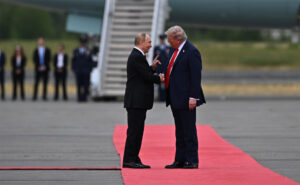


After months of being played by the Russians, it seems US President Donald Trump has had enough. On 23 October the United States has fully sanctioned Russia’s largest oil firms, barring interactions with US firms and corporations. Here’s what it means, what’s at stake, and what’s next.
Transcript
Hey all. Peter Zeihan here coming to you from Winona Terrace in Madison, Wisconsin. Just had some fried cheese curds for breakfast because, duh. Today, it’s the 23rd of October, and we have to talk about what just went down between the Trump administration and the Russians. Trump has been trying to force the Russians into a peace deal.
It’s not going to happen. The Russians, see the war in Ukraine as the start of a broader geopolitical offensive that they need in order to survive through the century. The right, basically, it’s a border issue and a demographic issue. They didn’t do the Ukraine war on a whim. They didn’t do it to satisfy someone’s ego.
They did it because they think they need it to survive. Anyway.
Trump is attempting to put a stop to the conflict. And so the Russians have been stringing him along, making him look like a fool and then going back on everything they agree on. Anyway, Trump has had enough of it, apparently.
And today Trump put sanctions on the two largest oil companies in the country. One of them is Rosneft, which is the state owned monopoly or near monopoly. And the other one is Lukoil, which is technically a private firm but takes its cues from the government.
Full sanctions, which basically means that any American national cannot do business with any of these companies. The impact on the United States is going to be limited to Lukoil at the moment. Lukoil has a number of gas stations, service stations throughout the country, about 150, and supplies crude and gasoline to the U.S. market in a limited way. Rosneft is different. Rosneft is does all of its business in Russia. It’s not particularly sophisticated company.
It just happens to be large and it’s absorbed pretty much all of the activity in the former Soviet Union that it could, So direct impacts on, Rosneft are somewhat limited. There are some projects that Rosneft and Lukoil have with American firms in the former Soviet Union, however, not Russia proper, primarily in Kazakhstan. There’s a super field called Crouch Cannot that does natural gas, oil and condensate.
And then there’s the super field of Tengiz, which is on the shore of the Caspian that ExxonMobil is very involved in. If these actually get shut down, you’re talking about multiple billions of dollars of loss for American companies. In the case of Lukoil, they’ve put over $20 billion of investment in this thing over the last 30 years. Now, I would argue that all of this was going to go down anyway sooner or later. the Kazakh crude that was coming out of Kazakhstan was always going to go away. The route is just to secure this, you have to go through, not just difficult parts of Kazakhstan, but then through Russia to get to the Black Sea, to load on a shuttle tanker, to get out to sea, Istanbul.
Eventually you get to the Mediterranean, we can get on a bigger tanker and eventually go around Africa or through Suez and eventually get around India. You know, it’s just it’s a crazy route. It only works in a fully globalized, safe world, and that’s not where we are anymore. So this was all going to fail anyway. But at some point you rip off the scab and it looks like we might be there now.
This is not enough to even remotely make the Russians consider changing their point of view. The only thing that might, might, might get their attention is a full embargo by the United States and the Europeans that prevents any crude and any natural gas from leaving Russia whatsoever. That’s going to require a lot more than just this. But it is the first time that the Trump administration has done anything that isn’t even marginally inconvenient for the Putin government, and it’s going to be interesting to see how the Russians respond to that the next stage, because I don’t think this is going to generate the effect that Trump wants is to look at something called secondary sanctions, which is something that the United States kind of has a bad rap of with the wider world. Basically, we don’t like you, so we’re going to sanction anyone who does anything with you. Iran has always been the key target of that. And secondary sanctions have often targeted a few, European companies here and there. Well, the Europeans really don’t like the Russians right now.
So if we get secondary sanctions, they’re probably going to go against countries like India and China. And then we’re in a very different environment. We’re not there yet. But this result is, from the Russian point of view, relatively minor. And it’s not enough to seriously get their attention. And so if Trump is serious about pressuring the Putin government, that is the next step.
The question, of course, is whether Trump’s cabinet and institutions can handle that. We still haven’t seen Trump build out the government. It’s still be cleared out. The entire government. When he came in, he still hasn’t replaced most of those positions. And implementing the secondary sanctions requires a lot of legwork in a lot of places. Unless you just want to say, I’m sanctioning everything in China, which would be, you know, notable.
So he’s probably gonna have to find some sort of hybrid approach, and he’s probably gonna have to create it from scratch with minimal input from a team that largely doesn’t exist. So we’re seeing in real time some of the weaknesses of the Trump administration’s ability to implement policy. But again, we’re not there yet. That’s probably a challenge for next week.