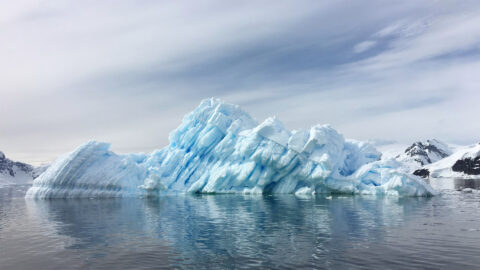

As sea levels rise, the infrastructure that protects shorelines and prevents coastal flooding will become essential, especially for low-lying countries with more coastal exposure.
Global temps are on the rise, so the ice is melting quicker, and stronger storms are ravaging coastlines. Any country with large population centers near water should be concerned. So, places like China must adapt through coastal infrastructure, similar to what you can see behind me here in Italy.
Transcript
Peter Zeihan here, coming to you from the port of Vasto on the Adriatic. And today we’re going to talk about sea level, specifically. These guys down here see these geodesic shapes? These are the types of things you use if you want to protect a coast from storm surges. And especially if you’re looking to reclaim land, the Koreans use them to great effect.
Almost invented the technology, actually, back in the 1950s and 1960s, when they reclaimed huge swaths of their bays where there are big currents that go back and forth. The idea of these things is because they can interlocked on like a normal blocks. Let me show you the other side here. If you’re not worried about current so much, you just use big squares.
That’s all you need. But if you’re worried about currents and movement of water, you need something that’s going to lock together. And then you can either dredge if you want a deeper channel or fill it in if you’re trying to reclaim land. Anyway, the reason this matters is over the course of the last century, we know that temperature record has indicated an increase of about 1.2 1.25°C over that period, with the rate of increase jumping significantly since 1990.
Now, for those of you who know your economic history, from roughly 1820 1850 until roughly 1970 was the industrial age, but not everyone industrialized at the same time or the same pace. It was really just the Americans and the Western Europeans, and then the Japanese and Korean and Taiwanese. But once you fast forward to 1990, the entire developing world joined in with, of course, India and China being the two biggest contributors to economic growth in that time.
With the Chinese now having industrialized so much that they are kicking out significantly more carbon every year than even the United States and the Europeans together at this point. Anyway, what that means is a lot of ice around the world is leaving. I’m obviously in Italy right now, and I’m hearing stories from folks in Umbria. That’s the central region to the northeast of Rome that they haven’t seen meaningful snow now in over a decade.
And they used to actually have quite a few issues with snow and avalanches. Anyway, the reason I’m bringing up this is because we’re in a situation where the seas are getting higher and the storms are getting a little bit more intense, probably related as well. And this is really a problem if you happen to live near the coast, roughly 6% of the human population lives within five meters of sea level.
That’s about 16ft for you Americans out there. And the single largest concentrations of those people are the People’s Republic of China, with the areas around Bohai Bay and especially Shanghai being the most exposed. So you’re going to be seeing a lot more things like this as people try to break the energy of the sea before it can punch through and actually drown them.
This is something that is going to just become part of everyday life. As humanity attempts to adapt to climate change. A couple things to keep in mind about climate change in general. People talk about solar and wind. You know, that’s all well and good, but the material supply chains that are required to make that work at scale just don’t exist and can’t exist.
We do not have enough copper and zinc and nickel and the rest to really even try. And even if we did, everything is so spread out around the world that you need significantly more players to make it work than what you need for fossil fuel systems. And if we break down globalization, that’s absolutely not going to happen. And if we break down globalization, we will stop using some of the lower carbon fuels that we are currently using, such as well, and gas.
And we will switch to things that are more proximate because the alternative is to not have electricity. And that means a lot more coal and would be in burn, which is only going to speed this whole thing up. And then instead of talking about the five meter line, we’ll be talking about the ten meter line. Luckily, that for now is a problem for a different decade.