OPEC Production Deal, or Price War 2.0?

After the better part of five days of marathon negotiations spearheaded by Saudi Arabia with the goal of eliminating coronavirus-induced overhang in oil supply, global oil producers hammered out April 12 an agreement to reduce oil output by a record 8.5 million barrels a day.
 
The short version is the deal is a joke. I could spam readers with a full newsletter on just how much a joke it is – it relies upon cuts from countries who have never cut before, not all OPEC states are participating, it expects the Russians to cut as much in exports as Kuwait exports in total, the plan is to not begin the cut until May and then start rolling it back only two months later – but really it comes down to something far more basic:
 
Oil traders, the folks who probably have the best feel for just how much demand has dropped, estimate the global oversupply is now between 30mbpd and 35mbpd. Simply the reduction in demand for jet fuel is probably about 5mbpd. The OPEC cut is only for 5.6mbpd with another 2.9mbpd coming from non-OPEC members. Even if everyone plays along, this just isn’t enough to make a difference.
 
Which pushes the discussion to other directions. The world is running out of storage capacity. We’re really not quite sure how much spare storage exists in the world since everyone measures it a bit differently, while countries like Saudi Arabia and China are notoriously squirrely about just how much they have stashed around the world. Industry guesses as of the end of March ranged from 1 billion to 2 barrels, so I’m just going to split the difference and call it 1.5 billion.
 
If everyone sticks to the OPEC plan and if that 1.5 billion figure is correct and if the oil traders know what they are talking about, then all global storage is filled to the brim by early June at the latest. Should the OPEC deal collapse and everyone just keep pumping, zero-hour moves forward to roughly mid-May.

Or maybe sooner.
 
The quick and dirty of the backstory is that in addition to the coronavirus-induced demand collapse, the Saudis are engaged in a price war with the Russians. In every agreement the Saudis have hammered out with the Russians since the Soviet collapse, the Russians have never actually cut and simply made the Saudis eat the difference. Similar attitudes have prevailed in Venezuela, Iran, Nigeria and Iraq – the first two of whom are not even included in the cuts agreement.
 
Ok, on with the show.
 
On April 13 the Saudis announced sales prices for their crude shipments. They added $5 a barrel to their asking prices for American deliveries, but cut their asking prices for Asian deliveries.
 
US President Donald Trump has been aggressively lobbying the Saudis for a significant production cut in order to help US shale producers. While the April 12 OPEC agreement will likely keep Trump off the Saudis’ back for the time being, the change in contract prices is far more significant. They suggest the Saudis are going to stop dumping crude oil on the US market, so that the shale producers don’t drown quite so quickly. Add in that roughly half of all remaining (known) oil storage is in the United States, and most American shale producers won’t be facing chock-full infrastructure until at least late-summer. Any sort of output reductions in the American shale patches, whether caused by rapid well-decline rates or deliberate shut-ins, will extend that deadline out further.
 
But simultaneously, any Saudi crude that is not being shipped to the Gulf of Mexico will instead be steaming towards Asia, intensifying Saudi Arabia’s price war in countries where Russian and Iranian and Nigerian and Iraqi crudes feature. So the price war lives on, just in a more constrained economic geography. We could see a complete overload of Eurasian storage capacity in a matter of a few weeks.
 
All in all it’s a pretty shrewd play by Riyadh. Lead an agreement you know the Russians will violate in order to provide political cover. Reduce flows to the United States to get Donald Trump off your back. But redirect those flows to places that will really hurt your Eastern Hemispheric competition.

While things look rough for oil futures, it’s not all bad news! One area where the US supply chain is particularly resilient is regarding its agriculture. US farmers, food processors and grocer/retailers are in the strongest position in the world to continue delivering food supplies to American consumers. While consumption patterns and panic-induced hoarding will continue to empty shelves at local stores, all elements of the US supply chain have been able to continuously restock — and will continue to do so. 
 
If you have more questions about the resiliency of the US Agricultural supply system in the face of pressures due to COVID-19, join Zeihan on Geopolitics’ Peter Zeihan for an in-depth seminar on April 20, 2020. 

REGISTER HERE

Future planned invents include:

  • Transport and Supply Chains
  • Manufacturing
  • Industrial Commodities

The Shattering of Global Oil

Oil demand is relatively inelastic. That’s a fancy-schmancy economic term that means people and firms’ energy demand doesn’t vary very much from day-to-day or even year-to-year. Driving to work is perhaps the most accessible example. You do it every work day. If you don’t, you don’t work. And so you drive. Your gasoline demand is stable. Inelastic. Doesn’t matter much if gasoline sells for $1 or $4.
 
On the price side, this means the “normal” rules of supply and demand barely apply. Even minor shifts in supply or demand have wildly outsized impacts on price. We’re used to seeing this as a shortage. China booms and oil prices go up. Iran and Iraq go to war and prices go up. Derivatives trading enters the world of oil and prices go up.
 
But such lopsided impacts also work the other way. In 1991 when it became apparent that the first Gulf War would be a cakewalk and threats to oil supplies were not going to manifest, prices collapsed. They did so again at the beginning of the 2007 subprime real estate crisis after being on a multi-year tear.
 
And now coronavirus is introducing the greatest shift in oil pricing in history. Based on who is making the guess (because no one really has good data yet), coronavirus-instigated quarantines have reduced global oil demand by somewhere between 15 million and 35 million barrels per day out of a pre-crisis level of 100 million. Global prices have plunged to as low as $20 a barrel thus far, and they have (a lot) further to go.

In the past, OPEC has often attempted to micromanage oil markets by adding or subtracting bits of crude. But never before have such changes occurred on anything but a multi-month time-frame, and never before have such changes shifted the balance by more than a couple million barrels at a time. Coronavirus’ impact is already an order of magnitude more than OPEC’s greatest action, and it all happened in just three weeks.
 
This evisceration of demand, the sheer scale of imminent producer collapse is only the beginning. Deepening economic dislocation combined with the greater regionalization of a post-COVID world means oil demand – and global energy markets – will never recover. Join Peter Zeihan April 10 for an exploration of the path forward for the global energy sector, with a heavy emphasis on which producers might be able to stay the course, and which we may not hear from for years.

REGISTER HERE

Future planned invents include:

Coronavirus: The Energy Guide

As a rule I try to stay out of discussions about energy prices. Energy trading is a hectic business with a lot of stress, plagued by fleets of hot-headed issues that have nothing to do with supply or demand or technology. But that’s not the problem today.

Continue reading

The Oil Wars Are Going Viral

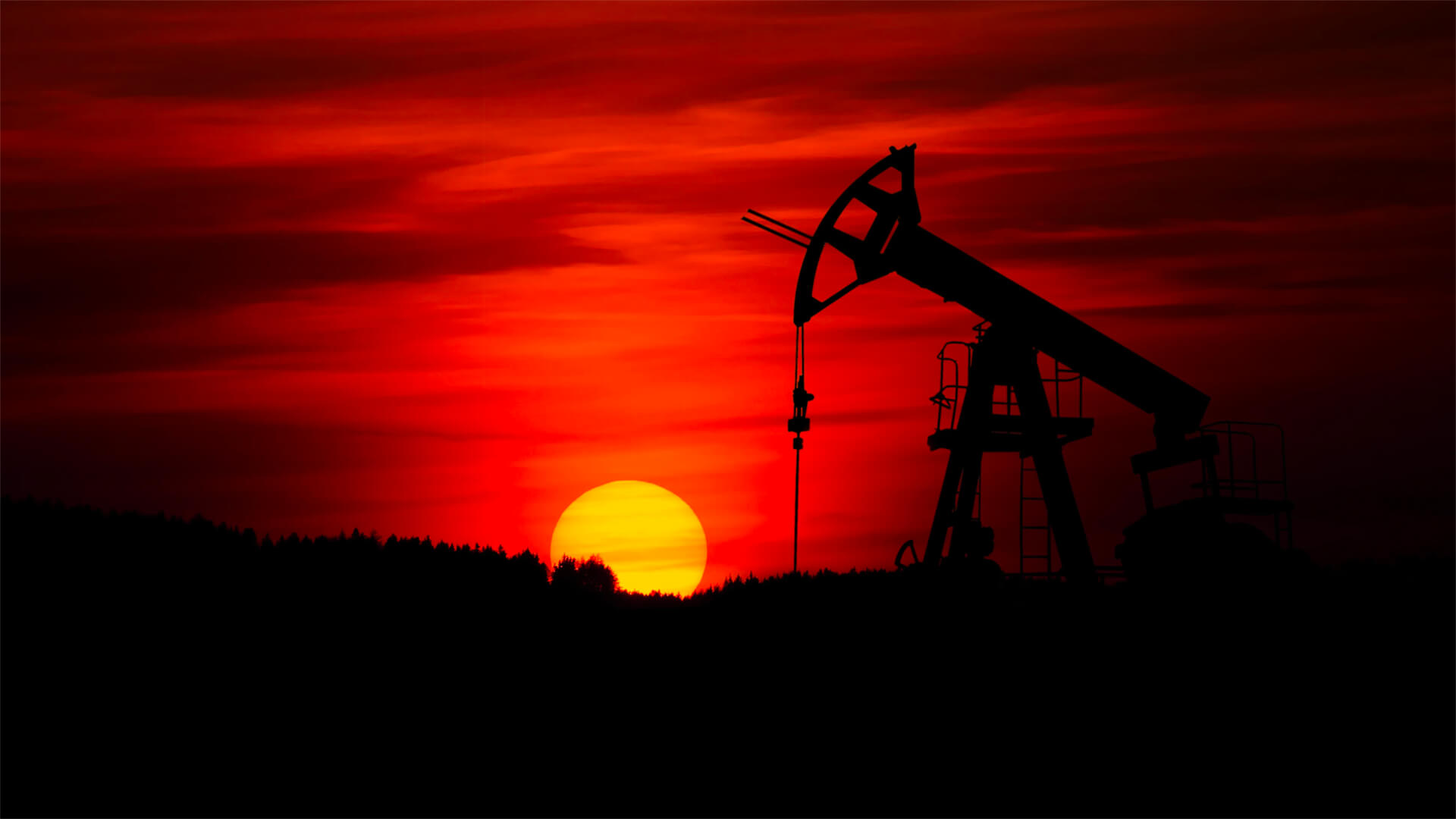
Photo of a pumping station at sunset

We just had the second-biggest oil price drop on record as Asian markets opened March 8.

For the past couple of weeks the Saudis have been attempting to cobble together an oil production cut of about 1.5 million barrels per day. As of last Friday, they had been sufficiently successful to get buy-in from the bulk of both OPEC and non-OPEC members, but there was one niggling hold out: Russia. On March 7 any pretense of a deal collapsed and the Saudis committed to flooding the market. First, they lowered their asking prices for crude being shipped to Europe and Asia. Second, they announced plans to quickly ramp up output from some of their spare capacity.

There was a hilarious day-long window where the Russian propaganda machine seized control of the narrative and fooled a host of financial reporters into proclaiming that Russia was going to war with the U.S. shale industry. It is difficult to delineate just how incredulous such a claim is since U.S. shale output has a lower production cost than Russian crude, but hey, people fall for propaganda allll the time. 

The primary reason I laughed when I read those breathless headlines is that the Russians couldn’t launch a price war even if they wanted to do so. The problem is all about location. Much of Russian production happens on difficult land that can turn swampy in the summer and freeze solid during the winter. If those wells are shut-in, particularly during the winter, the risk of well damage (up to and including explosions!) is high. In the truly frozen sections of Russia, when the time comes to restart production, you can’t just turn them back on. You must re-drill them. In winter. Likely the following winter. 

Russia has never cut production on purpose. Its “cuts” in 2019 were nothing more than some seasonal maintenance. The last time the Russians actually reduced output it was the Soviet collapse. It then took Russia nearly two decades to get back to where they had been. 

Much of Russia’s power in the world, triply so in Europe, has to do with energy politics. The Continent counts Russia as one of its top three energy suppliers in any given year, and with the Brits now out of the EU that dependency will increase. Moscow (rightly) sees the American shale patch as a threat to that influence and so has sought to use propaganda to thwart the sector where possible, up to and including bankrolling some American environmental groups to lambast shale (ask Michael Moore and Jill Stein for details). 

And at least to a degree, some of the Russian scuttlebutt on all things oil and shale are correct. The Russians supposedly have been ranting of late that the last round of Russian/OPEC oil output cuts in 2019 simply provided more market share for American shale to fill. That’s totally what happened. 

Anywho, the Saudis made the reason for their moves crystal clear late March 8, saying they would compete for market share at every point they can reach where the Russians currently sell their oil, with the intent of underbidding any Russian offers. Saudi Arabia is nearly unique in that it can turn production on and off on a three-month time scale. Most other countries can’t, and certainly not the Russians. In fact, the only oil production zone in the world that can adjust faster than Saudi Arabia is…the American shale patch, where new wells can come online in under six weeks, and where depletion rates are measured in months rather than years.

We’re already scraping the $30 a barrel level. That’s the number where about two-thirds of U.S. shale operators find themselves crying themselves to sleep at night. Even worse (or better based on your point of view), oil prices are likely to remain lower for longer.

The first reason is the most obvious: 

Courtesy of the spreading coronavirus epidemic, best guess is nearly half of the Chinese workforce is still off-line this week, and much of China’s industrial plant remains shut-down due to quarantine efforts – most notably in the industrial heartlands of the Yangtze Valley and the Pearl River Delta. China is undoubtedly going to suffer a real recession this year, which will absolutely impact manufacturing supply chains as well as the supply of consumer products globally in the second and third quarters. Chinese oil demand has probably dropped about 2 million barrels per day. 

Avoiding additional widespread infections throughout the rest of China is probably statistically impossible at this point, and it is spreading globally like, well, a virus. Iran, Italy, Switzerland and South Korea have robust epidemics that have erupted in just the past two weeks. Follow-on epidemics are all but certain in France, Germany, the United States, Canada and, well, nearly everywhere else later this month and into April. The virus tends to hit less harshly than a cold in 6 out of 7 cases and is not particularly lethal if you are under age 70 and otherwise healthy, so CALM DOWN, but for everyone’s sake follow normal sanity about exposure and hygiene. Following sanity means less movement and travel and interaction and since oil is the fuel of transport, that means less oil gets used. Everywhere.

The second reason is more…colorful. Riyadh and Moscow have rarely gotten along, with their biggest big blow-up occurring at the instigation of none other than Ronald Reagan. In the mid-1980s the Saudis expanded oil output in order to wreck the overextended finances of the Soviet Union. It was part of a collage of factors which heralded the Soviet collapse. With the Russians increasingly active in Iran and Syria and Iraq and Afghanistan, the Saudis have plenty of reasons to dust off an old tool and whap the Russians on the face.

The third reason is more…personal. With the Americans stepping back from the world, the Saudis are finding themselves facing off against the Iranians without the American buffer between them. The Trump administration’s anti-Iranian sanctions are strangling the Iranian economy, an economy that survives on oil exports. Shrinking what little income Iran is still getting via a price war isn’t a dumb move.

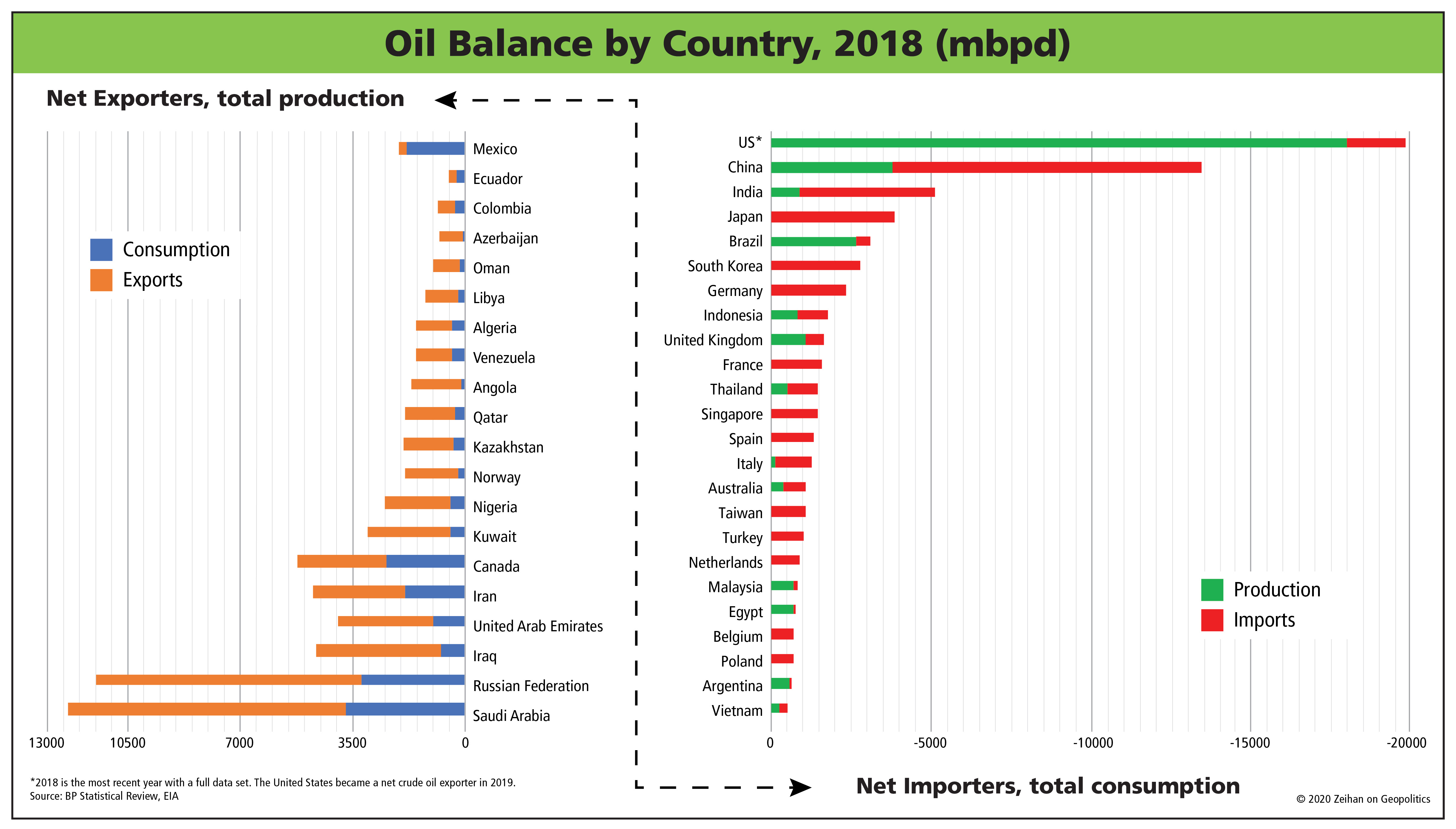
The fourth reason is simple economics. Saudi Arabia is annoyed not simply by Iran and Russia, but other oil producers which range from Venezuela to Ecuador to Libya to Nigeria to Angola to Norway to Azerbaijan to Kazakhstan to…American shale. Saudi Arabia has lower production costs than them all. Anything that takes the snuff out of the competition is something that’ll make the Saudis smile. Of all of these, U.S. shale will bounce back fastest, but there will be a lot of bankruptcies and consolidation between here and there. Other countries will face outcomes far more painful. 

The final reason is less about economics and local strategy and more about resetting Saudi Arabia’s position in the world. The Syrian Civil War is in its final chapter. The Iranians and Russians are on the winning side…while the Saudis are on the losing side. If Russian-Saudi relations are already deteriorating, it doesn’t take much of a push for the Saudis to remind the Russians (and everyone else) that there is another field of competition – one in which the Saudis excel and the Russians (and everyone else) do not.


My new book Disunited Nations: The Scramble for Power in an Ungoverned World published March 3. It features a whole section on Saudi Arabia’s attempts to reassert itself and, when it can’t, burn it all down.

READ THE INTRODUCTION TO DISUNITED NATIONS