
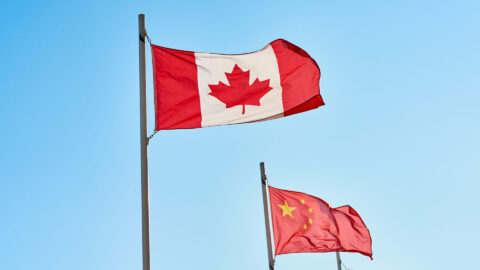

Canada’s prime minister, Mark Carney, recently visited Beijing. This trip sparked rumors that Canada was ditching the US and buddying up with China instead. Let’s pump the brakes a bit.
On paper, all that came from this meeting was China lifting punitive tariffs on Canadian canola and Canada easing restrictions on Chinese EVs. Canada knows that it can’t replace the US with a distant partner like China, but it could be stacking chips for the upcoming NAFTA renegotiations.
With Trump signaling indifference to NAFTA’s future and possibly favoring bilateral deals instead, it’s smart for the Canadians to have some bargaining chips when the time comes. Especially with how messy these negotiations might be.
Transcript
Hey all. Peter Zeihan here. Coming to you from Colorado. Today we’re talking about our northern neighbors, the Canadians. Prime Minister Kearney recently completed a trip to Beijing. And in the aftermath of the Trump administration, going off the rails a little bit when it comes to trade in the alliance and threatened to invade Greenland, which is a territory of an allied, nation.
A lot of the talk out there is about Canada finding alternatives, and a lot of people are talking about Kearney’s trip to China. In that light, and they’re not completely off base. But we need to keep a sense of perspective here. While there were lots and lots and lots of documents and memorandums, signed, on everything from agriculture and manufacturing detect IP.
Really, there are only two takeaways from the entire trip. The first one is that Beijing will stop charging exorbitant, punishing tariffs on Canadian canola exports. Canada is by far the world’s largest exporter of that sort of thing. China has always been the single largest consumer. And so in the past, when Canada has done things like help out the Americans with sanctions regimes or, say, arrest somebody who’s violating Iran sanctions, the Canadians have been punished by Beijing as an arm of the United States.
So at least that one piece now is undone. Second, if you remember, back during the Biden administration, the entire world put massive tariffs on Chinese electric vehicles because the Chinese were subsidizing their production and then dumping up on the market with the intent of bankrupting everybody else’s, production. That has now been scaled back. The Canadians will allow, instead of having 100% tariff on all Chinese vehicles, will allow about 50,000 in, this coming year, at a much lower tariff rate, something like 6%, and then ramping that over five years to 70,000.
Not a huge opening, but for the Chinese who have basically have oversupply across the market, getting every little bit out helps and that’s it. And you know, I hate to break it to you, if you’re looking for me to make a mountain out of a molehill here, but the future of Canadian canola and Chinese EVs, when they’re already banned in most countries isn’t what an alliance or an economic relationship is going to turn upon.
But there is an angle of to this that is, of course, Trump, because we’ve now had a year of all Trump all the time. And it’s really pretty straight forward, this calendar year 2026, the Americans, the Mexicans and the Canadians renegotiate the NAFTA two treaty. If you remember, NAFTA started back in the late 80s, was ratified and implemented in the 90s under Clinton and then was renegotiated under Trump, won.
Now it’s time for the five year review where everything’s up in the air again and nations are starting to lay out their opening positions. Overall, the NAFTA accords of all variations have been very, very good for the United States and most of the growth we’ve seen in manufacturing over the course of the last 30 years has been because of NAFTA.
And it integrates Canada, Mexico and the United States into a single manufacturing space, especially for automotive. In fact, you would really not be able to make any vehicles in the United States right now without that integration. Basically, think of Canada as a partner to Michigan and Auto Alley, where parts are going back and forth across the border all the time.
Anyway, the Trump administration. Let me rephrase that. Donald Trump personally has said that he doesn’t care about the future of NAFTA, although the Canadians, of course, want it. He might just want a bilateral deal with Mexico or a separate bilateral deal with Canada. That is a potential form that this could all take. But the bottom line is that countries are starting to get their chips in order for the talks.
And you should look at Carney’s trip to China in that light. It’s not that Canada has really any other options for a big trading partner like the United States. There isn’t one all provinces, but two in Canada trade more with the United States than they do with one another.
And the two exceptions. One of them is Prince Edwards Island, which is basically a retirement community that lives on government handouts from Ottawa and the other one is British Columbia, where its primary trade partner isn’t the rest of Canada. It’s the East Asian rim, and they serve as the import point for everything that flows into the rest of the country.
So there isn’t an option here for Canada to go anywhere else. It’s the tyranny of geography writ large. But the same is true for the United States. Right now, the United States gets access to the workforce in Canada and the infrastructure in Canada without having to pay for any of it, which is about as good of a deal and a trade deal as you can get.
I mean, it’s pretty awesome. They pay for all that weird socialism they have up there. We get all the manufacturing benefits. It’s great. But that doesn’t mean that is how the American administration sees it. So Carney is trying to find some things that he can trade away. And at the end of the day, with the Chinese facing demographic mortality, in a way that is historically unprecedented, combined with the general anti-Chinese position of Washington, it makes sense that you get some Chinese chips that you can trade away because you don’t care about them.
And it’s a reasonable strategy whether it’ll work or not, of course. Depends upon how the negotiations actually go. On both sides of both borders. The big problem we’re going to have here in the United States is that the US Trade Representative Office still hasn’t been staffed out to carry out normal operations, much less the 200 plus trade agreements that the Trump administration is trying to simultaneously negotiate.
Hopefully, NAFTA will rise to the very top of that to do list when the time comes. But at the moment there is a very real bandwidth problem. All right. That’s it for now. See you next time.