The Federal Reserve’s Dilemma

Photo of the building of the US Federal Reserve

The Fed is facing a catch-22. While they would typically lower rates when consumption and growth begin to slow, there are also competing policies that are shrinking the labor force and driving up costs via tariffs. Other countries have faced similar dilemmas due to demographic issues, but the US is in this pickle largely due to policy decisions.

With record deficits and no political will to cut entitlements, cooperation between Trump and the Fed isn’t going to happen. So, the Fed is stuck between a rock and a hard place…

Transcript

Hey all, Peter Zeihan here. Coming to you from a breezy Colorado. This week we have a Federal Reserve meeting in D.C. where they’re going to decide what to do with interest rates. The idea is, if you lower interest rates, you reduce the cost of capital, which spurs economic growth, whereas if you raise interest rates, you dampen demand, which tends to get inflation under control and balancing growth versus inflation. 

That is basically why the Federal Reserve exists and why we have monetary policy in the first place. The real problem the Federal Reserve is facing right now is policy out of the white House. The combination of high and rising tariffs are increasing the cost of operation for American businesses and increasing purchasing costs for American consumers, which is reducing economic growth. 

At the same time, anti migration policies the Trump administration has implemented is shrinking the labor pool to the point that the American population is actually expected to shrink this year for the first time in American history. And that is triggering inflationary pressures throughout the supply chain that are complemented by the tariffs. So tariffs like 50% tariffs on steel, aluminum, copper drastically increase the cost of building for, among other things. 

And so the fed is kind of in a catch 22. The slower growth caused by the tariffs on the consumption side would seem to indicate that it wants to lower interest rates to spark growth, but the higher inflation, because of the tariffs and the immigration policies are raising the cost of everything or raising inflation, suggesting that the Federal Reserve should, if anything, raise rates in order to keep inflation under control. 

And there is no way to win this, there’s no way to make everybody happy and there is no balance to be found. So the Federal Reserve is in a catch 22. Now, this is not a unique situation. If you go back to the last 20 years in Europe and Japan, we’ve had somewhat similar situation, but largely caused by demographic issues as populations age out of the 2030s and 40s and into their 50s, 60s and 70s, consumption naturally goes down and eventually you lose people from the workforce on the tax base altogether. 

And when that happens, monetary policy is not nearly as useful tool. And you’re dealing with exactly these same issues, chronically lower demand and consumption because the population is getting poorer and older and ongoing inflationary pressures as the labor force shrinks. The difference between the European and the Japanese experience and the American experience is in the European. In the Japanese experience, it was primarily a demographic issue, whereas in the American experience, at least so far this year, it’s primarily a policy issue. 

Now, what has happened in the United States in the past is the Federal Reserve chair has sat down with the American president to discuss priorities and what it takes to get what you want. This was most famously done by Federal Reserve chair, former Federal Reserve Chair Alan Greenspan and former American President Bill Clinton back in the 90s, where the discussion was, if you can keep the budget under control, if you don’t do a lot of deficit spending, then I, the Federal Reserve chair, can keep interest rates low and generate a boom which lasted for the better part of a decade. 

Unfortunately, that is not possible this time around, and not just because the president doesn’t like the Federal Reserve chair. The other problem is simply that the fiscal deficit we have today is bigger than we have had at any time in American history, with the exception of a couple of hiccups during war time and getting that deficit under control would require basically eliminating Medicaid and cutting Medicare and Social Security by half. 

That’s how overextended we are. So it leaves the fed in a no win situation. Governance is hard, especially when you’re a quasi independent institution like the Federal Reserve.

While I Was Gone, Part 3: Economic Status

Person using Forex trading on a laptop and phone

Today, we’ll be turning our attention towards the economic moves that the Trump admin made while I was away.

Intel was partially nationalized (10% government stake); this move supports semiconductor security but could also turn the company into a defense contractor rather than an innovator driven by profit. The Block Island wind farm project was completely halted…despite being nearly completed; this undermines US energy reliability, trust in government contracts, and the need for rapid energy expansion. And of course, Trump had to throw in an out-of-pocket personal attack with a Fed board member (Lisa Cook) over mortgage discrepancies, which is just another step towards making the Fed a political tool.

All these economic actions nudge the US further away from free-market capitalism, and closer to something where the government dominates industry, contracts, and monetary policy. However, experimenting with new economic models is inevitable, it would just be nice to let some other countries be the guinea pigs.

Transcript

Hey all Peter Zeihan here. Coming to you from a rainy lake of the Ozarks. We’re continuing our series on. What the hell were you guys thinking while I was gone backpacking? Today we’re going to talk about some economic issues in the United States. We’ve got three things that you guys decided were good idea to do. A certain green. Got three ideas that you guys decided were good ones while I was gone. 

The first one was that Donald Trump partially nationalize Intel. Intel is, of course, America’s premier semiconductor manufacturing firm, taking a 10% stake for the government. This does not give the United States a seat on the board, but it does obligate the United States to pay for a lot of R&D. And if your goal is to near-shore semiconductor fabrication, there’s some serious logic here. 

And if your goal is to deepen the government’s involvement in design and control the technology, there’s some logic there as well. But it does come at a pretty significant cost. When you start to nationalize companies, they treat the government as one of their stakeholders, and they start to optimize their operations to do whatever the government wants that might achieve a national security goal, perhaps, but it comes at the cost of the company basically letting everything else fly, and reducing the profit motive to actually make the company better. 

They become more of a defense contractor. So pros and cons, Second big item is that the Trump administration issued a cease order for the Block Island windfarm off the coast of Rhode Island, and it’s really hard to spin this as a positive. The money had already been allotted. Things have been paid for. Remember, you have to pay for green tech projects pretty much upfront. And so the financing was all in place. 

The project was already 80% completed and was about to start wiring power next year. And now it’s just completely stopped. So number one, this is an investment issue. Number two, this is a foreign investment issue because the Danish companies were involved. And number three, it’s a power issue for the eastern seaboard. But most importantly, the federal government has now decided to kill the project specifically because Donald Trump doesn’t like wind turbines. 

He doesn’t like the way that they look now. Wind turbines in the right spots are among the most efficient ways of generating power. This isn’t like solar, where the it’s dark half the year. Wind, especially offshore wind, is a very strong, reliable source of energy. But Donald Trump doesn’t like the look of them. So from the point of view of contract law, the federal government has now established itself as a relatively unreliable partner in the power sector. 

And no matter what your interpretation of America’s near term future, whether you’re like me and you see, we need to double size of the industrial space with your tech guy and you want to massively expand AI. Whether all you want to do is replace the old infrastructure with new infrastructure. The United States needs to expand its power grid by at least 50% over the next several years, and all of a sudden, the federal government is no longer a positive contributing partner to that. 

And everyone who is involved in government contracting in the power sector is now going to be wondering if there’s any reliability at all. That’s really bad. If you’re trying to do something quickly, because the federal government will always be the single largest economic entity in the United States. And now it’s got people wondering if they can be trusted of all, because there’s no scientific reason, there’s no economic reason, there’s no financial reason. 

There’s no national security reason for this contract to be canceled. It’s just been canceled because Trump doesn’t like the look of windmills. That is very, very Latin American. The third issue is that Donald Trump has tried to fire or has fired a woman by the name of Lisa Cook, who is a member of the Federal Reserve Board. Now, the US Federal Reserve is basically the central bank of the United States. 

They say interest rates and manage monetary policies in order to manage the American economy. And under existing law, you cannot fire a board member unless there’s cause. The cause that Donald Trump cited was that Lisa Cook now stands accused of falsifying some data, on free home purchases she’s made over the last 10 to 15 years. I believe. 

In total, the three mortgages in question have a total finance value of about $1 million. Have all since been paid off. And he’s saying that she lied about it being her primary residence in order to get a slightly better interest rates. And we’re talking here about less than a half a percent. This is kind of rich because no charges have been brought. 

It’s simply an accusation. No data has been presented. But Donald Trump has been convicted in a court of law of over a half $1 billion of real estate fraud. So you know, there’s a little bit of a ocracy here. Whether or not if she were charged and found guilty, is qualifies her as a being fired for cause is a really open question. It’s really questionable whether the Supreme Court would rule that way. And this is a court that will absolutely go all the way it up. But the core issue here is Donald Trump has found a way to remake the Federal Reserve in his own image. 

One of the problems that Trump is facing is a lot of the tariff policies that are in place at the moment are highly inflationary and are driving economic activity out of the United States by making the United States a less reliable partner in things like manufacturing supply chains in addition, things like steel and aluminum, copper tariffs to make it much more difficult to construct anything, whether it’s in the power grid or your house. 

And so we are set up for higher inflationary, lower growth environment moving forward. So Trump’s idea is if we can reduce capital costs significantly, then we will have more economic activity. And faster growth that people will get credit for. The Federal Reserve would never go for that because that would be wildly inflationary. Think about what happened under the Biden administration when we had a series of federal spending projects, none of which Donald Trump has really trimmed down. 

That dumped a lot of money into the economy post Covid and generated faster economic growth, but faster inflation because we saw demand go up and up and up and up without an underlying increase in supply. What Trump is doing is constructing supply and now trying to goosed demand with interest rate policies, achieving something that’s at least as bad, for political reasons, demand scarcity or a directed demand, something like that. It’s a lot like, like wartime mobilization, where the government takes a larger role in the system controlling the production, but it’s not driven by a crisis, is driven by a change in macroeconomic fundamentals, and it’s is focused on demand as it is on supply. 

And if that sounds not particularly capitalistic, that’s because it’s not even remotely capitalistic. But as we’ve seen from the Donald Trump administration so far, that is really not a major concern. Nationalizing companies, he sees as a plus, taking over direct control, personal control of the monetary authority he sees as a plus. And the sacrosanct nature of contracts is not something he seems even remotely bothered by. 

These are characteristics that have a lot more in common with, like the Latin American flavor of socialism or even modern day China. And one thing that they do not generate is efficiency, or private ownership or private decision making. But kind of that’s the point. 

So none of these steps are good. They all basically make the federal government part of the problem, in a way that five years ago we would have said something that the liberals prefer to do, but now Donald Trump is there. The reason that this bothers me so much, but the reason why I’m trying to maintain an open mind is that the models that we use to manage our economy and by our, I mean humans are changing and need to change. 

For the last century, we’ve basically had four overarching economic models. We’ve had free market capitalism, which is something the United States tends to champion. Not anymore. We’ve had a European social model that is more based on social placidity and equality, but doesn’t generate as fast of economic growth and as much economic dynamism. Europe, of course, is known for that. 

You get command communism, where you have a central authority that makes most of the economic decisions. That’s Maoist China, that is the Soviet Union. And then you have something called fascist corporatism, where there’s a fusion of corporate interests and government interests. And that’s classically Nazi Germany, but also like 1970s and 1980s Korea, maybe a little bit of, Japan and certainly China today. 

All four of these models are based on the relationship between supply and demand and capital and labor. And with the world going not just through a globalization phase, but a massive population phase, we are losing access to labor and capital in the volumes and in the ratios that we’re used to, because when people retire, they take their money with them and they are no longer working. 

So we’re seeing a change in the fundamentals that define our four economic models. And we need to try something new. What that something will be is very much in play. But what the Trump administration seems to be pushing us towards, whether it’s consciously or not, is something that’s kind of like a constrained, managed demand model where the government is the single largest player in determining who gets what, and because of problems with supply and consumption. 

They’re actively ratcheting down demand because there won’t be enough stuff to go around. But Trump is also constraining artificially the supply of product within the American market. So whether this, constrained demand model is something that is going to be a thing in the future, I don’t know, it’ll probably need to be a lot more cohered than what we’re seeing out of Washington right now. 

But it is something we shouldn’t reject out of hand because we know the old models aren’t going to work. The primary concern that I have at the moment is that the United States has the healthiest democracy of any major country in the world, which means we don’t need to make the adjustments first. We can wait to see what everybody else does first and then sort of pick and choose. 

The idea that we are needs to be the ones at the vanguard of this next phase of economic theory, I think, is a bit of a stretch. And if we are going to do it, I would like to see it be a system that is a lot more coherent and a lot more geared to American strengths and weaknesses than what we’ve seen out of the administration these last couple of weeks. 

Soooo…. 

Avoiding the Middle-Income Trap

Stacks of money coins and a green arrow pointing up. Increasing income and wealth.

There’s a point in many nations’ timelines where the per capita income stalls. This is known as the middle-income trap. And the way to avoid it is moving beyond basic manufacturing…

Success depends upon three factors: openness to foreign capital, broad-based investment, and the rule of law. Of course, you also need solid demographics to make this all sustainable. Countries like China will remain stuck because they have pursued the exact opposite of what is required. However, even countries that find the right mix (Germany, Ireland, South Korea, etc.) will eventually fail if the demographics aren’t right.

Transcript

Hey all. Peter Zeihan here coming to you from Colorado. Today we are taking a question from the Patreon crowd. Specifically, how do countries avoid the middle income trap and become advanced rich countries? For those of you who don’t follow economic development like I do, the middle income trap is this concept that you can build the infrastructure, you can get into manufacturing, you can make a lot of stuff for export, but you’re never able to cross a threshold of roughly 10 to $12,000 income per person. 

The issue is eventually you hit a value add point that you can’t push past. You can only take manufacturing so far because the technology will eventually provide more of the value add than the people. And so you’re kind of stuck in a situation where people are working in the factories. They can’t do anything more advanced because I’m not educated enough and the machines do more and more, which bleeds off some of the income and sends it to the people who own them. 

So if you want to get past that, you’re talking about graduating to a fundamentally different economic tier, and it’s a different sort of cultural and industrial structure than what you have as a mid tier manufacturing country. So for that you need four things, really three things on one to make it stick. First you need to be open, very open, almost painfully open to foreign capital. 

The cost of building the physical infrastructure in the industrial plant is a big part of this. And if you can allow the money to come in, do its thing and then take some of the money out once profits start happening, that generates a degree of openness in your system that will enable more and more people on the outside to assist with your development process. 

But it’s more than just building the plant because the plant is what comes first. The plant is what the foreigners are first interested in. But as your income levels rise, that capital can be used for other things like credit cards and mortgages, and you start building a consumption driven society. And when you get a more broad base like that, then you can see the numbers start to go up as people have off of the manufacturing industries and start opening up their own firms and doing their own value added work. 

So that’s one capital number two, investment, which can come from foreign money, doesn’t have to, but not just investment in infrastructure and manufacturing plant, but in more advanced things like education that gets outside of the technical fields, infrastructure that is beyond road and rail and industrial facilities, basically making the money available to invest in different sorts of economic activities that are related to more than just making widgets. 

Again, that broad based unlocks the creativity of the people, especially if you’re investing in creative education so that people can kind of take it from there. 

one of the big secrets of getting past the middle income trap, is that you have to let go, because the more that the state is organizing, yes, the faster you can move, the more national enterprises you can, conquer. 

But that’s not where real high end growth comes from in the long term. It comes from having millions of people who are making decisions every single day about what is best for them, and then they put their back into a way that they just don’t do on an assembly line. Let’s see, what was the number three, rule of law? 

If you’re going to move into a system where the state is not the sole decision maker, if you’re going to allow capital, have a degree of rights, you’re going to allow people to have a say in what they do in their own lives. You need a system that gives them a leg to stand on. You need a legal structure of rule of law where people know what the system is. They know what their rights are, and they can prosecute to protect them and defend them. 

if you stay with a kind of single tier manufacturing system, you’re never going to get that, because people always are going to be facing the risk of challenging the system just to do anything. So these are these three things. 

These are the big ones. And this is part of the reason why China just can’t advance past where it is right now. Foreign capital has always been a little stingy with it wants to keep everything under control. It’s definitely not rule of law. It’s law by rules and the educational system they’ve built excels at the technical side of things. 

It’s stuff you can memorize, but giving people the freedom to go after what they want is a political threat. And so China’s stock roughly at that 9 to 12,000 range, and they’re never to get past it. And, one of the big reasons that we know they’re never going to get past it is number four. And that is have babies. 

I mean, this doesn’t sound like much of an industrial policy at work with me here. When you have people in their 20s, in their 30s who are willing to work 60, 80 hours a week, yes, you get a lot of productivity from that and you get wealth generation from that, but you can only do that once because if by the time they get 40, if they haven’t had kids yet, they can’t work 80 hour weeks anymore, at least not with the same degree of regularity, their productivity starts to peak and then eventually fall off. 

And there’s no replacement generation. So it’s all well and good if you can push past $12,000 a person. But if there’s no one coming up from behind, then does it really matter? Part of the problem, the world with some of the countries that have beaten the middle income trap. 

And I’m thinking here about Germany or Ireland or Korea, is it. Yes. They’ve made these jumps. Yes. They’ve respected rule of law. Yes. They’ve been open to capital. Yes. They’ve expanded their educational systems, but they forgot that it doesn’t end with the current generation. And now some of these places are facing the sharpest contractions in birth rates and national prerogatives, in human history. 

Now, here in the United States, we’ve done this process over several generations. And the drop in our birth rate is something that really didn’t even start in any meaningful way until the 1970s. But we now we have drop below replacement levels, and we are also ejecting millions. But the plan for the current administration is to reject millions of people from the workforce who have higher birth rates. 

So the United States is in this weird little situation where we’ve done everything more or less right to this point, and now we’re looking around the world and figuring out what didn’t work and applying that in force. And if that keeps up for any number of years, that is something that we are going to regret for generations to come.

Trump Wants a Second Opinion on Labor Statistics

Businessmen figurines standing and sitting on top of colorful plastic blocks forming a bar chart from Envato Elements: https://elements.envato.com/businessmen-figurines-standing-and-sitting-on-top--2YBGNE8

Imagine you go to a doctor and run some blood tests. A few days later you get the results and don’t like them. What do you next? Maybe you start eating more Cheerios to help with your cholesterol. Well, Trump would just dump that doctor and find a new one who would tell him he’s perfectly healthy…at least that’s what he did to the commissioner of the Bureau of Labor Statistics (BLS).

The US is known for having the world’s most respected, apolitical data systems. Trump’s undermining of this system could jeopardize US policymaking for decades and is eerily reminiscent of what Hugo Chávez did during his rule in Venezuela.

Getting rid of the BLS commissioner is scary enough on its own, but couple that with the echo chamber in the White House and you have a full-on horror movie brewing.

Rewatch the video on Economic Indicators here

Transcript

Peter Zeihan here, coming to you from Colorado today. We’re talking about the U.S. economy from a numbers point of view. The issue is that a couple of weeks back, Donald Trump fired the commissioner of the Bureau of Labor Statistics, which is basically the institutional in the US government that generates a whole lot of the data that guides policymaking from a global point of view. 

U.S. government statistics are generally considered to be above world class. They’re by far the best on the planet because they’re differentiated, they’re apolitical, and the United States government collects touch points from local, state, and national policymakers in order to build a really good picture that businesses and government can use to help make decisions. Well, a number came out on new job creation that Trump hated, so he fired the head of the BLS within hours and says he’ll replace her with someone who can actually do the work, which is anyway, the idea are three things here. 

Number one, the idea that one person just decides what the day is going to be is beyond asinine. The only place that happens with any reliability is places like Russia, where they decide what the numbers are going to be before they publish them, and then just make them up. And they don’t even have a functional statistics section in the government anymore. 

The statistics are the end results of not just dozens of people, but thousands of people across the country. And the only way you can get a politicized justice stick is if you don’t just go after people at the head, but you go after the rank and file statisticians, which is something the Trump administration has already started, not just for jobs data, but GDP data. 

And that’s something that’s going to make it much harder for the US government to target policies for decades to come. It will take us a generation to rebuild that expertise. That’s problem one. Number two, if you’re going to get cheesed off about a statistic, this isn’t even the one you should be angry about. The jobs report is an estimate based on a series of estimates based on a series of surveys, which are in themselves estimates. 

It’s not a very realistic picture of the economy from my point of view. And it goes through phases of, revisions over three months. And so the idea that the number that Trump didn’t like is what it’s going to be like three months from now. I think it’s kind of silly in the first place. Anyway, if you’re looking for a more accurate statistic, you want to look for first time unemployment claims. 

So the jobs report indicates jobs that have been created, but based on estimates and estimates and estimates, the first time unemployment claims is based on people who have lost their jobs because they file for coverage. And that is a hard number. That’s a real number. So here’s the QR code. If that is a statistic you’re interested in. 

The fact that Trump doesn’t know this is concerning, because anyone who is working in, say, the Commerce Department is going to know which statistics are better than others, and the Commerce secretary is a guy by the name of Howard. Let make it will basically tell Trump anything he wants to hear. And so we have just gotten a very good example of the echo chamber that is developed in the Trump White House, where it’s not just that no one is speaking truth to power, it’s just the truth. 

Can’t even make it in the room in paper form. Okay, third thing, the president that is most similar to Donald Trump and going after the statisticians, isn’t g of China. Those people are dead. It isn’t Putin of Russia. Those people were let go 20 years ago. It’s Hugo Chavez, the deceased leader of Venezuela. When he became president in 1998. 

He basically went through the entire institutions of Venezuela, which at the time was generally considered to be the best well run of the Latin American states. High standard of living, good educational system, good infrastructure, pretty good policy. They basically had an oil largesse and they used it on the people. You’re crazy idea. And he basically went after the entire set of institutions that supported that system, root and branch, until the only information he got was the information he wanted to hear. 

It’s very similar to what we’re seeing right now. And if you look at some of the things that Donald Trump is doing with, say, energy policy, wanting to produce more crude, say, from public lands and only sell it to countries that he has a handshake deal with. This is very Hugo Chavez. Hugo Chavez would sell the crude at a discounted rate, only to markets that he was ideologically aligned with wherever they happen to be. Cuba, of course, with the top of that list, 

Donald Trump personally is basically setting up, trying to set up something similar where the crude is only sold to specific markets, where he feels he’s beaten them into aggressive submission with European Union. Be at the top of the list. That means less income by a significant amount and de facto subsidization of those countries for personal and political reasons. 

So this is not simply an issue of a few numbers. This is something that allows the US government to function, and allows it to function in a way that benefits the president. But until some people in the white House grow some spines and speak truth to power, which means I’ll probably be fired the next day, we’re probably not going to get a lot of that. 

Keep an Eye on Industrial Construction Spending

View above an industrial construction site

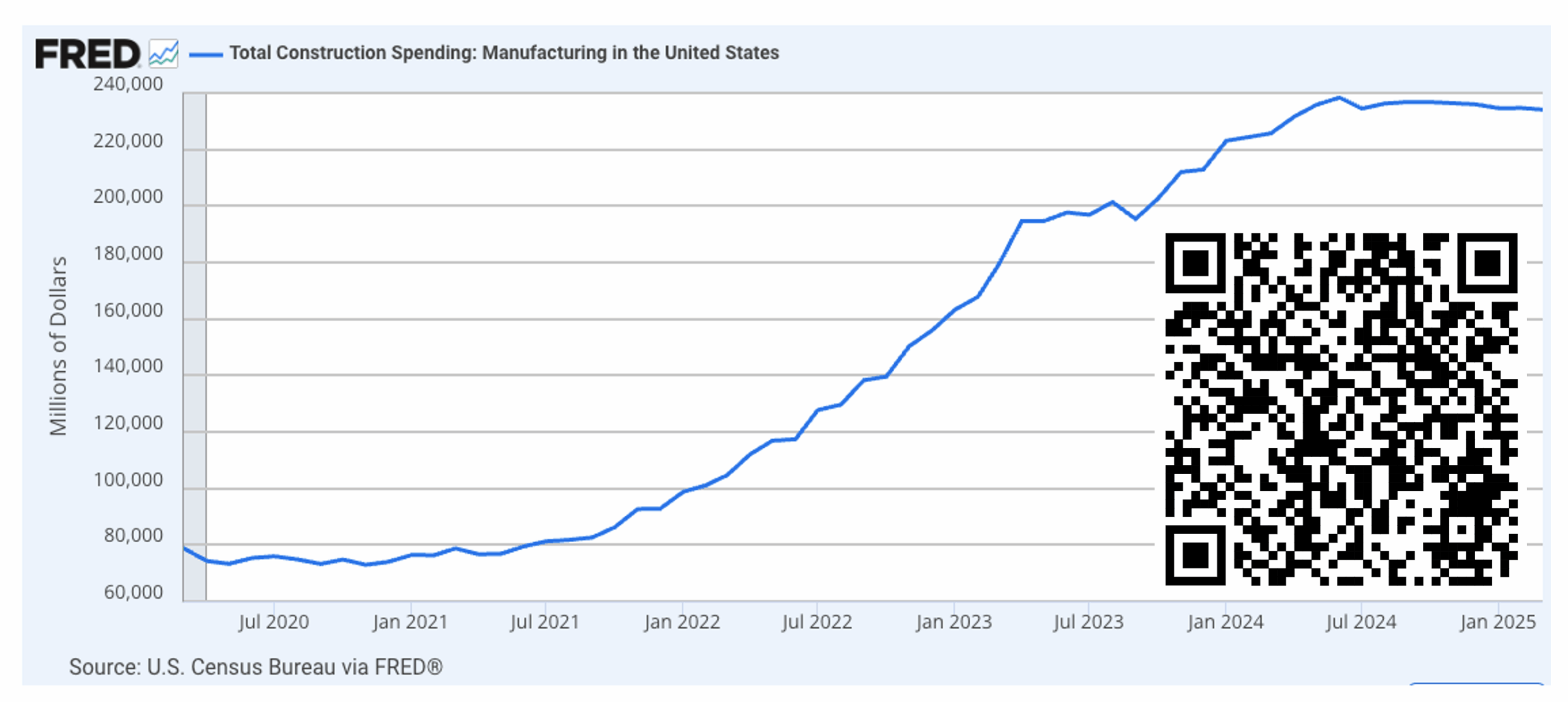
We’ve got another economic metric for y’all to keep an eye on. Today, we’re looking at total construction spending for US manufacturing capacity.

This metric helps us understand how quickly the US is preparing to rebuild its industrial base. Which, as we’ve discussed extensively, is going to be essential as the US faces deglobalization…and China going bye-bye.

But things are stalling. Trump has created a construction purgatory, and businesses are holding investments until they know the rules of the game. And as we prepare for the next chapter of the global order, a drop in construction spending could spell serious problems.

Link: https://fred.stlouisfed.org/series/TLMFGCONS

Transcript

Hey, all. Good morning. From the Front Range foothills above Denver. Today I’m going to talk about one of these other economic statistics that I’m following very closely in the current environment. And it is something that is collected by the Federal Reserve. It is called total construction spending for manufacturing capacity. Basically, it tracks how the United States is spending to expand its industrial plant. 

Now, if you’ve been following me for any time whatsoever, you know that I am concerned that we are not getting ready for the Chinese collapse fast enough and that we only have a certain number of years left, probably no more than eight. And that’s before you consider the trade war and some of the policies of the Trump administration, which are greatly accelerating China’s fall. 

So basically, if we still want manufactured goods stuff, we’re gonna have to make a lot more of it here locally. And that means a lot more factories. This statistic tracks exactly what we’ve been doing for the last several years. And if you start at the beginning in 2019, 2020, it’s Trump one. You’ll see that it was really low. 

And honestly, that’s pretty historically normal. But that number makes it Trump look worse than he is by far. And part of it is simply Covid. We didn’t know what the rules of the game, where we didn’t know how long it was going to last. We didn’t know if was gonna be a lockdown. We didn’t know how many people were going to kill, because if you remember back to the early days, something like 3 to 4% of the people who were getting infected were dying. 

And none of the treatments we had, especially in that early outbreak in New York, were working. It was it was awful. And nobody knew what to invest for. Then we have the Biden years where we had a lot of government spending to boost industrial production. And this makes Biden look better than he is, because while things like the Chips act and the IRA did put money into the system and did build industrial plants, only about 20% of that rise can be attributed to government spending. 

Most of that was actually American corporations realizing that something was happening with globalization that was not just a one off. It was a trend, and they needed to build more capacity here. And so we saw a steady increase for those four years. More lately, you’ll notice that it has flatlined again. And this you can blame on Trump. This is the tariff policy. 

At the time of this recording, we’re now at our 149th tariff policy since the 20th of January. And the rules of the game are changing every day, sometimes every hour. And so while everyone is completing the greenfield projects that they started, very, very few new projects have actually began. Any sort of construction and all of the deals that Trump likes to brag about. 

None of them have moved at all. So this is the number that matters from my point of view. Here’s a QR code so that you can watch it yourself with live releases. Whenever the fed updates its data. This number goes up. You know we’re moving in the right direction. We’re getting ready for a future that is inevitable, 

And if it goes down, then we are well and truly screwed.

Key Economic Indicators to Watch: Retail Sales

Photo of a economic chart trending downward

The last time we discussed numbers to watch, we talked about first-time unemployment claims as a recession indicator. This time, we’re talking about retail sales as a key economic indicator.

Consumer activity accounts for some 65-70% of the US economy, so it is probably worth paying attention to. Retail sales give us a slice of the pie, covering purchases of goods and services. Sure, it doesn’t include housing, healthcare, and B2B transactions and it comes with a 6-week delay, but hey, beggars can’t be choosers.

Below is a link to the website where you can look at retail sales in the US.

Link: https://www.census.gov/retail/sales.html

Transcript

Hey, everybody. Peter Zeihan here. Coming to you from Colorado. And today we’re going to take another question from the Patreon crowd. Specifically, how do I do what I do? And we’re going to talk about one of the economic statistics that I use to figure out where the world is going and what’s going on in the country at the moment. 

And that statistic is retail sales roughly 65 to 70% of the American economy is based on consumer activity. So anything that gives me some insight into that is something I’m all about. Retail sales is arguably the single largest chunk of that, but it’s nowhere near all of it. Retail sales is everything that you purchase, whether a goods or a service, up to and including vehicles. 

But it does not include things like health care and most importantly, housing, which for most people is their single largest expense. What it does is it gives us a relatively accurate picture in a sectoral breakdown on what Americans are spending their money on over a long period of time. So from a positive point of view, retail sales tells us what is up and how people are operating. 

But there are a couple really big drawbacks on the statistic. That means that you have to look at as one of a constellation of factors, rather than just the one thing that you look at. The first problem, in addition to, of course, the fact that it doesn’t include all spending like housing is it doesn’t include any sort of business activity. 

If it’s a business selling a service or good to another business that’s not in retail sales, it only covers business activities that go to consumers. So if you’re like me and you’re very concerned about an industrial and a manufacturing slowdown because of the Trump administration’s tariff policies, it’s not going to get you anything in retail sales. For that, you have to look for industrial construction spending. 

Second issue. It’s not a hard number. It’s an estimate based on surveys of thousands of companies. Which means that not only are you not getting a hard data point like you would with, say, first time unemployment benefits, which is another video we’ve done recently. 

It also means that it takes time to put it all together, because you have to wait for the month to complete, and then you do your surveys and your survey data back, and then you compile that into the overall number of retail sales. And so from the point that you start the process at the end of the month to the point that you have your final data point, it’s about six, almost seven weeks. 

So in just this last week, we got data finally about what went down in June and the June data was pretty good. It was a pretty strong expansion of retail activity, and after two months of negative growth, it was kind of a relief to see some activity with that probably meant is that we were on the backside of Trump’s just kidding. 

Tariffs where he originally had US high tariffs in April, which suppressed activity that continued into May, which suppressed activity. And then in May, he said, you know what, we’re going to give everybody a couple months to adapt to this, and we will revisit this in August. And so in June, the tariffs came off, people started spending again, and we got back to some version of normal, although I’m not sure what that word even means anymore. 

Anyway, June numbers came in looking pretty good, but we didn’t find that out until halfway through July. And again, it’s an estimate. So by the time we get to the other side of Trump’s tariff break in August, it’s not going to be until September that we have some idea of what’s going on. So it’s a great data point. 

It’s an estimate, it’s somewhat backward looking and it doesn’t give you the whole picture, but it’s better than nothing. So I watch it. And now with this QR code you can watch it to.

Here’s Why Inflation Isn’t a Solution

Photo of dollars behind American flag

Would inflation be good for the US? Sure, it could erode some of the federal debt, but if that’s the best we can come up with…yikes.

Technically inflation does reduce the relative burden of government debt, but only if economic growth and income outpace inflation. While the debt is shrinking, we’d also see all assets be devalued – including stocks, homes, bonds, and real estate. Basically, anywhere American have stored their wealth.

So, while it sounds appealing to reduce the $34 trillion of federal debt, everything else gets steamrolled in the process.

Transcript

Hey all, Peter Zeihan here, coming to you from Colorado. And today we are taking a question from the Patreon page and it’s specifically on finance. The person who’s been hearing that, some government decision makers and some folks, especially in the MAGA world, are talking about how inflation could actually be a good thing because it will inflate away the debt and make the overall level of payments of the US federal government has to make, relatively less compared to what they borrowed in the first place. 

And there is something to that. If you have a high inflationary period, then the relative value of the debt compared to what you actually got when you borrowed it does go down. And it does become easier to pay if, if, if, if growth keeps up. And so that income growth exceeds the level of the inflation. 

So problem number one let’s say that we get 10% inflation for four years. That comes out to a total of about a price increase. If income does not grow faster than that, you’ve actually dug yourself into a little bit of a hole. Some, careful how what you wish for here, because there aren’t a lot of people out there. 

Certainly countries that expand their income by more than 50% in four years. So the problem one, problem two, inflation doesn’t just whittle away at the federal debt, it whittles away at the relative value of everything. So think of a stock market that’s worth 50 trillion. Do you want to reduce that by half. Because that’s more than the US government owns in debt. 

Think about your house. Do you want that to be reduced? You know, that’s another $35 trillion for private single family homes, another 11 trillion for the bond market, not counting federal debt, of course. And another what is it, 15? 15 yeah, 15 trillion for say, commercial real estate, another 5 trillion for farm real estate. 

The point is that inflation doesn’t just hit one thing. So it raises the cost of living. And then if your income doesn’t keep up, life kind of sucks. So hurting all of these asset classes that pretty much all Americans have all of their savings in in order to whittle down the one debt class because, we can’t seem to get anyone in government who can do basic math. 

I would vote against this solution.

Watch This Number for Recession Indicators

Photo of the word recession with storm clouds overhead

Everyone, get your calendars out and draw a big red circle around July. Why? Because a recession could be coming.

The tariff war caused a huge drop in imports from China, with transpacific shipments falling to historic lows. Trump has since backed off the gas, but the supply gap could strain US inventories. If those stockpiles run out, a recession will follow in short order. And we can say thanks to the erratic policy for this recession, as consumer demand and investments have remained steady.

But the real point of this video is to give you a tool to monitor early signs of economic trouble: first-time unemployment claims. What we’re seeing right now is a rise in claims, when all other economic signs say that unemployment should be falling. There are some specifics and nuance to this, but it’s a good starting point.

Link to the tracker: https://fred.stlouisfed.org/series/ICNSA

Transcript

Hey all, Peter Zeihan here come to you from Colorado today. We’re going to give you a benchmark that you can evaluate for the status of the United States economic expansion slash recession. Quick reminder, I’m of the belief that July is going to be the critical month. And the reason is an 

interruption in shipments, of product from the rest of the world, most notably China, when Trump started the tariff war back in early April, we quickly got into a shouting match with the Chinese that saw bilateral tariffs go over 150% and cargoes just stopped moving. 

Functionally, it wasn’t a tariff was an embargo. And we have had more transpacific shipments canceled, since then than what happened during the entirety of Covid times five. So the last of the pre tariff ships arrived in New York at the end of May. And we’re now in this complete drought and probably in July, we’re looking at the consumption rate of the American economy overwhelming what was stored in terms of inventories from companies that kind of pre surged imports into the country. 

The question is the problem is the reason I can’t be any more specific than that is that Trump then gave in on the tariffs in order to restart talks with the Chinese. He did that about a month ago now. So we’ve had roughly a two month period with almost no sailings and then they’ve restarted. No, those new sailings haven’t reached the United States yet. 

They’ve only now started to leave Chinese ports. So we’ve got this gap where product is going to be insufficient. And the question is whether the inventories that have been built up are enough, and there’s no way to know. We don’t have a good enough data on the inventories to know. But July is when the rubber is going to hit the road. 

And we’re going to find out this is a really weird recession because everything else, whether it’s capital formation, retail sales and investment levels, has actually been pretty robust, has been for a couple of years. We’re dealing with a policy recession caused by really, really crazy easy decision making. And Washington has a very Venezuelan, Zimbabwe and Greek feel to it. 

And one of the weird things about that is it means you can schedule when the, recession is going to happen because everything else is kind of holding steady. So July is when we’ll find out. Now, the reason I’m bringing this up today is because we’ve got a measure that I want to make sure that everybody understand. 

It’s called first time unemployment claims. There’s a lot of pieces of data that economists look at for various reasons. But the problem with most of this data is it’s only as good as the data collection. And usually there’s a huge lag. So for example, retail sales, great measure, but they can’t finish collating all the data right away. 

It takes 6 to 7 weeks before the data comes out. So if we have low retail sales in July because of, insufficient inventory, we’re not going to know that until September. And by then it’s too late. Same thing goes for the Department of Labor’s estimate on job creation. It’s an estimate that is based on a series of estimates that are based on a series of more estimates and surveys. 

And so I don’t want to call it a made up number. It’s one of the best things we’ve got. But it’s not a real data point. But first time unemployment claims are because when people go to file for unemployment assistance, they do it right when they lose their job. And it’s a real number. Now, the data increase from today indicated that first time unemployment claims in the United States has risen to hit 248,000 people. Under normal circumstances, I would not even blink at this number. It’s actually a pretty good number because normally when you hit 300,000 or below, it means that not a lot of people are losing their jobs. The job market is strong. It’s when you hit 400,000 jobs or higher that you’re getting the danger territory, and 3 to 400 requires a little bit of loosey goosey analysis. 

So under 300 should be fine, but it shouldn’t be rising at all. Two things going on here. The first is industrial construction spending, another number that I figure has basically been flat ever since Trump came in. We’ve now had 140 tariff changes since the 20th of January. Trump has made it very clear that, especially for a major trading partners, in the next two weeks, there’s at least another 20 tariff policies coming in. 

They are still working on secondary sanctions for Venezuela. Congress is talking secondary sanctions for Russia. And we still have semiconductor and agricultural tariffs that are supposed to be just around the corner, although the US now has been just around the corner for two months. There’s more coming and as long as that is the case, no one knows what the rules of the game are and no one wants to break ground. 

So industrial construction spending hasn’t dropped. Everyone’s still finishing the projects they were on, but this should be a job creation story and it’s not so. First time unemployment claims should be going down and they’re going up. And even though they’re still well below the threshold, I normally worry about, I’m a little bit more worried. Second problem is the baby boomers are always the baby boomers. 

Over two thirds of them are retired, which means that the balance in the economy between number of workers and number of non workers is in the process of shifting by the greatest proportion since the baby boomers entered the markets back in the 60s, which means a lot of our benchmarks might need to be readjusted because that balance is shifted. 

And when you remove that many workers from the economy, workers who are retiring, not workers who are being fired, then maybe that 300 to 400,000 arc in first time unemployment claims should actually be revised down to maybe 250 to 350, because there’s fewer people to theoretically lose their jobs. We’ll have to find a new equilibrium on that as years go ahead, all of the baby boomers will be out of the market the next few years. 

But we live in the now. Anyway, so here’s a QR code for first time unemployment claims as garnered by the fed every single week. It is one of the measures I am watching most closely and now so can you.

Coping Mechanisms 101: The “TACO” Trade

Newspaper photo of President Donald Trump

I won’t ramble on about Trump’s chaotic trade policy because you’re all aware of that. However, there are some interesting updates to share.

After most of America’s key trading partners have been subjected to the chaos, Wall Street has adopted a new strategy called the “TACO” trade – short for “Trump Always Chickens Out.” You know since most of his aggressive threats are walked back within weeks of announcing them.

We’ve also seen a court ruling state that Trump’s tariff actions may be unconstitutional. We’ll have to wait and see what the result is following the appeal, but convos regarding presidential trade authority have been sparked.

This all contributes to the stalling of industrial investment in the US, because if you don’t know the rules, how can you play? It would be nice to get some clarity here soon, but we may be in for four-year ride on this roller coaster.

Transcript

Hey, all. Peter Zeihan here coming to you from Colorado. I am recording this over the weekend. You’re going to see it on Monday, June 2nd, which means we will undoubtedly have a few updates that are not being folded in. And because that’s just the nature of the beast these days. We’re talking about trade today, specifically, what is up with the Trump administration and the current status of the many trade wars the Trump administration has launched. 

If you remember, this is the most aggressive president we have ever had when it comes to issues of trade. We have already had a 132 documented trade policy changes by this administration, and things are getting a little out of control. Let’s start by talking about two of the United States is four biggest trading partners. So number one and two are Mexico and Canada. 

We’ve dealt with those bear for I’m sure we’re gonna deal with them again. But in the last few days we’ve had a lot of movement on Europe and China who are number three and number four. 

Let’s start with Europe. Trump decided that the Europeans are not serious with their trade talks. The primary reason is that there’s no one on the US side to answer the phone when the Europeans call. 

The Trump administration still hasn’t staffed up for really anything. Most notably for trade talks, normally takes several dozen, if not several hundred people to handle the negotiations. For one major trade deal. And the United States is attempting to do 200 deals at the same time. So everything is just kind of slogged. Anyway, Trump laid the blame on the Europeans and said that come July 1st, tariffs will increase by a factor of 5 to 50%. 

He then had a call with the commission president, Ursula von der Leyen, and said that, no, that’s going to actually happen on July 9th. By the way, these are not trade policy adjustments. So they don’t go to that 132 number. These are just, things that he said on Truth Social. And with the Chinese, we had a recent deal in Geneva where the Trump administration agreed to peel back the tariffs from 145% to 10% while talks continue. 

So it was just an agreement to talk. Trump has now said again on Truth Social that the Chinese had violated the deal to talk. And so tariffs are probably going to be coming back in soon. I have no idea what’s going on behind the scenes in the Trump administration. There are so few people that you can tap to find out. 

But it appears, at least from the Chinese and the European point of view, as well as the Canadian, the Mexican and the Japanese and the Korean and blah, blah, blah. Is that the Trump administration is basically making policy off of a whim, the normal flows of information that would inform the white House of what’s going on in the world don’t exist anymore. 

The Trump administration has fired the top 1400 positions in the federal government. Very few of those have been replaced with anyone. And those that have been replaced have generally been replaced with party loyalists, rather than anyone who knows anything about in this instance, trade. So we’re just getting things going back and forth and back and forth, not based on data, not based on reality, not based on trade flows, not based on national security concerns, based on whatever it is that Trump feels the issue of the moment happens to be. 

And the result is just this erratic nature of policy. As a result, now that we’re a few months in, Wall Street has had to deal with this, and they’ve developed something called the taco trade. Taco stands for Trump Always Chickens out. And the logic behind the trade is that Trump says these big things implement these big policies. 

And then he immediately backs down immediately within a few weeks. I’m not sure that’s entirely fair. Trump obviously finds it a lot less amusing than a lot of other people do, but it gives you an idea of just how everyone feels. We don’t know, day to day what the policy is going to be. We don’t know, day to day what the goal is. 

And so we don’t know day to day how Trump is getting from A to B, assuming there is a B and what information I’ve been able to clean out of the white House is that there was never a goal in the first place. This is just how Trump likes to run the show, and this is what we can look forward to for four years. 

Which explains in vivid detail why industrial construction in the United States is basically seized up because nobody wants to invest in an industrial plant if they don’t know what the rules of the game are, especially if the person who’s making up the rules of the game keeps making up the rules of the game. On top of that, we have now had a court case by a trade court in the United States that says that the Trump administration does not have the legal authority to do most of these trade policies. 

Now, according to the Constitution, the Congress is the only body in the United States that has any trade authority on tariffs. But over the last several decades, most notably in the 70s, the Congress submitted some of that authority to the US executive for emergency circumstances. And almost every tariff that the Trump administration has put in place to this point has drawn upon that emergency authority. 

So Trump declares an emergency and then defines the tariff. The court disagrees with the logic of that, saying, not that Trump is interpreting the statute incorrectly, but that Congress cannot unilaterally cede, tariff authority to the president. Now, I’m not a legal scholar. I’m not going to parse out. I just found a case kind of interesting that they were going after Congress with the ruling rather than the presidency. 

It’s already been appealed, and there’s already been a stay on that tariff suspension. So those are two of the 132 tariff changes that we’ve had now. And the Trump administration, of course, is going to appeal this all the way up to the Supreme Court. And since we’re already at the upper federal district court level, it’s not going to probably take too long to get there to get some legal clarity. 

But the bottom line is clear. We’re in a bit of an institutional crisis over the ability of Trump to do what he is doing. And now Congress has been roped into that discussion as well. From my point of view, the fact that Congress actually is being called to the carpet on some of these issues is actually great, because it’s going to force a degree of clarification about what is possible, what is not without an act of Congress. 

But between now and then, you should expect nothing but more confusion as everyone is trying to figure out what’s going on while the floor keeps shifting under all of us.