Dealing With Chinese Drones

Imagine of a drone firing missiles

Drones are all the rage right now and China is jumping on the bandwagon. With Chinese plans to create over 1 million combat-ready drones within two years, should the US be worried?

Drones may seem like a foolproof option, but that’s not the case. There are range, payload, and speed issues to consider, as well as ensuring an accurate guidance and targeting system is in place. The Chinese haven’t quite figured out all of those pieces. You must also factor in the US space and tech capabilities, which could render Chinese drones useless if it came to that.

If you want to make the argument that these drones open new doors for the Chinese, consider these factors. China’s drones would likely limit US naval operations near the mainland, but the Chinese air force already does that. Sure, there might be opportunities to make a little cash by offloading these drones in foreign markets, but not enough to move the needle. The only way I see these drones really impacting much would be if a drone-mothership was created and deployed (which the US is working on, not the Chinese).

All this to say, China’s drone production is impressive in scale, but their effectiveness in naval combat will be limited.

Here at Zeihan on Geopolitics, our chosen charity partner is MedShare. They provide emergency medical services to communities in need, with a very heavy emphasis on locations facing acute crises. Medshare operates right in the thick of it, so we can be sure that every cent of our donation is not simply going directly to where help is needed most, but our donations serve as a force multiplier for a system already in existence.

For those who would like to donate directly to MedShare or to learn more about their efforts, you can click this link.

Transcript

Hey everybody. Peter Zeihan here. Coming to you from the air in slow burn. And a glacier in New Zealand just to the north of the town of Glenorchy. Today we are taking a question from the Patreon page. And it is how is the United States going to deal with the absolute scads of drones that the Chinese say that they’re going to build? 

The Chinese official plan, which I have no reason to doubt that they cannot achieve it, is to have over 1 million combat ready drones within two years. First, let’s talk about the nature of that sort of threat. And then second, what the US Navy has to do differently from what it’s uphill, might have to do differently. 

I’m just climbing the marine here. 

First of all, a million is a lot. But keep in mind, as we are learning from the Ukraine war, whenever you’re going to have a weapons platform, you have to choose, largely between payload and range. So the farther you’re going to go, the less of a warhead you can carry. And there’s always detection issues too. So even the new rocket drones that the Ukrainians have been using, which have more weaponry and more kinetic force, really only have a range of, low number of hundreds of kilometers. 

So if you got a million weaponized systems and you can only throw them, a couple hundred kilometers or less, it’s, never going to even enter the defensive envelope. Of an American destroyer, much less an aircraft carrier. Second, in addition to the balance between range and warhead, there’s also the issue of speed. 

For example, the Iranian Shaheed drones, which have been causing a lot of havoc in the Ukraine war, only fly had about 150km a hour. It’s roughly 9100 miles an hour. So, you know, I don’t if you knew this, but naval ships, they move, so move pretty fast. So as in the words of the great man, Mr. Miyagi, best way to avoid a punch is no be there. 

Which brings us to guidance. Something we have discovered over and over in the Ukraine war is it doesn’t matter how many drones you have and how fast they are and how big their warheads are. If they can’t see the target. Most drones today require eyes on. They require a controller. And so if you don’t have a controller with a constant telemetry link to the weapon system, the weapon is just going to spin out of control and crash harmlessly. 

And you know, when you’re talking about naval combat, that, harmlessly means in the ocean, you might like you can have a lot of collateral damage. Now, there are two ways around this. The first is a problem that the Chinese are struggling with, with all of their other weapons systems. The Chinese have a number of long range systems, especially when it comes to, ballistic missiles. 

The problem is targeting. So the United States is really good with its missile forces. If we’re doing something like a ballistic against a land target, you know, you have coordinates. It’s really hard to do anything about that. And if you’re going to use something like a cruise missile, the United States basically loads in geographic information into the brain of the cruise missile. 

And the follow is a programed route to hit its target. When you’re dealing with moving targets, it’s a lot harder. You have to have eyes on. And the problem that the Chinese have is while they do have a whole lot of weapons systems and people and manufacturing capacity, it’s really hard to have eyes on something that’s over the horizon that is moving. 

So everything is dependent upon maintaining that telemetry link and having eyes in the sky, probably in the form of a reconnaissance satellite. And while the Chinese do have the ability to launch and maintain their own satellite fleet, their space weapons systems are woefully nascent. They’re new. And if we were to have a conflict with any of the technologies that the Chinese currently have in place or deployed, you basically have the United States who’s been playing this game for 60 years, take out every Chinese satellite in the sky in a matter of a few days, if not even a few hours. 

And then all of a sudden, all of these longer range weapons systems that the Chinese have are blind and can’t hit anything that can move. And again, that’s way to avoid a punch movie there. Okay. With drones, this is even more problematic. The only way that we have technology today where a drone can reliably get around jamming is to have a fiber optic spool where you literally have a physical cable connecting the drone back several kilometers to the operator. 

But several kilometers is like, you know, the range of seeing the horizon when you’re at sea level. You put it on a boat, you might be able to go a little bit further, but nothing weighs nothing. And you’re going to have a spool that goes out 50 K. You know, that’s already beyond the technology that we have today. 

So like everything the Chinese do, they do it at scale. But that doesn’t necessarily mean it’s a game changer. It may limit what the US Navy can do within sight of the mainland. But I would argue that all this talk about Chinese drones when it comes to naval combat, does not do anything for them at all. That their air force doesn’t do better already. 

So it’s a lot of talk and, it’s interesting because it is a new technology. It will keep evolving, but I think the field where it’s going to be more of an issue is arms exports, because of the Chinese can make lots and lots of these things. They may not be useful, in a sea fight or even in a land fight. 

Although if they decided to invade Russia, I could get curious. But they might be useful as an export product. If the Chinese started sending all kinds of stuff in to say, just to pick something out of random, the African theater and arming groups to achieve this or that, that could go some interesting directions. But make no mistake, the places where the Chinese are going to find customers here are not places that are. 

How should I put this civilization strong? It’s more likely to be in semi stateless areas, which is going to limit the amount of income that they can get from them. And if they start deciding to supply weapons to quote unquote countries. Who’s it going to be? I mean, no one in Latin America has a territorial dispute. We haven’t seen a war in Latin American, not counting the soccer world worth a bunch of people got lost in the jungle. 

I think you have to go back to, like, the 1880s. 

 They get involved in Europe. The Russians, you know, might buy this stuff in scale. But if the Chinese start supplying hundreds of thousands of weapons systems that are finished to the Russians, we’re in a very different world already. Southeast Asia could be fun, but drones with today’s technology really don’t do well in heavy forest or jungles. 

I mean, I tried it. That was an expensive experiment. That just leaves Africa and the opens of places like, say, the Sahel. A booming arms market for a country the size of China. That is not so with today’s technology, with the likely evolution of this technology over the next several years. This is not something I worry about too much. 

What would make this change is not just a general improvement in the range and the payload and the accuracy and all that good stuff, but being able to make, a drone mothership, that has all the normal aspects of a military vessel, but also has the ability to manufacture drones at scale, with its own facilities. 

And that’s something that at the moment, the Chinese are not working on because they haven’t figured out the tech. That is, however, something that the United States is working on with the replicator initiative, which should be operational by the end of 2026.

AI Drama: DeepSeek, Nvidia, and China

A Chinese firm, DeepSeek, claimed to develop an AI model at a fraction of the cost used to develop competing models. This has caused quite the stir, but what is actually going on?

China’s domestic chip manufacturing is dated and their attempts to catch up have fallen short. I’m always skeptical when approaching topics involving Chinese tech claims, but if the DeepSeek breakthrough is true, it would mean a massive AI leap has occurred. This would reduce the reliance on high-end chips and drastically mitigate supply chain vulnerabilities.

Nvidia had designed downgraded chips for China, but even those were banned by the Biden administration in late 2023. So, even if DeepSeek’s breakthrough turns out to be real, the Chinese will struggle to fully capitalize on the opportunity due to hardware restrictions and access. And Trump could make those restrictions even tighter.

But again, I’m doubtful that we’re getting the full picture out of DeepSeek and I suspect we’ll know what actually happened very soon.

Here at Zeihan on Geopolitics, our chosen charity partner is MedShare. They provide emergency medical services to communities in need, with a very heavy emphasis on locations facing acute crises. Medshare operates right in the thick of it, so we can be sure that every cent of our donation is not simply going directly to where help is needed most, but our donations serve as a force multiplier for a system already in existence.

For those who would like to donate directly to MedShare or to learn more about their efforts, you can click this link.

Transcript

Hey everybody. Peter Zeihan here. Coming from Colorado. Lots of people have asked me to comment about recent things that are going on with artificial intelligence from a market point of view. Let me begin by saying I never comment on market movements, and this is not going to change today. What is going on is we’ve had a bit of a rout in the United States for a company called Nvidia, which designs the ultra high end GPUs, as are graphics processing units, which are the advanced chips that are used in almost all artificial intelligence training and applications. 

Specifically, a Chinese company called Deep Seek says that it managed to generate an artificial intelligence model, at 1/20 of the cost of what Nvidia has been able to do or what companies had been able to do with Nvidia chips. And in doing so, we basically saw more market value, bleed off of Nvidia in about eight hours than most countries have economies. 

It was ridiculous. It’s also probably completely fabricated. Keep in mind that almost anything that comes out of U.S. high tech is proprietary. So the information is circumspect, and almost anything that comes out of China has a degree of fraud involved. And if you’re using either of these two things to color your trading decisions, I can’t help you at all. 

But what I can do is talk about where this leaves the industry and what it would mean one way or another. So let’s assume for the moment that this is all fraud, in which case this just all blows away really quickly. And a lot of people who have been trading money and trading stocks feel really stupid in the not too distant future. 

I think that’s the most likely outcome. But let’s assume for the moment that it’s real. And this Chinese firm working with subpar chips has been able to make superior, large language model trained AI systems to what the American bigwigs like OpenAI can do. 1/20 of the cost with dumber chips. That would be significant. One of the big problems that we have with the chips right now is the supply chain is so grossly vulnerable that it doesn’t take much of a disruption anywhere in the world to break the ability of the world to make these high end chips at all. And if that happens, then we’re going to have to decide how to ration our chip usage. If you can drop the cost of training these new models by 95%, obviously, that makes, that concern a little bit less of a problem. 

But even within that, there’s going to be some very clear breaks geopolitically. So again, assuming that this is for real, let’s look at the chips that were used. The high end chips that are basically three, four and five nanometers that provide the backbone of most AI operations. The ones that we think could be used for training AI models are all under sanctions as of 2022, and the chips that were used by deep seek to do their operation were custom built chips, basically. 

Nvidia looked at the sanctions, said that they still wanted a market in China. So they worked with the Chinese company Deep Seek to design a chip that would comply with sanctions, and they dumbed it down, if Deep Six announcements are true. Clearly Nvidia did not dumb it down enough, but the Biden administration, in one of its last actions, decided a couple months ago that, Nvidia has not been playing in good faith and basically banned all of these chips as well. 

So if deep secret was able to do this with the dumb down chips, those dumb down chips are no longer accessible to the Chinese economy writ large anyway. Moreover, the most advanced GPU that the Chinese system is capable of manufacturing is about a 14 nanometer. So you’re talking about a dozen generations behind where we are right now? 

It’s worse than it sounds, because even to make those 14 nanometers, they have to use imported equipment and a lot of imported labor to do the quality checks. Yes. Yes, yes. We have had a couple Chinese firms make something in the seven nanometer range, but it’s been really clunky. It’s been a massive power hog. They get something only like a 20% success rate. 

And most commercial chips, if they’d have anything less than 90%, are considered failures. So if they push and push and push and push and push and throw in an exorbitant amount of resources into it, they can make a chip that is still half a dozen generations behind what would be necessary to do an AI model. So if if Deep Seek is not lying, then we would have a breakthrough in AI that the Chinese would be utterly unable to participate in, and that would generate a very interesting world. 

But we’re going to know how this is going to go either way in the not too distant future, because everything that Deep Six says that it did is open source. And we’re going to be able to try to recreate it, in any number of companies, in any number of countries in the not too distant future. One other reason that I’m really doubtful the DPC actually did this. 

There are basically two ways you train AI. You basically you teach it like in school, like, you know, x plus two equals y three plus four equals seven. And once you’ve done that and built this kind of catalog of basic information, and you then let it loose on bigger problems, what deep seek is saying is they just skipped the first step, saying that you don’t need to teach basic math to the computers. 

You can just set them loose on calculus, if that’s true, which I find exceedingly unlikely. This can be replicated in a matter of weeks to months, not years. So we’re going to know, in the not too distant future, just what actually happened and how many people in the financial world jumped the gun. In a really silly way or not? And even in the, you know, worst case scenarios, the right term, even in the situation where deep secret really, really did generate a bit of a revolution, everyone’s going to be able to play except for the countries that can’t get the chips. And if there’s one thing that we understand about the Trump administration versus the Biden administration, is they have no problem taking sledgehammers to specific companies. 

So if it is the understanding of the Trump administration that Nvidia has been playing fast and loose with sanctions, you can count on Nvidia having much bigger problems than simply a Chinese company coming up with an a more efficient model.

The Failure of Chinese Real Estate

Most of us think of real estate as a solid investment, and a good chunk of the Chinese population thought the same, but things aren’t always what they seem.

There’s a massive housing bubble in China, the kind that makes the ’08 housing crisis in the US look like child’s play. There’s not a whole lot of options for Chinese citizens to invest, so real estate saw a huge boom. All that money flooding in was great, but declining population growth and urbanization slowing has led to a collapse in demand. So, now there’s way too much inventory, no one to live there, and complex ownership arrangements make liquidation nearly impossible.

This got started in the 80s, as local governments began to rely on the national government for funding…naturally they started lying about their populations and economic status to ensure they secured more funding. On top of that, local governments started selling land to fund themselves, which fueled the real estate bubble. As these revenue streams dried up, it revealed the consequences of all this fraudulent activity in the form of ghost cities.

Now take all those local issues and add in the macro trends throughout China, like demographic collapse, global trade challenges, debt crisis, and more, and the Chinese have a very scary decade ahead.

Here at Zeihan on Geopolitics, our chosen charity partner is MedShare. They provide emergency medical services to communities in need, with a very heavy emphasis on locations facing acute crises. Medshare operates right in the thick of it, so we can be sure that every cent of our donation is not simply going directly to where help is needed most, but our donations serve as a force multiplier for a system already in existence.

For those who would like to donate directly to MedShare or to learn more about their efforts, you can click this link.

Transcript

Hey, everyone. Peter Zeihan here coming to you from the Kepler track in New Zealand. Today I’m going to tell you a story in three parts about one of the disasters that is waiting China in the months and years to come. Let’s start with, yeah. Let’s start with how private folks save their money. This isn’t like the United States, where you have a wide variety of stocks and bonds and go international. 

No, everything’s pretty tightly regulated, and the money can really only go easily into the big state banks. The reason for this is this is how the Chinese government maintains social cohesion. If the big state banks have access to the entire deposit base, they can then shove below market rate loans well below the level of inflation into whatever company they want, in order to make sure that there’s enough capital flowing through the system to employ everyone. 

It doesn’t matter if it’s productive, just matters that people have jobs so they don’t protest. By doing this, they maintain full employment. But it means that people get very, very, very low rates of return. So people are always looking for other ways to get their money into something more productive so they can make an investment for themselves. 

So from time to time, there’s a fad. From time to time, there’s a way to get money out of the country, whether it is foreign direct investment or Bitcoin or some sort of weird bond or gold, and you see money surging to these things until the government figures it out and then they clamp it down. But about ten years ago, Chinese people found something that the government didn’t mind, and that was real estate. 

You could buy yourself a condo, put your money into it. And because the country was rapidly industrializing and rapidly urbanizing, there was always going to be demand for more housing. You could see upward of price appreciation. So this continued on for a while and prices did great. 

And the people who were early investors did great. But eventually, people started buying second homes. Now most people in China can’t afford a second home. So what happens is they get together with their friends, their relatives, their neighbors and people they’ve never met, and they pool their capital to purchase a unit. And then sometimes they sell slivers of that unit to someone else. 

Now, anywhere else in the world, we call this asset backed securities. And this is one of the many things that triggered the 2007 financial crisis in the United States. But in China, it’s pretty par for the course. However, it’s done at the private level, for individual savers, as opposed to corporations or banks. So, you know, no fiduciary responsibility involved there. 

Well, you play this forward to today. And what’s happened is that the story’s changed. There are no longer people in the countryside who can come to the cities. There is no population growth. In fact, with the exception of a handful of top tier cities, every major urban area in the country has seen significant population decline since just 2020, much less 2010. 

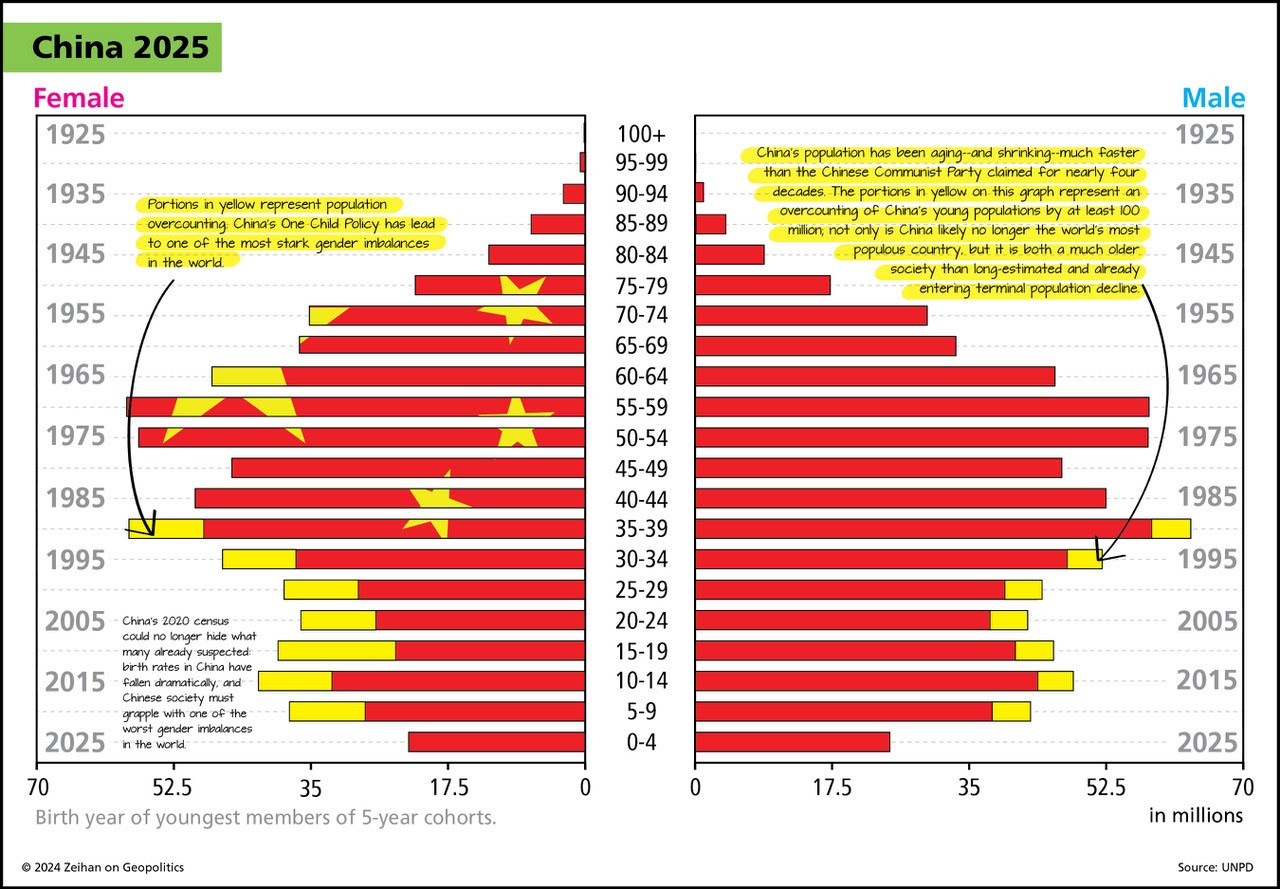
The reason for that? The birth rate has now been so low for so long. There are no longer enough people in China under age 40 to have kids that we’re seeing a collapse in population, which means a collapse in housing demand. How bad is it? Don’t really know. There’s no good data. The Chinese government stopped collecting data on this topic years ago because they were afraid that chairman G wouldn’t like the results. 

So they’re kind of flying blind private analysts who are not subject to the CCP’s whims. The Chinese Communist Party’s whims estimate that there’s probably sufficient spare housing to house more people than Brazil has. About 180 million people, government folks who are estimating say that the real number could be more than ten times as high, perhaps enough to house 3 billion people. 

Bottom line is, you can’t break these things down. You can’t really sell the properties because they’re not owned by just one person and they’re not owned by the same consortium of people. So just finding the ownership network is kind of strange. You can’t just knock them down, even though there’s just such huge excess supply. And a lot of people think that, you know, maybe when the economy turns, demand will come back, but there are no longer people to generate the demand in the first place. 

So probably most real estate in China is worth maybe $0.10 on the dollar. And in terms of even the controlled limited pricing signals that we have in China indicate that officially, prices have already dropped by about one sixth in just the last five years, which in any market. But China would be a disaster. But here, the numbers don’t necessarily mean the same thing. 

So that is part one. Part two is a real doozy. 

Okay. Part two. Still on the Kepler. I’ve got, hanging value on my right and some cosmic death on my left. Okay. Where were we? Oh, yes. Part two. So another story. The Chinese government is, extraordinarily paranoid. And that’s not just the Communist Party that rules the place. Now that has been true since the time of the emperors of old. 

The problems geographic, China’s a huge swath of territory, and any policy that is set in the center is going to be. How should we say, loosely interpreted by the time you get to the frontier? And so China has always flipped back and forth between two extremes. 

Centralization, where the emperor or the chairman of the CCP, basically says everything has to go his way. And if it doesn’t, everybody dies. That’s, for example, the attitude that killed over 20 million people in the Cultural Revolution back in the 60s, 70s, recently. That was Mao or, the territories. The provinces grab too much autonomy and go their own direction and generate their own militaries, and warlord ism erupts. Which is the story through the vast majority of Chinese history. 

Chinese like to talk about how they’ve got a continuous history stretching back millennia. But in terms of actually being united in more or less its current borders, with the government that is actually functional. Actually, they have less than 300 years of experience, and half of that was under Mongol occupation. So, yes, the Han Chinese are an ancient, ethnicity. 

But, let’s just say they’ve never managed to hold themselves together into a meaningful government or be a meaningful power until, the Cold War, when the United States basically took all the foreign powers off the deck and allowed the Chinese to export themselves to wealth for the first time. Anyhow, back and forth, back and forth over unification, over regionalization. 

That’s the needle that the Chinese government is trying to thread. So after a series of reforms in the 1980s, the central government under Xi’s ding, I believe, basically realized that, Mao was and that was a fuck. And so they needed to unwind everything that he had done while still leaving his poster on the walls. 

Yes. This video will totally get banned in China. Anyway, so what they did is they centralized revenue generation. So all tax authority rests at the national level. But they regionalized spending on the day to day things like, you know, infrastructure, public works, income support, their equivalent of Social security, all that good stuff. And in doing so built a split system. 

The idea that Deng was after it was try to avoid the over centralization while also avoiding the over regionalization. Unfortunately, they did this without rooting out the fraud that is endemic in the Chinese political and economic system. And so the local governments just basically started lying about everything. Generating statistics that indicated faster economic growth than they were really having. 

Generally, statistics said they have more population than they were really having. And if you remember, the one child policy started not too much longer, actually, by about the same time that this split happened. And so we have had almost 50 years of a disconnect in reality between what China’s population really is and how the funds get appropriated. 

So that’s problem one, that we have a half century of bad data about how many people there really are in China. According to the official statistics, it’s somewhere between 1.3 and 1.4 billion. They have recently revised that down to between 1.1 and 1.2 billion. Most independent estimates put it 100 to 200 million below that. And there are a lot of private ones that say it’s 2 to 300 million below that, something in the realm of 700 and 800 million. 

I don’t really have a number that I swear by. But, you know, it’s obviously bad. All right. So if you’re a local government and you’ve been lying through your teeth for decades to get more money out of the central government, you’re trying to justify getting more money. And so you have to come up with new ways to get it in order to do everything from building railroads to having more mistresses. 

And so what you do, since you can’t tax, is you borrow, the two main revenues are you take loans from state banks, the same ones that are oversaturated with capital because the private citizens don’t have anywhere to turn or you sell land, and if you sell land, you get a nice little pop. Also, if you sell land to, say, a development company and the development company puts up houses, or more likely, high rise condos get a pump from that. 

So I think you’re starting to see the problem here. A level of government whose entire existence is based on a degree of fraud has now established a vested interest in encouraging real estate investment in order to generate more income for itself. You play that forward to the current day, and two things have happened. Number one, they’ve so encouraged this in places where no one ever had any intention of living. 

That you’ve got, ghost cities or ghost suburbs. It’s probably better to phrase it in every major Chinese city. With, as a rule, as you move down the tiers. So not so much Shanghai and Beijing or even, Chongqing, but, much smaller places. That only have a population of a few hundred thousand or a few million have entire swaths of their skyline that are occupied by entirely empty residential high rises. 

Second, the Chinese population bomb is now so advanced that no one will ever move into these places. And third, the development companies whose interests have kind of been in lockstep with the local governments for the last couple of decades, no longer have anyone to draw upon. There aren’t enough young people coming up to provide the seed capital to generate a new wave of investments. 

And, since most of this was built in a pyramid scheme style, we have a whole wave of recently started condos within the last three years that will never get finished, because there’s no longer enough people coming into the system to generate the capital to provide, what’s necessary for the base of the pyramid. So we’re stalled, and we’ve seen home sales in China dropped by somewhere between 70 and 80%, again, using Chinese data. 

So take it for what it is. Over the last 18 months. So that is that’s phase two. So book one here, we’ve got an economic system that is wildly built on, how should I put this as yet unrealized losses? As the population moves into collapse and people haven’t yet quite realized that the investment that they’ve put every cent they have into, is dead. 

And we’re talking here 70% of private savings is involved in residential real estate. So and then second, we’ve got a level of government at the local level that’s based on fraud. That has been encouraging that bubble that no longer can encourage it and has no way of generating income because, you know, you can only sell land once and you can only sell it if there’s somebody who wants to build anything and the land has all been sold in the cities, and nobody wants to build anything anymore. 

So next phase three. 

Okay. Phase three. I’m guessing some of you might be able to see where this is going, but anyway, so we’ve got a housing bubble that is in the process of popping and that popping is going to take out the 70% of private savings that is locked up in real estate. And we’ve got a local government system that provides all the services that everybody needs to survive that is utterly bankrupt. 

And we don’t even have a really good feel for just how bankrupt. Best data available, which is wildly incomplete, suggests that the total debt for local governments is about 90% of GDP. So roughly the same for just local governments in China as the entire American federal debt. In relative terms of that, about half is money that they have borrowed through something called a local financing vehicle or local government financing vehicle. 

If you want the full acronym, which is murky, to say the least. And most folks have even stopped collecting data on it because the central government and the local governments have been trying to obstruct it. So if you happen to be, lending money to the Chinese local governments in that you’re never getting any of that back, sorry. 

So what has happened now is we’re entering into a fundamentally new structure internationally for the last 25, 35 years. The Chinese have done well in mobilizing their workforce, which was the world’s largest to sell product, processed, low end manufactured goods for the most part, to the wider world. Basically, they bring in the inputs, process them, add a little value, send it back out. 

Well, that’s no longer an option. The steadily decreasing birthrate means that they no longer have a labor advantage. So labor costs in Mexico are now less than half what they are in China. And Mexican labor is over twice as qualified for whatever they’re doing. And the Chinese are, on average. That’s before you consider that courtesy of the Ukraine war, we’re likely to have some problems with shipping internationally in the not too distant future. 

And since the Chinese are completely dependent on freedom of the seas to get their raw materials in and the product out, that’s a problem. And then third, the entire world, and especially the United States has turned sharply protectionist versus the Chinese specifically to the point that under the Biden administration, we saw a massive ramp up in tariffs on top of what Trump did in his first term, with electric vehicles and green tech being, the more recent things added to that list. 

And with Donald Trump coming in, who says that the word tariff is the most beautiful word in the English language and is threatening a 60% tariff on day one? Some version of a tightening of restrictions on Chinese exports is sure to happen. And since there’s really no one left in China under age 40, there’s not a lot of consumption left in the system. 

So all of this is happening at once. But the real cherry on this cake. Is that the new news is that so many development companies are going bankrupt, that they’re trying to pay off their outstanding debts with finished and partially finished apartments that no one’s ever lived in. And a lot of these end up eventually in the hands of local governments who have started to accept them as a sort of secondary currency, and they’re starting to use them to pay off debts. 

So you’ve got you’ve got this completely bloated market where most of the products are probably only worth $0.10 of the dollar. They end up in the hands of a local government who can no longer raise capital by borrowing or, what’s nice can no longer race. I’ve got a nice little spring here. I can no longer raise capital by borrowing. 

That jig is up. It can no longer brings capital by selling land. There isn’t any left. And now that the demographic situation is so obvious, they are having a harder time lying to the central government about what their populations are. So we’re seeing a freezing, slowing, declining ability of the local governments to provide basic services, which only encourages more people to move out, which only puts downward pressure on the property markets, which only pushes down the cost of all this stuff in the first place. 

So we are at like step two of a really nasty, vicious cycle with every bit of bad reinforcing the next. And under normal circumstances, which probably never applied to China, you could look to national government, to come in with a bailout, take some of these apartments off the market level, some buildings. 

But because of the deliberately complex nature of ownership. Anything that you take out, especially in a building that has a few occupants, is going to completely destroy the life savings of a not small number of people. So there’s no really clean way out of this. The bottom line is that the local governments have gone from something that serves the needs of the Chinese nation and the Chinese state to something that’s just simply dead weight. 

And now we’re looking at private savings and local governments basically breaking more or less at the same time that we have a national economic catastrophe because of the degrading trade situation. So lots of fun will be had in the months and years to come. I’ve been saying that by roughly, 2034 that this is all going to be over, that there won’t be, China. 

But this situation has gotten so out of hand and so big that it’s entirely reasonable for me to bring that timeframe forward. I’m not going to do that because I don’t have good data to work with the situation at the federal level, and China is now not deliberately suppressing data that’s been collected, but suppressing the people who would have collected the data. 

So it’s never collected in the first place. So this is becoming ever more of a black box and little glimpses that we get like this with, the secondary market for, apartments as a mode of local governments paying off their debts. Just show how much rot is in the system and how deep it has gone. Okay. 

I’m done. 

Intel Keeps Playing Catch-Up with TSMC

Photo of an INtel microchip

We’ve discussed what TSMC is up to in a recent video, so let’s look at what another big name in the semiconductor space -Intel- is doing to keep up.

Intel was once the big dog of the industry but fell behind due to delays in adopting new technology (aka they got complacent and didn’t think anyone could surpass them). Then TSMC pulled the rug out from under them and Intel has been playing catch-up ever since.

The semiconductor production process is complex and there are lots of different steps along the way. One of Intel’s unique advantages is that it controls more stages of the production process than TSMC does. So, Intel has a bit more protection against single point failures, which in the geopolitical landscape we find ourselves in…could prove to be an essential layer of security in the long run.

So, TSMC remains the industry leader, but they could take a page out of Intel’s book and bring some steps in their supply chain a bit closer to home.

Here at Zeihan on Geopolitics, our chosen charity partner is MedShare. They provide emergency medical services to communities in need, with a very heavy emphasis on locations facing acute crises. Medshare operates right in the thick of it, so we can be sure that every cent of our donation is not simply going directly to where help is needed most, but our donations serve as a force multiplier for a system already in existence.

For those who would like to donate directly to MedShare or to learn more about their efforts, you can click this link.

Transcript

Hey everybody Peter Zeihan here today we’re going to talk about the semiconductor sector, specifically the American company Intel. Now Intel has had a rough few years. 20 years, ten years ago, 20 or 25 years ago, they used to be the industry leader, and they were so far ahead that they would release designs that were nowhere near the most sophisticated, because they knew it would take forever to the market to catch up. 

So they had years of work plan in front of them. Unfortunately, they rested on their laurels and they failed to invest in the technology called extreme ultraviolet that instead a Taiwanese from TSMC picked up on, which allowed for much faster fabrication and much more accuracy. Much less waste. And in a few years, TSMC overtook Intel become the world leader. 

Intel did get on the extreme ultraviolet bandwagon eventually, but it took them a while to master the technology, and they’ve been behind ever since. Now, that said, the semiconductor industry is really weird and that we really do only have that one world leader, TSMC, that makes almost all of the high end chips. Intel is trying to catch up from behind. 

And Samsung out of Korea has picked up some fabrication facilities, from a merger and is doing their best to play, but they’re a distant, distant, distant, distant, distant distant second. So I thought it would be worth understanding where this technology is going to evolve and where the corporations are going to evolve. American politicians like to focus on the fabrication facilities, the places where the semiconductors are actually, grown, attached, doped and, built. 

But that’s really not the hard part of the process. I mean, know, no offense to the fabricators. They do amazing work in difficult condition and technologically challenging fields, but the harder work is in design. A basic design for a high end chip can take upwards of 24 months to really get going, and that’s assuming you’re not really incorporating any fundamentally new technology into it. 

And most of this design work is done in the United States, with a lesser degree in Japan, but that makes it sound like it’s just some guy with a protractor basically scribbling on paper. And that’s not what it is. You’re bringing together literally tens of thousands of elements into a design to try to do something new, process faster, manage heat better, use electricity, use less electricity, use different materials, and so on. 

And all the new technologies have to be incorporated into this theoretical construct, which is then taken to Taiwan, where they work with TSMC in order to basically make an instruction booklet that the TSMC staff will follow. And then you have to worry about all of the inputs coming from around the world, because it’s not like you just take some silicon and you’re off to the races. 

No no no no no no. There’s copper, there’s palladium. There’s all kinds of different inputs, things like transistors that have to be very, very specially designed and produced. TSMC doesn’t do any of that. The logistics and the design companies in the United States do so even today, with TSMC producing 90% of the world’s high end chips. Most of the real work, most of the value added work, most of the high paying jobs are actually done in the United States, and operating a side facility while it’s still highly skilled work. 

It’s not nearly as highly skilled as what happens on the other side of the Pacific. The problem that brings me back to Intel is what happens on the other side of the equation, once you have all of your raw semiconductors, you then break them into their individual components and test them and package them. And then you have to put them into an intermediate product, like a motherboard or a memory drive or, a chip within a sensor system. 

And only then can you go into the proper manufacturing process where it is put into a car or a plane or a satellite or whatever else. So this one step fabrication, obviously unavoidable, obviously important, but it’s not really where the money is. Now, TSMC is a little obsessed with its security because it is a Taiwanese company. And you can understand why. 

And so the concern a lot of people have in the sector and more broadly is that if something happens to Taiwan, we lose all the iron semiconductors, and that is true. But if something happens to South Africa, we lose a lot of the rare materials that go into it. If something happens in North Carolina, we lose the ability to purify the silicon that goes into it. 

God forbid something happens to San Jose, we lose the ability to do a lot of the software work on the back end. There are thousands of single point failures throughout the system. What makes Intel unique, from my point of view, is that they have a number of these other steps under the umbrella. There are still literally thousands of single point failures throughout the Intel system, but probably about a third to have less than what TSMC has. 

So in a world that is on the verge of rapid globalization, the idea that we’re going to be able to make these high end chips at all is kind of a stretch to me, because there’s just too many places where a single break means the whole thing falls apart. But Intel has three advantages. Number one, more of the steps are under the umbrella. 

Number two, its fab facilities are in the United States. And number three, if we’re going to have to rebuild this environment anyway, easier to do it if you only have to replace 3000 steps instead of 4500. So one way or another, regardless of the corporate success or failure of Intel in the months and years ahead. The fact that more of this stuff is concentrated in Intel and in the United States suggests that some version of Intel is actually going to be a bigger part of the semiconductor future globally than TSMC over the long run. 

Of course, we’re all dead in the long run. So this is all about timing.

Trump 2.0 – China

Great Hall of the People, Rendahuitang West Road, 前门 Xicheng District, China

In this video, Peter mentioned a total fertility rate (TFR) of 0.5. While this may be the case for certain urban cores, China’s national TFR is closer to 1.0. Still abysmal, though slightly less catastrophic. —ZoG

Everyone knows where I stand on China, but how will Trump’s second term play into that?

Let’s run through China’s situation. The Chinese economic model is dependent upon continuous capital flows. Should that be interrupted, China’s industrial economy could collapse. The demographic picture is bleak too, as birth rates continue to decline and the population ages. And Xi Jinping’s master plan to fix all this is to push workers harder, tighten state controls and micromanage reproduction.

Trump is fixated on reducing trade deficits, but China has been able to sidestep previous deals due to lack of enforcement. Trump needs to work with our other Asian allies to counter China’s influence, and some more faith in defense institutions wouldn’t hurt either.

Overall, the Chinese view Trump as a disruptor and relatively easy to manipulate. While there is some historical truth to that, Trump has shifted US sentiment to be broadly anti-China, so tariffs and supply chain diversification get bipartisan support. The question remains, what will Trump actually accomplish? Tariffs are one thing but planning and developing an alliance network and alternative industrial capacity are a completely different beast.

Here at Zeihan on Geopolitics, our chosen charity partner is MedShare. They provide emergency medical services to communities in need, with a very heavy emphasis on locations facing acute crises. Medshare operates right in the thick of it, so we can be sure that every cent of our donation is not simply going directly to where help is needed most, but our donations serve as a force multiplier for a system already in existence.

For those who would like to donate directly to MedShare or to learn more about their efforts, you can click this link.

Transcript

Hey, everybody. Peter Zeihan here. Coming to you from Blenheim, New Zealand, where I am walking through a vineyard, because that’s just what I like to do. Anyway, today we’re gonna do the second part of our open edit series on the issues that’s going to be facing President-Elect Trump on his first day of office, not the ones that he wants to face, the ones that are going to face him. 

And today we’re going to talk about China. First things first, let’s review what it is that the Chinese are dealing with. Before we talk about how Trump plugs into that, China has an economic model that is based on central state control, and that means the state controls the financial system and uses the financial system to shove money into whatever economic sector they feel that they need to. 

Now, they use this to achieve technological control of certain areas where they feel they can master the tech. They use it to subsidize development of technologies that they don’t master in the hopes that they will be able to. And they do it to build out the supply chains locally so they can drive competitors internationally out of business. But all of that pales to the primary goal, which is to make sure that everybody has a job so that nobody goes out in protest and gets together in a large group and goes on a long walk together, because that’s how the government got its job in the first place, and they don’t want that to happen to them. 

So you get this system that is over capitalized or capital is remarkably cheap. And as long as the capital keeps flowing, everything’s happy and for those of you who have ever been part of an economic sector that has busted, whether it’s, say, energy during a bust period or a boom bust period, or Enron or real estate back in the 2007, the 2009 crisis, you know this very well. 

As long as the capital keeps flowing, as long as the capital is cheap, then the system keeps running. But if for whatever reason, capital access dries up, then this artificially inflated sector basically withers away to nothing in a very short period of time. And the Chinese have been doing it. So long in so many subsectors that if that capital stopped flowing at any time, you’d basically see the end of China’s industrialized state at this point. 

That’s problem one. Problem two demographics. When you tell everyone that what you’re supposed to do as a Chinese is just work 12 hours a day, six days a week, well, there’s not a lot of room for anything else. When you pull people off of the farm and put them into the city so they can work 12 hours a day, there’s not a lot of time in their lives or physically in their apartment for kids. 

And so the birth rate drops and drops and drops and drops. And according to the most recent data, from December of 2024, the average woman in China is now having less than a half a child. So in most of China, we have a repopulation rate that is one quarter what is necessary just to sustain the population? We probably almost certainly have a lot more people in China over age 50 than under. 

And the place is looking at demographic collapse. And if you remember back to my earlier demographic work, most of the consumption that is done in the society is done by people who are under age 45, who are raising their kids and building homes. And that population is basically becoming an endangered species in China. And now that birth rate has been so low for so long, it’s been lower than the United States since the 1990s that we are looking at the dissolution of the heart of city around the end of the century. 

And there’s no way that the Chinese state will last very long. I’d say a decade or less at this point. So that’s their starting point. In order to make their system last as long as possible. Sherman Ji believes three things. Number one, everyone just has to work harder, which is only compounding the demographic situation because no one really sees a hope that this is going to change. 

Number two, he believes that the Chinese Communist Party, which let’s be specific here, it’s not the parties interested, it’s him, should face no challenge to its authority, and it should be able to micromanage every aspect of everyone’s lives. In fact, we now have the agency that used to enforce the one child policy making unannounced house calls to see if couples are having sex without contraception to make sure the birthrate goes back up, because that’s what the state wants now. 

You can imagine how well that goes over. And third, he has to keep export markets open because all of this production, all of this forced production, all of this over subsidized production can’t be consumed by the population because most of them are now over 45, which means it has to be exported. So they have to be able to shove the products they produce down everyone else’s throats just to keep their country alive. 

Enter Donald Trump. Donald Trump is singularly obsessed with the trade deficit, which is probably not the best way to look at the issue. But that’s how he sees it. So it doesn’t matter what I think. And as a result, he likes to think that he can make deals that will force things in the United States, his direction. 

For the most part, the Chinese, especially at the top, are not worried about this because they’ve dealt with him before. They see him as an eminently lateral person. And so they basically give way in negotiations, knowing that the day after the negotiations close, that there will be no enforcement and they never have to worry about him again. 

Why do they feel this way? They’ve already done it before. The phase one trade deal that was negotiated by the Trump team back in. Who was it seven, six years ago, committed the Chinese to buying X number of dollars of various products and by the end of the Trump term, he hadn’t met any of the criteria at all. 

In fact, they never intended to. All they did was make sure that whenever there was a product like what they needed available anywhere else in the country, they went to that first. So actually, we saw the trade deficit in a structural sense, go up because of trade talks with the Trump administration. The other reason that the Chinese are really not concerned about Trump is that they don’t take him seriously as a strategic thinker. 

The Chinese understand, as everyone in Asia understands, that if you want to him in China, you can’t do it alone. It can’t be just a trade. You can’t just be a strategic issue. It has to be holistic. You have to bring in all the other countries, from Indonesia to Malaysia to Singapore to the Philippines, to Taiwan, to Korea, to Japan. 

And if you don’t do that, the Chinese will easily find a weak link in the chain and be able to push out. And they see Donald Trump as being more danger to the alliance than they are now, whether or not that is accurate enough of that. That’s how they see things. And again, they’ve done this before with Trump the first time around. 

They don’t see anything different in round two except the Donald Trump is trying to wreck, law enforcement and the Defense Department and, the intelligence agencies with his appointees, which are the things that generally keep China in check as well as, if you’re going to have any sort of meaningful policy against China that deals with security and culture and technology and theft and trade, you need everyone working together. 

And they see Donald Trump as the best possible candidate for wrecking that capacity within the American system. So they’re actually broadly looking forward to Trump two, because they think they’re going to be able to get even more out of the United States than they did under Trump. One, much like the Russians are feeling and like the Russians, I think they’re miscalculating. 

This is not 2017. We are in a very different world now. And the single biggest difference on the Chinese front is that Donald Trump did succeed in changing the conversation in the United States, and there is now a competition among all factions in Congress about who can be the most anti-Chinese. Now, translating that sentiment and policy, that’s a lot easier said than done. 

But there’s no longer this core disagreement within the parties because the business community has been ejected from the Republican coalition. So the faction that used to be the most organized and calling the shots in the Republican Party on economic policy is no longer even part of the conversation, which leaves everybody else to fill the gap. And no one else is as concerned with economic stability as the business community was. 

So we’ve already seen in the last five years a significant outflow of investment from China, foreign firms and even of Chinese firms as everyone tries to get away from this country. That is facing economic implosion because of its demographic issues. And while Donald Trump certainly isn’t the guy to build a broad coalition within his own government, much less across multiple governments, to have any sort of coherent policy towards China, dude knows how to do tariffs. 

And that is certainly something that’s going to hit the Chinese on the headline. Now, as a rule, I would say tariffs are a really bad tool for shaping policy. So for example, the terror that Trump has threatened, not that I think are going to happen, against China and Mexico would be the fastest way to trigger an inflation induced recession in the United States, because most of the trade among the NAFTA partners goes back and forth across the border every time. 

And if you do a flat tariff, because doing anything about a flat tariff would require administration, Trump is not very good at that. You’re going to basically tax every product multiple times and drive each industry out of business and allow Chinese products to fill the gap. That’s not how things work in China. China, they have as much of the supply chain system in one country as possible. 

So if you do a big flat tariff on it, it actually does hurt the question is whether Trump can realize that if the goal is to actually break the trade relationship with China, you have to do more than tariff them. You have to actually take that income and build alternate industrial plant within North America. So there’s actually another option. 

Otherwise you get an inflation pulse, you get a consumer crisis, and you don’t actually change anything on the back end. You just make everything more expensive. Now, whether or not his ultimate appointees are people who can convince him of that. I don’t know. But what I do know for sure is that if we do get into a situation where Trump basically waltzes into East Asia with a sledgehammer, yes, the U.S. is going to take a lot of hits. 

Yes, it’s going to hurt. Yes, he will go down in history as triggering the highest inflation the United States has ever had. Yes, it will be ugly, but there won’t be a China on the other side of that. There are easy ways to do this. There are smart ways to do this. But that doesn’t mean that there are only 1 or 2 ways to do this. 

If the goal is simply to smash China and move on, I have no doubt that Trump can do that. If the goal is to smash China, move on, and have America in a much better place domestically. That requires a skill set that I have not seen Donald Trump wield just yet. All right, I’m done. See you tomorrow.

China Has No Chance

Chinese flag over a building

The Chinese are stockpiling resources – food, fuel, and materials – to help it endure a protracted conflict with the US. Is this something to be concerned about?

If China wants 120 days of stockpile, good for them, but it’s not going to help. China is completely import dependent; they rely on imports for energy, food, and raw materials and their economy is tied to the global supply chain. As soon as war breaks out, all that is going away.

Even if China has a 120-day stockpile, it’s not going to be very secure. Oil will be vulnerable to attacks. Food will be subjected to poor storage infrastructure and will likely spoil. So, that 120-day stockpile isn’t looking so strong anymore.

And if you start to factor in naval blockades, no access to US markets, and the power projection of the US, this stockpile quickly turns into the same smoke and mirrors that the Chinese are so great at.

Here at Zeihan on Geopolitics, our chosen charity partner is MedShare. They provide emergency medical services to communities in need, with a very heavy emphasis on locations facing acute crises. Medshare operates right in the thick of it, so we can be sure that every cent of our donation is not simply going directly to where help is needed most, but our donations serve as a force multiplier for a system already in existence.

For those who would like to donate directly to MedShare or to learn more about their efforts, you can click this link.

Transcript

Hey, everybody. Peter Zeihan here. Coming to you from a toilet in New Zealand. I just had to do a video here for The View, which I will share with you now. 

So you’re not going to have my ugly mug on this one. But just keep in mind the theme of where I am and what I’m doing. Anyway, the question from the Patreon page is pretty straightforward. China is stockpiling all kinds of things foods, fuels, materials, in order to survive a protracted conflict with the United States. 

Is that something that will work and the short version is no. China is the world’s largest importer of energy, food stuffs. The materials they need to grow food, as well as every mineral in the world. There really isn’t a lot of raw material that is produced within China. It’s brought in, it’s processed, it’s turned into value added goods, mostly manufacturing, and then export it. 

So China is vulnerable to cut offs at all stages of production chain of every industry in the world. Now they are. Yes, storing lots of stuff. But let’s assume for the moment they get to the goal of having 120 days of import cover for oil. Well, number one, so that would last them 120 days. Number two, they don’t have the salt domes at the United States has. 

So storing has to be largely done above ground, which means it’s something you can hit with a missile, which means that in a hot war, it’s all going to be gone within the first couple of days anyway. And keep in mind, the Chinese are vulnerable to the United States sea power, not just on the Chinese coast, but anywhere that can interdict anything, with the Strait of Malacca arguably being the most sensitive spot, because that’s where about 80% of their oil imports come from. 

Same basically goes for food. Storing food requires storage facilities. So a while ago, the Chinese built a massive corn storage facility, but all it was was giant piles of corn piled up along the side of the road. And they all rotted within a year, and it all went to nothing. Some version of that will happen for everything. 

And even if I’m wrong about energy and food and all the material inputs, they still have to export stuff. And their number one customer is the United States. So the Chinese battle plan literally is for the United States Navy to all sail within sight of the shore so that the Chinese can hit them with their air force. And then for the United States to continue to patrol the global ocean. 

So they can still import all the food and energy that they want, and that the United States will still keep its market open so that the Chinese can pay for everything. It’s a stupid, stupid, stupid plan. And so if there ever is a real fight between the Americans and the Chinese, not saying there will be, I honestly don’t think there will be. 

But if there ever is. Then the Chinese will be in the same situation. I am in the shitter. Although the view won’t be nearly as good.

Bring on the Chinese Investments in LATAM

Photo of the Chinese yen

A lot of you have been worried about all of China’s investments in Latin America. I get that it might sound a little scary, but you need to put these actions into the broader context of China’s circumstances.

China is in terminal decline. Its population is aging, and its resources are dwindling. So, they’re not going to be able to sustain these LATAM investments long-term. And don’t try to bring up the Monroe Doctrine, because recent administrations haven’t been enforcing it anyway.

Places like Peru, Brazil, Colombia, and Argentina are getting a sweet deal, since this is basically a form of subsidizing future industrialization of the region. And the US is only going to benefit from that as well, since we are partners to many of these countries.

So, if China wants to spend their limited resources (and time) laying the groundwork for a brighter future in a region that the US is so closely tied to, why should we stop ’em?

Here at Zeihan on Geopolitics, our chosen charity partner is MedShare. They provide emergency medical services to communities in need, with a very heavy emphasis on locations facing acute crises. Medshare operates right in the thick of it, so we can be sure that every cent of our donation is not simply going directly to where help is needed most, but our donations serve as a force multiplier for a system already in existence.

For those who would like to donate directly to MedShare or to learn more about their efforts, you can click this link.

Transcript

Hey everybody. Peter Zeihan here comes to you from Tongariro National Park in New Zealand. This is Taranaki Falls, just about done with the circuit. I thank God my back hurts. Anyway, taking an entry from, the Patreon page specifically. 

Tourists, specifically. It’s. Do I worry at all about China’s investments into Latin America? There’s a big port going into Peru. 

There’s a lot of mineral extraction stuff going into Brazil. There’s a general infrastructure going to Colombia. And then, of course, purchase agreements for everything under the sun to Argentina. What do I worry about? You know, I mean, don’t get me wrong, there’s a Monroe doctrine thing here going on, but, we haven’t had a president in the last 25 years who’s really acted on it. 

Certainly not, Obama or Trump or Biden. So, this is a very bipartisan kind of slouch strategically if if that’s the thing you’re concerned about. But I’m really not concerned about it. Remember that the Chinese are literally dying out. And if they want to throw some of their limited resources into the Western Hemisphere to build physical infrastructure that will help industrialize the Western Hemisphere to prepare for when China’s going to recover after China storm, I say let them, specifically the port in Peru probably isn’t going to get too much activity. 

There isn’t a really good transshipment port anywhere on the west coast of South America, so having one makes sense. And here, lo and behold, the Chinese are building it for everybody. In Argentina it’s more straight up sales issue. Those things can always go somewhere else when the Chinese are no longer the high price bidder. Colombia is a mountainous country where the population. 

Well, it’s unique, usually, like in Mexico, you live on the top of the plateaus to get above the tropics or anywhere else. You live at the bottom of the mountains where it’s cheaper to build. But in Colombia, because it’s right on the equator and the mountains are really steep and there’s jungle. They live on the side of the mountains. 

The top is tundra, the bottom is hard jungle and everyone lives in the middle. And so infrastructure is really hard. And if the Chinese want to pay for that grid because the U.S has a free trade agreement with Colombia, and any Colombian success is one for us as well. And then finally there’s Brazil. The Chinese are spending to build infrastructure from the coast up the skirt mint where Sao Paulo is, and then down into the interior again, expensive geography to develop and the Chinese are paying for it all. 

So if the Chinese want to pay for tomorrow’s world, I say let them. 

The Chinese Cut Off Drone Exports

Image of a drone firing missiles

The Chinese Government has moved toward implementing an export ban on drones and drone components, with an eye toward making supply issues a particular headache for the United States and the Ukrainians.

In regard to the latter group, Kyiv has had particular success in utilizing drones in their war against Russia. From reconnaissance to swarm attacks to providing targeting data for UAVs, the Ukrainian war effort has been building and burning through thousands of drones.

While the design and rebuild activity is happening primarily within Ukraine, several key components: motors, flight controls, and especially the batteries and made in China. China’s massive supply of affordable parts is what drove the Ukrainians to make up for shortages within their arsenals with drones in the first place, and you can bet Moscow has been pushing China heavily to stop the flow of these parts to Ukraine.

As for the Americans, the Chinese are looking to respond to the bevy of tech export restrictions pushed through by the Biden administration, and Beijing is bracing for an onslaught of new Trump tariffs. Things like drone components are one of the few levers Beijing has in this fight.

But what will the ultimate outcomes be? This is an excellent opportunity for the United States and others in the West to start building out their own manufacturing capacity for these components—a win for both strategic and economic reasons. Even if the Chinese were everyone’s best buddies, the current Chinese system is dying. Literally. The Chinese government cannot hold back the impacts of the collapse of the population growth rate, and the Chinese economy is undeniably slowing down. The global economy’s reliance on Chinese overproduction is coming to an end, regardless of whether anyone wants it to or not.

Here at Zeihan on Geopolitics, our chosen charity partner is MedShare. They provide emergency medical services to communities in need, with a very heavy emphasis on locations facing acute crises. Medshare operates right in the thick of it, so we can be sure that every cent of our donation is not simply going directly to where help is needed most, but our donations serve as a force multiplier for a system already in existence.

For those who would like to donate directly to MedShare or to learn more about their efforts, you can click this link.

Trump Tariffs Part 1 – China

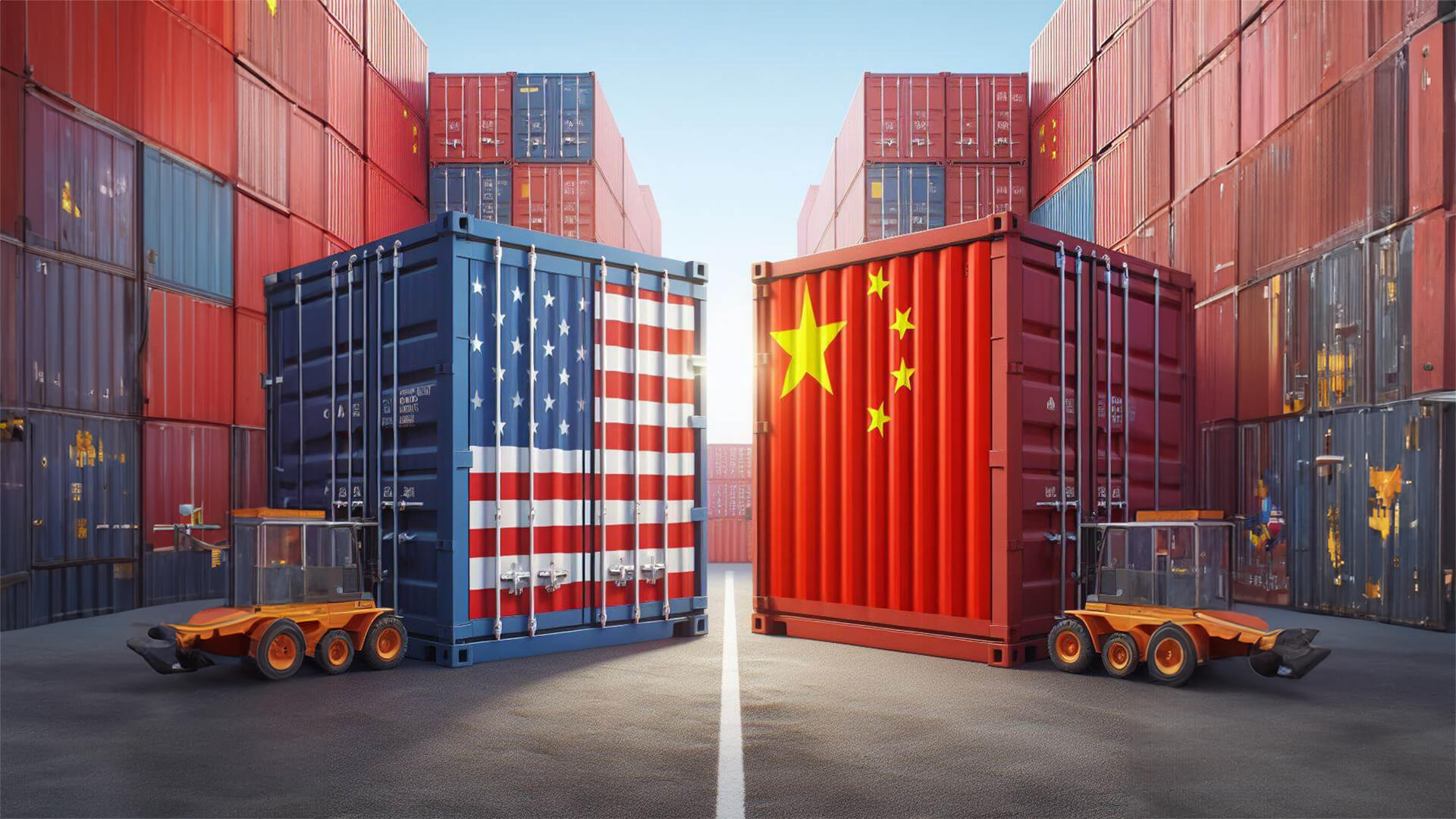
An AI generated image of connex boxes with American and Chinese flags on them

The Trump administration is planning to impose some hefty tariffs on China. This isn’t just to reform trade practices and show China “who’s the boss”, but rather to shift industrial production away from China permanently.

Trump’s goal is to wean the US off that $500 billion worth of annual imports. This is going to be a challenging time for everyone involved; China is having their feet swept out from under them, and the US will have to find someone who can replace the Chinese (because we surely can’t do it on our own). And not to mention an unwanted bump in living costs for the Americans.

It’s not all bad news bears though. The US has enough cheap energy to help build all the processing and manufacturing it might need, but it will require significant investments, policy changes, and TIME. Trump has the right idea, but his approach is lacking a bit of the strategic depth that this will require.

Here at Zeihan on Geopolitics, our chosen charity partner is MedShare. They provide emergency medical services to communities in need, with a very heavy emphasis on locations facing acute crises. Medshare operates right in the thick of it, so we can be sure that every cent of our donation is not simply going directly to where help is needed most, but our donations serve as a force multiplier for a system already in existence.

For those who would like to donate directly to MedShare or to learn more about their efforts, you can click this link.

Transcript

Hey, everybody. Peter Zeihan here, coming to you from Colorado. Today’s the 26th of November, and today we’re going to talk about the incoming Trump administration’s initial plans for trade policy.

Last night, Donald Trump texted out that he plans to levy very sharp tariffs on Mexico, Canada, and China—our three largest trading partners. For this discussion, we’ll focus on the Chinese component.

We’re talking about China first because Mexico and Canada are different issues with different factors at play. First, with China: we don’t like China, and China doesn’t like us very much. The Trump tariffs, if implemented on the Chinese merchandise exports that come to the United States—roughly half a trillion dollars a year—would increase the average cost of living for the average American, every man, woman, and child, by about a thousand U.S. dollars a year.

The stuff that comes from China, like I said, is mostly manufactured goods, almost exclusively. The bulk of it falls into the electronics category, which includes computers, cell phones, cellular technology, white goods, consumer goods, and parts that can go into pretty much anything.

The Chinese have a very predatory trade system, so overall support from the U.S. citizenry is likely to be pretty high, despite the cost of this. This is a more traditional tariff goal here. The Trump administration has long wanted to reroute global trade flows, specifically where China is involved.

That means punishing the Chinese until alternatives can be generated. But therein lies the rub. No American trade policy going back to World War II has ever been very good at building that alternative system. We punish countries we think are engaging in unfair trade practices, but those punishments are usually designed to get them to dismantle those trade policies so we can return to something more fair or normal.

That is not the goal this time around. The goal here is to permanently relocate industrial plants. Simply throwing on a tariff and funneling the money to a general fund doesn’t achieve that. You also need to build a complementary industrial policy that takes some of the income and uses it to build a long-term alternative.

Here’s where the challenge and the opportunity lie. First, the challenge: the things China does, it doesn’t do by itself. It has relatively low-cost wages, especially for its mode of production. However, it’s not a very profitable industrial power. It has only managed to get to where it is now and maintain its position through a massive amount of subsidies.

If those subsidies were to go away, you would see mass de-industrialization of China, which would probably lead to the collapse of its political system. The Chinese aren’t even going to consider that, which is ultimately what a normal trade policy would aim for. To overpower that, you’d not only need a fairly steep tariff rate—much higher than the 10-25% that Trump’s team is suggesting—you’d also have to build an alternative.

When it comes to things like electronics assembly and components creation, the United States is not a very competitive player in that market. Our labor, to be perfectly blunt, is too highly skilled. The same goes for Canada and Mexico. You’d need to develop a different model, and doing that quickly is very difficult and expensive.

However, there is some low-hanging fruit. The Chinese dominate not just electronics manufacturing and assembly but also materials processing—turning bauxite into aluminum, cobalt into cobalt metal, and lithium into battery chassis, for example. This is something the U.S. and the rest of the world have largely stepped back from for two reasons:

  1. It takes up space and is environmentally damaging, leading to regulatory challenges.
  2. If the Chinese are willing to pollute their environment, exploit their workers, and subsidize the industry, why compete with them when they can do it cheaper and hand you the end product?

There are problems with that argument. The Chinese have discovered that this gives them leverage in trade talks. However, rebuilding this capacity elsewhere isn’t difficult or even particularly expensive. For example, the U.S., thanks to the shale revolution, produces a huge amount of excess natural gas and has the cheapest natural gas in the world. From that, we’ve developed the cheapest electricity in the world.

Over the last 15 years, the chemicals industry has shifted to run on natural gas rather than oil whenever possible. As of 2024, the United States is by far the largest, highest-quality, and lowest-cost producer of intermediate chemical inputs for modern manufacturing.

But it took the free market 15 years to make that happen. If we want to speed up the process for everything else, it means implementing an industrial policy that uses revenue from Chinese tariffs to help build the supporting infrastructure. This is low-hanging fruit that we need to address anyway. The Chinese won’t be around much longer, and even if they were, we wouldn’t want them to maintain the leverage they currently have.

Building up industrial plants isn’t necessarily expensive. For example, creating capacity for something like aluminum might only cost a few billion dollars. It’s not costly or time-consuming, but “cheap and quick” isn’t the same as “free and immediate.” It requires a policy to make it happen. Otherwise, the market will handle it over the next 15-20 years, but I’d argue we need to start the transition much sooner.

Once that foundation is established, we can begin tackling more difficult pieces like electronics. So far, the Trump administration has not demonstrated an awareness of this level of nuance in tariff policy. The general belief seems to be, “A tariff is good. Do it, and we win.” It’s going to take a lot more effort than that.

That’s the situation with China. The situations with Mexico and Canada are very different, and we’ll tackle those tomorrow.

Things I (Don’t) Worry About – Chinese Investment in Mexico

A photo of mexico city at night

If you’re getting worried about Chinese investments into infrastructure in Mexico, it might be time to switch the TV off and take a walk…because that narrative is a complete fabrication.

This should help ease your mind: China doesn’t even crack the top ten list of foreign investors in Mexico, there are regulations for  the origins of goods outlined in NAFTA 2 that China can’t bypass (and the person who negotiated these rules will likely be in Trump’s cabinet), and any major investments by China would be outed by business leaders in Mexico (so we don’t need to stress about stuff happening beneath our noses).

And if that wasn’t enough, the Chinese system is in decline, and so is their global influence. If they do somehow manage to make investments in the region, it’s only going to help the North American industrial base prepare for the collapse of China. At least this is a good thought experiment to remind us that the US needs to focus on building out its own industrial capacity.

Here at Zeihan on Geopolitics, our chosen charity partner is MedShare. They provide emergency medical services to communities in need, with a very heavy emphasis on locations facing acute crises. Medshare operates right in the thick of it, so we can be sure that every cent of our donation is not simply going directly to where help is needed most, but our donations serve as a force multiplier for a system already in existence.

For those who would like to donate directly to MedShare or to learn more about their efforts, you can click this link.

Transcript

Hey everybody, Peter Zeihan here, coming to you from Massey Draw above the Denver metroplex. Today we’re gonna talk about something that has been on a lot of people’s minds during my work trips the last couple of weeks.

Two weeks ago, I was in Mexico, and one of the first questions that everybody asked me was what I thought about the Chinese effort to build industrial plants in Mexico to get around NAFTA regulations and ship stuff into the United States.

Last week, I was in Canada, and that same question popped up. I decided to turn on the television for 15 seconds for the first time in a year and wow, wow, wow. It doesn’t matter who you are—left, right, center, economics, socialist, whatever. Whatever you’re watching, this is a hot topic. It pleases me to say, as somebody who just looks at the data, it’s a complete fabrication.

China doesn’t even make the top ten list for foreign direct investment—that’s investment in physical plants—in Mexico. In fact, it doesn’t even show up in government statistics; it’s so low down the scale.

And, you know, honestly, folks, let’s be honest here. The soul-searching… this kind of stuff is really hard to hide. I mean, an industrial plant that’s going to be big enough to process—even if it’s just to stamp “Made in Mexico” onto a previously made Chinese product and ship it to the United States—

That’s not small. That’s not quiet. We don’t have stealth fields, and there isn’t a single facility doing this anywhere in the northern Mexican states. The infrastructure into central Mexican states is insufficient for the task anyway.

This is something that we have dreamed up ourselves in our post-truth environment that just happens to have taken on a life of its own.

It reminds me a little bit of when everyone was panicking a couple of years ago about the Chinese purchasing farmland. And again, the Chinese weren’t even in the top ten list. Now, that doesn’t mean there aren’t foreign entities looking to do something like this, but it’s not China—it’s Canada.

Canada is the number one owner of farmland in the United States outside of Americans. It’s also the number one investor into Mexico after the United States. And yes, yes, we should be concerned about Canada, though with the rule of law, their politeness, and their heavy coats… I mean, Canada, I’m watching you.

Anyway, should things change—should this become a real thing—three things to keep in mind.

Number one: NAFTA 2, which was renegotiated by Donald Trump in his first term, has very clear rules of origin laws that say a certain percentage of goods have to be made in the NAFTA states. This hypothetical scenario where the Chinese are trying to get around that is already covered by US law, and the US already has tools within the NAFTA system to deal with it economically, politically, and to block the products should it become a problem.

That authority already exists.

In addition, the most likely person to take over trade policy in a second Trump term is Robert Lighthizer, who is the guy who wrote these clauses and negotiated NAFTA 2 in the first Trump situation. So I have no doubt that if there’s any inkling this is going to go down, Lighthizer will take personal responsibility for this. And he is by far the most competent person who was on Trump’s first team.

And if he accepts Trump’s offer, he’ll be the most competent and capable person on Trump’s team. So put that to the side.

Second concern: If something like this does go up, it will not be quiet. When the Chinese build industrial plants in third countries, they bring in their own workers. They house them on-site, and it generally generates a lot of labor protests for the host country to deal with.

And Mexico now has a healthier press environment than the United States does. Mexican workers will not be shy. Mexican business leaders will not be shy about shining a light on something like this should it go down. Keep in mind that most of the business leaders in northern Mexico are relatively oligarchic—a little bit Elon Musk—and they really don’t like it when things don’t go their way. They’re not going to be quiet.

So we have a really good alarm system built in should this happen.

Third, and finally: The Chinese system is failing due to demographic collapse. Before you consider trade tensions, before you consider the possibility of a conflict in the world that would interrupt raw material supplies, energy supplies, or merchandise exports, we need to prepare for a post-Chinese world.

Which means here in North America, we need to roughly double the size of the industrial plant.

And if the Chinese do decide to come in to build industrial plants in North America, think about what that means. They are spending some of their limited capital resources, technology, and labor in order to help us get ready for a world without them.

So even in the worst-case scenario, where I’m completely wrong and this is about to happen at scale, the worst-case scenario is still pretty good.