Why Would Europe Trust France with ALL the Nukes?

A french flag over the Arc de Triumph

Macron is proposing that France expand its nuclear deterrent to help shield the entire European Union. This comes at a time when Europe is losing confidence in the United States’ security guarantees. But there are major obstacles in the way.

Many European countries could build their own nuclear weapons, and do so quickly. So, why would they rely on France? Would Paris really risk nuclear war for a smaller EU state that was under attack?

Rather than a centralized French nuclear umbrella, proliferation throughout Europe is more likely. Many countries could spin up a weapon within months, so we could be looking at a more heavily armed and fragmented Europe very soon.

Transcript

Hey, all, Peter Zeihan here, coming to you from Colorado. And today we’re going to talk about nukes in the European context. Specifically, the president of France, Emmanuel Macron, wants to expand the French nuclear deterrent in order to provide a missile shield for everybody in the European Union. Right now, because the Brits left the EU several years ago. 

France is the only country in the EU that currently has nuclear weapons. Now, what’s going on here? Is that the French just trying to make a power play to make themselves sound important. You can answer that yes to anything that the French say. That doesn’t mean that there’s not something here. What is going on? Is that, well, to make it perfectly blunt, the Europeans have lost confidence in the United States. 

When the Greenland fiasco happened earlier this year, the Europeans realized that 75 years of alliance was functionally over. And if the United States was willing to threaten its most loyal allies, directly with military intervention in order to get a piece of property that is useless, what will the Americans do when something’s actually important is on the line, like, say, a threat that requires a nuclear strike? 

And so the conversations that are going around Europe are is what do we do? What do we do? What do we do? Part of this means building, much bigger militaries that are independent, the United States. Part of this means fuzing their defense establishments with the Ukrainian one, to put Ukrainian tech and European capital manufacturing capacity to generate an entirely new style of war. 

That leaves both the United States and the Russians out in the cold. And a third layer of it is a nuclear shield. The problem here, what the French are going to run into is that third one is the least feasible of the three because, well, a couple of things. Number one, the technology is not new. Any country that has a nuclear power plant, there’s a dozen European countries like that could relatively easy build a nuke with what they have on hand. 

A one gigawatt nuclear power plant, which is, you know, medium to large size, generates enough waste plutonium every year to make a dozen or so weapons quite easily with technology that was developed in the 1940s. So there’s not a technical obstacle at all. And since the United States is basically no longer enforcing any of its weapons treaties, the non proliferation treaty is one of those. 

And there’s really nothing standing in the Europeans way except for the European sense of propriety. 

which means that nobody has to rely on the French. They could build their own. The second problem the French are going to have is the issue of thresholds. So let’s say, for example, that Estonia, a country with less than a million and a half people way up in northeastern Europe, was under attack by the Russians, and the prime minister was dead, and the cabinet had been strung up in the streets. 

And the deputy education minister, because that’s all that’s left, calls up. The French president says you got to nuke Moscow. What’s the French response going to be like? Maybe. No, that’s not very convincing. So what is more likely to happen is just a mass proliferation process throughout all of Europe. They might coordinate on fighter jets and tanks and drones and the rest, but nukes. 

Every country is going to want their own deterrent. 

Every country is going to want to be able to say yes or no for their own reasons. And that means we should be looking in the next few years for a number of countries that are already very close technically Finland, Sweden, Romania, Poland, Germany all getting their own deterrent, and probably some smaller countries as well, because one of the things that the Europeans like to forget that those of us who know our history, remember, is that, historically speaking, well, almost all of the Europeans have been at odds and at the throats of the Russians and vice versa. 

They also have been at odds with themselves and at the throats of one another. Historically speaking, Europe is the most blood drenched chunk of territory on this planet, and it’s only with the post-World War II settlements where the Americans basically occupied the place for 40 years, that all of these countries were forced to be on the same side. 

And then when the Berlin Wall and Iron Curtain came down, Central Europe kind of rejoined that group under the egis of NATO. And if NATO doesn’t mean anything anymore than the Europeans have to start making decisions for themselves, and a lot of Europeans are going to make decisions that not only the Americans don’t like, but other Europeans don’t like either.

The End of the Shadow Fleet? – French Edition

French military vessel | Licensed by Envato elements: https://app.envato.com/search/photos/d93044ee-6076-4af6-a69b-29bbfe8f6cd3?itemType=photos&term=french+navy&sort=relevance

France has seized a shadow fleet tanker suspected of carrying sanctioned oil under a false flag and has taken it to Marseille. Should this ship be formally impounded, the entirety of the shadow fleet would fall.

If a precedent is set here, everyone could begin detaining similar vessels. And it wouldn’t be hard to rapidly clear the waters of these vessels via major maritime choke points. A maritime services firm has kindly offered to legally take possession of seized shadow fleet ships and dismantle them (most of these floating rust-buckets should have been scrapped years ago, but instead were used to evade sanctions).

So, the shadow fleet could fall within months, but that creates a new series of problems. That’s 5 million barrels per day of crude going offline very quickly, making global energy markets quite volatile.

Transcript

Hey everybody. Peter Zeihan here. Coming to you from Colorado. Today we’re looking at the Russian shadow fleet, specifically non-U.S. countries going after the fleet. What was really interesting from my point of view is, on the 22nd of January. So last Thursday, the French grabbed a ship called The Grinch, for suspicion of flying an inaccurate flag and carrying sanctioned oil which would define every ship that the Russians, the Iranians, and until recently, the Venezuelans have been using to transport their oil. 

The reason why this really matters is, with the exception of the Venezuelan enforcement actions that the U.S. is engaged in, right now, no country has pulled over any shadow fleet vessel for those reasons. Maybe they think that there’s a drone launch system on board and they see it as a security issue. Maybe the ship is having engine trouble. 

They need to tow it to port. Those things have happened, but never one has ever tried to use military force to enforce the sanctions on Russia, or to try to break the shadow fleet. This would be the very first instance of that. And the French have grabbed the shift and towed it to Marseilles for investigation. And obviously it’s false flags and obviously it doesn’t have an insurance policy. 

And obviously it’s part of the shuttle fleet. So we are watching this very closely because if this actually results in the ship being impounded and its cargo seized and distributed, however the French decide to handle it. We will then see every NATO country and probably quite a few non-NATO countries basically going through and gobbling up the entire shadow fleet in a matter of weeks, because it is very easy to do so now. 

The French are a competent naval power. They grab the ship in the Mediterranean, but, you know, most of them is not going to be that complicated because you’ve got places like the English Channel or the Sky around, or the Turkish Straits, where the ships have to pass through a narrow choke point in an area where local labor powers are more than capable of grabbing civilian traffic that isn’t supposed to be there. 

The second piece is that a company called GM’s Global Maritime Services has applied for permission to o. Fact, that’s the Office of Foreign Assets, or works with Treasury in the U.S. departments to basically manage foreign assets. Has basically said, hey, we are here. We are ready to take possession of these shuttle fleets, will bid on it, will pay for them, and then we’ll break them down and remove them from service completely. 

None of these ships are new. Most of them are just floating rusted buckets. They’re accidents waiting to happen. And if it hadn’t been for the existence of, the Russians needing to create the shadow fleet, the Iranians needed to create the Shadow Fleet. All of these ships would have been decommissioned years ago. So let us do our job and help you do your job. 

And we can easily take more than 100 of these things in the next six months. There’s probably about a thousand shadow vessels out there anyway. GM’s is the largest company that has expressed an interest in playing a role in this. They’ve applied directly to the U.S. government. And so we’re seeing the institutions now starting to move to grab the shuttle fleet, remove it from contention, and then permanently dismantle it so that it can never be rebuilt. 

If this goes the direction it seems to be going, this next six months is going to be wild in energy markets, because these tankers are collectively carrying something like 5 million barrels of crude a day. Removing all of that in a short period of time is going to cause a lot of pain in a lot of places, but nowhere more than the countries that will no longer be able to sell their crude. 

Most notably Iran and the Russian Federation. So you’re is off to a rolling start and here we go.

France Hits the Demographic Point of No Return

A French flag ribbon with an axe on a chopping block

The Americans and Kiwis are the last of the developed countries still holding onto growing populations. France is the most recent victim to have fallen into demographic decline, so let’s see what the future has in store.

France has a sizeable working-age population to help ward off any serious economic strain for two to four decades. Germany, on the other hand, has been in decline for 50 years and is running out of workers, meaning the Germans must reinvent their economic model.

The US isn’t far behind France, though. And China is a whole other topic. The broader issue is that as more and more countries reach the demographic point of no return, the world still hasn’t found a sustainable economic path forward.

Transcript

Hey, all Peter Zeihan here coming to you from a snowy Colorado. Got a fresh inch overnight. Today we’re talking about, demographics, specifically in France. French statistics were released in the last couple of days, indicating that France is the latest country in the world to now have more deaths than births. France has long been the country Europe with the highest birth rate, with the most prone policies. 

And now they have slipped into, population decline as well. This means that every country in the first world, with the exception of the United States and New Zealand, are now in this position where they are in demographic decline. The Germans are among those that are furthest along. They actually hit this point back in 1972 or 1973. 

So short version. This isn’t the end for France, but it is the beginning of the end. Germany’s great example. They’ve been in this situation for about 50 years now, but from the point that you have more deaths than births, you then have to wait for everybody to kind of leak through the system. That literally takes an entire human lifetime. 

In the case of Germany, what this means is for the last 30 years, they really haven’t had many people under age 20. And so most of the economic growth comes from high productivity, workforce and exports. You can only have a consumption led economy if you have a lot of people aged 20 to 50. Those are the people who do most of the spending. 

France still has a lot of those. It’ll be another 20 years before those numbers start to decline. So France, in whatever the world evolves into next, still has at least two, three, four decades. But in the case of the Germans, this next ten year period is when they simply run out of working aged adults they have to invent a new, economic model, for the United States. We’re going to hit that point, where France is today in about five years, is the estimate. We’ve seen smaller and smaller generations for the last, 30 years. And now with the Trump administration turning so gung ho against migration, which is the one thing that can buy you time, we’re looking at probably the United States being a net zero growth population last calendar year. Full statistics aren’t in yet, but, we will hit that more deaths than births, by natural causes, by 2030. And then we will start that decline till now, as again with the German example. That doesn’t mean it the end is nigh. But something to keep in mind is. Whereas the Germans aged out during a time that there was a lot of young people on a global basis, and there was someone to export to the United States, and France will be aging out in a period where that is no longer true, because we already have a large number of developing countries, ranging from Chile to Colombia to oh, Thailand, that have already crossed this Rubicon. And so you can’t export to the world if the world is not young enough and rich enough to buy from you. So while we still do literally have decades left, it’s going to be a more compressed experience. And what happened in, say, Italy or Germany or Korea or Japan? One other note. 

China officially, according to their own statistics, hit this point about five years ago, the statistics aren’t very good. They probably hit it more like 15 years ago. Also, the, Chinese birthrate, just this last calendar year dropped by 17% in one year in a time where there wasn’t an economic crisis. So just because you have more deaths than births doesn’t mean that you’re gone already. 

But it also means that countries age at different paces and the Chinese don’t have nearly as much time. So we really are looking at an economic dissolution in the German situation within a decade, because they’ve been moving this way for a half century, and also with from the Chinese system in this decade, because they are aging so much more quickly. 

All right. That’s it for this one. Talk to you guys later.

What It Means to Be a State

Man waving the Palestinian flag over Gaza

News recently broke that France has decided to officially recognize Palestinian statehood—a move welcomed by some and ignored by others. The fact of the matter is that there are certain entry-level requirements needed for a group of people to operate as a modern country, and Palestine fails to meet them. Most glaringly, Palestine in its present form consists of several different political entities controlling pockets of territory separated by Israeli-held land. Add to that the almost 100% important dependence for food and energy and we are looking at a state that could only survive by receiving continuous outside support.

And if you are one of those people advocating for a Palestine from the river to the sea, that will not solve anything. As much as people dislike the reality, the only way to begin to solve this decades-long problem is for the two parties to swallow their pride and make uncomfortable concessions.

Transcript

Hey all. Peter Zeihan here. Coming to you from Oregon. Today we’re to talk about, the French recent recognition of the Palestinians as an independent country. The question is whether this moves anything in Gaza and the region at all. And the answer is really no. To be a a country. There’s a few things you have to have. 

You have to have a a permanent, contiguous population. You have to have clearly defined borders. You have to have a government that can project power throughout that zone. And ideally, an economy that can support the population. And really, Palestine does not qualify. The single biggest problem, of course, is this is not one chunk of territory. It’s two. 

If you’re being charitable, that’d be the Gaza Strip. And then you have the West Bank. But even within that, that’s not true. Even if you ignore the fact that there’s a war going on in Israel, has basically balkanized the Gaza Strip into a bunch of pieces. That happened a long time ago in the West Bank. And it’s not one piece. 

It’s dozens. So the Palestinians, by any definition, can’t control their own territory and have been broken up into a few dozen different bits that in many cases are not on the same side. That’s problem two. There’s no single government here for TAA, which is the group that cut the peace deal with the Israelis all those years ago, controls the West Bank enclaves. 

And Hamas, which is at war with Israel, controls the Gaza Strip. So this isn’t one government. This is several governments. Or if you’re being charitable to so it doesn’t qualify. Third, the borders. I mean, yeah, technically on a map to there. But again, Israel controls all of the territory between all of the and that’s before you consider the war in Gaza. 

And then finally, there’s the economics of it. This is a chunk of land that imports well over 95% of its energy, and well over 95% of its food. And so there’s no way it could function as an independent state unless somebody pays for it to exist. And if you’re one of those horrible people who says that the solution is just to kill all the Jews and allow all of this territory to be Palestinian? 

I’m sorry, that doesn’t help. And you’re also a monster because Israel imports over 90% of its energy. And based on who’s numbers you’re using, somewhere between 50% and 80% of its food before you consider the Palestinian territories. So there’s no version of this where it works. Unless it is done hand in glove with the Israeli government. So if you’re looking for a solution to the Palestinian problem, and it is a problem, it starts with talks with the Israeli government, which of course means that the Israeli government is the one who has a functional veto power. 

And yes, yes, yes, that can get ugly and messy, but unfortunately it is the only way forward. Having somebody on the outside saying that the Palestinians are a thing achieves nothing.

Can the French Lead the EU into the Future?

The EU was established to promote unity and peace, but times have changed and priorities have shifted. So, what does the future of the European Union look like and how does France fit into the mix?

The EU’s expansion throughout the years has involved integrating some diverse countries, at first for stability and later for economic and political strength. Recent challenges like Brexit, a financial crisis, and the Ukraine War have demanded a shift from an economic focus, to a political and military focus.

France is well suited to lead this transition, thanks to its centralized government and strong military. In order to ensure long-term stability, the French will have to decide what their role is in all of this and where to go from here.

Here at Zeihan On Geopolitics we select a single charity to sponsor. We have two criteria:

First, we look across the world and use our skill sets to identify where the needs are most acute. Second, we look for an institution with preexisting networks for both materials gathering and aid distribution. That way we know every cent of our donation is not simply going directly to where help is needed most, but our donations serve as a force multiplier for a system already in existence. Then we give what we can.

Today, our chosen charity is a group called Medshare, which provides emergency medical services to communities in need, with a very heavy emphasis on locations facing acute crises. Medshare operates right in the thick of it. Until future notice, every cent we earn from every book we sell in every format through every retailer is going to Medshare’s Ukraine fund.

And then there’s you.

Our newsletters and videologues are not only free, they will always be free. We also will never share your contact information with anyone. All we ask is that if you find one of our releases in any way useful, that you make a donation to Medshare. Over one third of Ukraine’s pre-war population has either been forced from their homes, kidnapped and shipped to Russia, or is trying to survive in occupied lands. This is our way to help who we can. Please, join us.

Why Should Europe Worry About the French Elections

After the first round of European Parliament elections, the French far-right (represented by the National Rally) had a great showing. President Macron wasn’t too happy with that outcome, so he called snap elections to give his party a second shot at capturing a majority.

There are a few reasons that Macron knew this might yield more favorable results. There is a known shift in voting patterns between first and second round votes, where voters start more emotional and end more practical. There are lots of voting tactics Macron’s party could use to garner some more votes, like removing multiple candidates to prop up a single one. The most important one here was the timing; the other parties didn’t have enough time to pull together strong candidates, so Macron’s party could use that to their advantage. And Macron was right…mostly.

The National Rally took third in the snap elections, Macron’s party took second, and the Left came in first. The French aren’t out of the woods quite yet though. Since none of the factions had a majority to form a government, we’re going to see some French cooperation, and you can expect how that will go.

The threat of political instability within France could prove to be a big problem for the rest of Europe too. Without France (attempting to be) at the helm, and no other countries fit to step into that role, Europe will need to figure something out ASAP.

Here at Zeihan On Geopolitics we select a single charity to sponsor. We have two criteria:

First, we look across the world and use our skill sets to identify where the needs are most acute. Second, we look for an institution with preexisting networks for both materials gathering and aid distribution. That way we know every cent of our donation is not simply going directly to where help is needed most, but our donations serve as a force multiplier for a system already in existence. Then we give what we can.

Today, our chosen charity is a group called Medshare, which provides emergency medical services to communities in need, with a very heavy emphasis on locations facing acute crises. Medshare operates right in the thick of it. Until future notice, every cent we earn from every book we sell in every format through every retailer is going to Medshare’s Ukraine fund.

And then there’s you.

Our newsletters and videologues are not only free, they will always be free. We also will never share your contact information with anyone. All we ask is that if you find one of our releases in any way useful, that you make a donation to Medshare. Over one third of Ukraine’s pre-war population has either been forced from their homes, kidnapped and shipped to Russia, or is trying to survive in occupied lands. This is our way to help who we can. Please, join us.

Transcript

Hey everybody, Peter Zeihan here, coming to you from the Lake of the Ozarks in southern Missouri. We’re going to finish up our election series today by talking about one of the most convoluted of the big elections that just happened last week, and that is France.

The backdrop is that a few weeks ago, we had European Parliament elections. The French hard-right, represented by a group that calls themselves the National Rally, did very, very, very, very well. The president of France, Emmanuel Macron, who’s of a more centrist alliance, saw this as a threat and decided to try his hand at snap elections to force the French people to support a more pragmatic government, i.e., his. In a way, it worked out in two rounds of voting. At first, the National Rally did very, very, very, very well. Then they did very, very, very, very badly. Ultimately, they came in third behind a couple of other alliance groups, one on the left, one in the center, supporting Macron.

There are a couple of reasons for this. The first reason is that there’s a typical pattern in French voting where, in your first vote in the first round, you vote your heart, and in the second vote, you vote your head. So, the idea is you might vote for what you’re passionate about the first time around, but you’re much more practical the second time around. That was definitely in play. A second reason is that there’s a lot of tactical voting where you could have five, six, seven, or eight candidates contesting the same seat in the first round. In the second round, basically everyone who was third, fourth, fifth, sixth, or seventh dropped out in order to concentrate the oppositional votes to make sure that the National Rally would not get the seat. That meant that the National Rally went from being the faraway favorite to coming in a relatively distant third.

But the third, and far more important reason why the National Rally busted, was simply time. From the point Macron called the elections to the point that we had the first round, it was only two weeks, and then only another week before we had the second round, so they really didn’t have a lot of time to prepare. There are 577 parliament districts in France, and going into these elections, the National Rally really wasn’t a true national party in that they had representation and supporters in every single district. So when they had to come up with 577 candidates, one for each district, one who lived in each district, a lot of times they went with just some activists.

And if you guys are politically wired, you know that there are activists in your party who are wackadoo. There were some wild racists and some wildly incompetent people who found themselves on the ticket for the National Rally, which meant not just that they didn’t have a chance, but the candidates on the left and the center were able to parade these people nationwide and show what fools the National Rally were. At least that was their view. Take this together, especially that last piece, and it worked.

But we’re not out of the woods yet. Remember, there are three big factions here. You had the hard right, the National Rally, you had the centrists around Macron, and then you had this left alliance that is actually four different parties made up of radicals, communists, socialists, and Greens. They had the same problem that the National Rally had; they only had a couple of weeks to build this electoral alliance to contest the elections. While they came in first, they have nowhere near enough seats in parliament to run a government. Nobody does. In fact, if you were to take any of these three factions and throw all the minor parties in with them, there’s still not enough.

So to have a majority government, two of these three factions have to be able to work together. Well, no one wants to work with the National Rally, so that eliminates them. For the new leftist alliance, the single largest chunk is the party of a guy named Jean-Luc Mélenchon. The best way to describe this is he has the personal charm of Marjorie Taylor Greene in the United States, the intelligence of Cori Bush, makes up math like Elizabeth Warren, and has the personality of a cold, hairy pile of vomit. He’s a hateful person, he’s a snake, and no one wants to work with him. But his party in that four-group coalition that is the left alliance is the single largest.

We already have party leaders throughout the leftist alliance saying that Mélenchon is a problem and he will never be prime minister, but he now represents the single largest chunk of seats in parliament as part of that alliance. So we’re entering into something that is very unexpected and unfamiliar for France: political instability. The single largest party in the overall parliament, the National Rally, no one wants to work with. The ruling party that works with Macron has been a little bit discredited. The left is an absolute mess, with its titular leader being a complete moron. There is no clear path forward here.

This isn’t Israel, this isn’t Italy; no one here has experience building coalition governments. According to the French constitution, you can’t have another election to fix this at the ballot box within a year. So you take France, which until now has been the Eurozone country with the single strongest political leadership, and you basically remove it from play until such time as the French can find a way to make this work. I doubt that’s going to happen in this calendar year or next calendar year. This is a really bad time for Europe to not have leadership.

If you look around Europe and see what’s left, the French are out to lunch dealing with their own internal stuff. The Germans have a three-party coalition that is already incredibly weak, led by an even weaker chancellor. The next country down is Italy, which is led by someone on the right, Giorgia Meloni. That means if you’re the United States and Russia at this time, all of a sudden Europe has become a little bit of a piece of taffy to be pulled.

At the moment, because of the Ukraine war, that means the ball is very clearly in the United States’ court. But never forget, this is an election year in the United States too. Whether it’s Biden or Trump, it’s going to be difficult for Washington to focus the kind of attention on Europe that it honestly deserves right now.

So we basically took the last big pillar of European—not solidarity, not leadership, not democracy, but coordination—and we’ve knocked it down. This is going to be a big problem, as you’ll see in the next video, because this is only the beginning of what needs to be done within Europe.

How France, Germany and Poland Can Strengthen the Weimar Triangle

In the post-Cold War world, France, Germany and Poland concocted the Weimar Triangle as a way to foster cooperation amongst the three countries. The trio has weakened over the years – due to differing national priorities – but Russia’s invasion of Ukraine might necessitate getting the gang back together.

Thanks to their renewed military collaboration, the Weimar Triangle will be working to develop long-range weapons to enhance their defensive capabilities; the aim is to prevent Russia from falling back into its old ways. While these three countries have a good thing going, Henry Kissinger argued that a Weimar Quartet might be even better – if not necessary.

Ukraine would strengthen the triangles’ ability to ensure regional stability and effectively counter Russian threats. The bottom line is that when (or if since we’re feeling optimistic) the Russians come knocking, these countries sure as hell want all the tools and partners necessary to stop them in their tracks…

Here at Zeihan On Geopolitics we select a single charity to sponsor. We have two criteria:

First, we look across the world and use our skill sets to identify where the needs are most acute. Second, we look for an institution with preexisting networks for both materials gathering and aid distribution. That way we know every cent of our donation is not simply going directly to where help is needed most, but our donations serve as a force multiplier for a system already in existence. Then we give what we can.

Today, our chosen charity is a group called Medshare, which provides emergency medical services to communities in need, with a very heavy emphasis on locations facing acute crises. Medshare operates right in the thick of it. Until future notice, every cent we earn from every book we sell in every format through every retailer is going to Medshare’s Ukraine fund.

And then there’s you.

Our newsletters and videologues are not only free, they will always be free. We also will never share your contact information with anyone. All we ask is that if you find one of our releases in any way useful, that you make a donation to Medshare. Over one third of Ukraine’s pre-war population has either been forced from their homes, kidnapped and shipped to Russia, or is trying to survive in occupied lands. This is our way to help who we can. Please, join us.

Transcript

Hey everybody, Peter Zeihan here. Coming to you from the base of the serious part of West Spanish Peak in New Mexico, adjacent to southern Colorado. I’m waiting for a storm to pass before I get out on the ridge line. Being 6.5 feet tall and a Thunder Boomer isn’t really the best call. Anyway, on the topic of things that have been mehhhh, but very soon may be incredible.

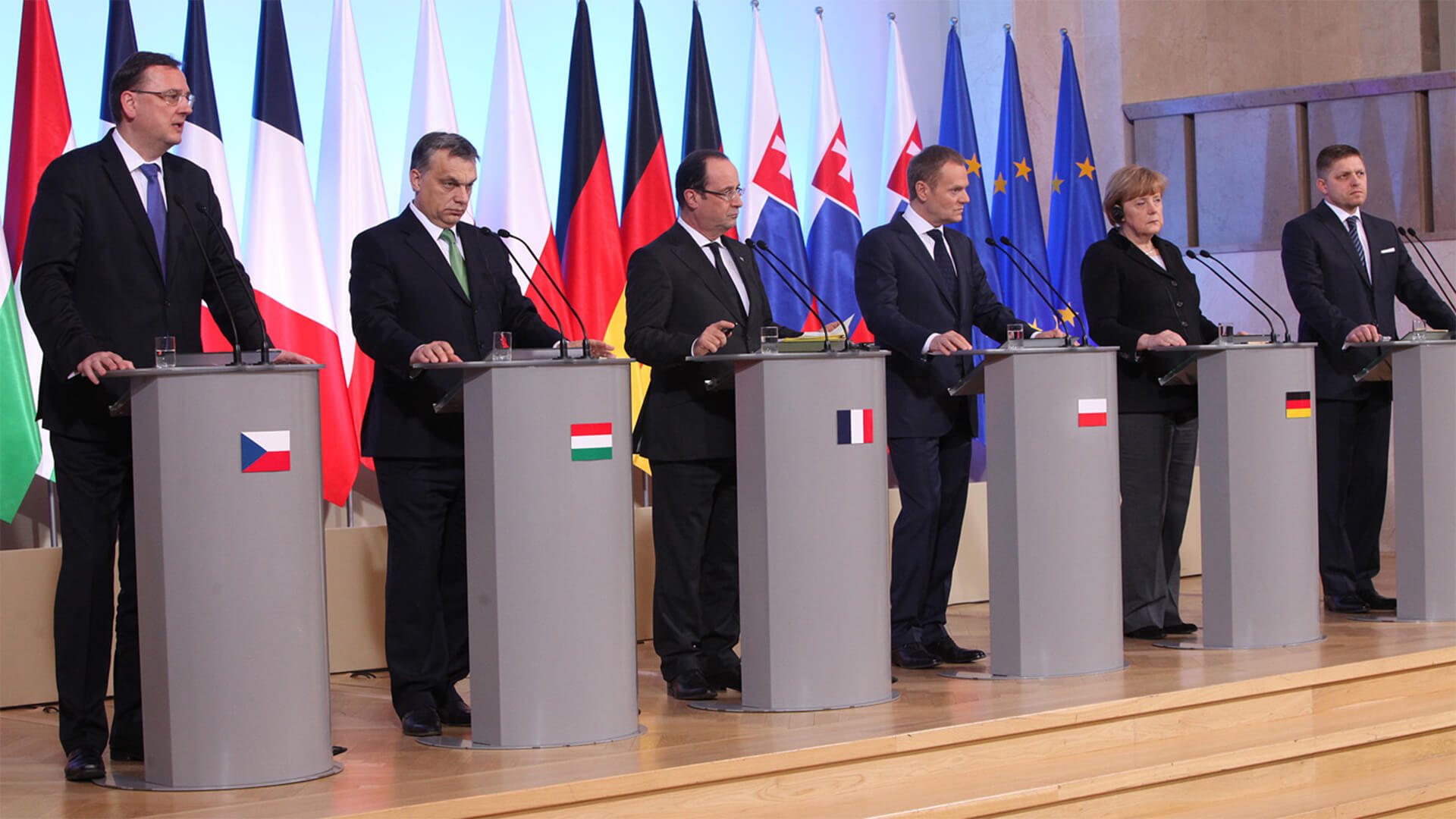
Today, 27th of June, there was a summit with a group called the Weimar Triangle, which includes the leadership of France, Poland, and Germany, the three critical countries of the Northern European Plain. The Weimar Triangle was envisioned in the aftermath of the Cold War when Poland was no longer a Soviet satellite country and was on the way to joining the European Union and NATO organizations that Poland has since joined. The idea was that in the long swath of bloody European history, France, Germany, and Poland tended to find themselves on different sides of most major issues, leading to many of the major wars.

Anyway, the idea was that if you get them all on the same side, then the Northern European Plain, instead of being the most blood-soaked part of the planet, can become something better—a path of trade and cooperation.

And you could argue that the idea of the Weimar Triangle has been realized, but it’s not because of the triangle. This is how it all started in the 1990s, but by the time we got to the 2010s, the three countries drifted apart. France tried to be an independent pole in international affairs, which is always a mixed bag. Germany tried to forego the politics and security talks and simply focused on trade by exploiting labor and infrastructure in Central Europe, taking a completely amoral position on everything that mattered. And Poland was in and out, in and out, with every possible interpretation of what it means to be Polish. Remember that Poland had its first democratic elections in the early 1990s.

So here we are, really only one generation later. There are a lot of deep divisions within Polish society about the role of government and where Poland fits within Europe and the wider world, and it’s not going to reach equilibrium anytime soon. By the time we got to about 2002, especially with the Iraq war in 2003, the Weimar Triangle had basically fallen apart until Russia invaded Ukraine in 2022.

Now, the three states are starting to talk a lot. Instead of collaborating on economic issues, they have decided to start working on joint military acquisitions and development, specifically for long-range cruise missiles with a range in excess of 2000 km. The reason is simple: as the Germans will tell you, if you go to war with the Russians and take a defensive position, the entire wealth and resources of the Russian Federation, Soviet Union, or Tsarist Imperial Russia, whatever it happens to be, can be collected into a single fist and punch at you wherever it wants. If you are left playing defense against that, you are going to lose. You have to have a deep strike capacity that shatters the infrastructure and logistical capability of the Russians far from the front. Throughout the Cold War, this is basically what NATO did by practicing things like the North Cape exercises, which weren’t necessarily designed to plug the Fulda Gap but instead to prevent the Russians from reaching the gap in the first place.

Now, where to go with this? It’s a realization, especially in Germany, where the defense minister is heading up this effort, that we are in a fundamentally different world. The foreign policies of the French and the Germans in recent years simply don’t work anymore. Getting that sort of weapons capacity in Europe gives the Europeans the ability to forestall a Russian invasion if Ukraine falls. The Poles know they’re next, and the Germans are fearful they’re after the Poles. So it makes sense to do this as soon as possible.

The question, of course, is whether it’s going to work as well as my hike. The answer is probably not, because even if the triangle can come up with the perfect weapon system, launching from the eastern half of Poland, you’re still a long way from huge parts of the Russian industrial base. Remember, during World War II, with the German invasion of the Soviet Union, Stalin built a lot of industrial plants on the other side of the Urals. We’re talking about a big place here, which is why that greenie peacenik Henry Kissinger always said in the post-Cold War era that no matter what your goal is vis-à-vis Moscow, it can’t be achieved by the Weimar Triangle alone—it has to be a Weimar Quartet. Ukraine has to be involved. If Russia is hostile, then you get a civil war among the Slavs, and you can launch an assault from 1500 miles further east, throwing a huge amount of Russian territory open.

Remember, from the Ukrainian border to Moscow is only about 350 miles. That’s not that far. More importantly, Ukraine is not technically part of the Northern European Plain; it’s actually in the Eurasian heartlands itself. So you split that territory between Russia and Ukraine, and instead of Russia being able to focus all of its attention on the Polish Gap, it suddenly has this massive frontier to worry about.

That’s in part why Putin launched the war in the first place. But second, the better option, as Kissinger put forward, is to assume that Russia gives up its genocidal irredentist ways and decides to join the family of nations. Splitting the territory ensures that you can never have a retrenchment that would be sustainable. If there is a way forward where Moscow is a decent place and Russia becomes a normal country, it will do so with Ukraine on its side. The only way to ensure that works is to have the Weimar Quartet fortify Ukraine, not just economically but also militarily, so there can’t be any backsliding.

Of course, the question then is: will that work? Well, that’s why we call it making history. All right, see you on the next mountain.

Photo in header by Občanská demokratická strana | Civic Democratic Party in the Czech Republic | Wikimedia Commons

Why France and Azerbaijan Are Fighting Over New Caledonia

WEBINAR – Peter Zeihan’s Risk List: What Keeps a Geopolitical Strategist Up at Night

Please join Peter Zeihan for a webinar on June 5th at 12:00 PM EST on a topic that is near and dear to the hearts of the Zeihan on Geopolitics team: geopolitical risk. This webinar will feature Peter’s reasonable-fear list, focused on issues that in his opinion have the most potential to impact market outcomes.

It’s no surprise that the French like to be “involved” in as many places as possible, but what’s going on with the current rebellion in the French protectorate of New Caledonia?

The independence movement is gaining traction in New Caledonia, but the French are changing electoral laws to prevent the movement from succeeding. Given France’s recent moves in Armenia, they’ve attracted the attention of Azerbaijan to this little foothold in the Southwest Pacific.

While Azerbaijan might not have the most experience in supporting dissidents, they do have the financial resources to piss off the French. Tensions are rising and this little island known for nickel mining might be getting more interesting than usual.

Here at Zeihan On Geopolitics we select a single charity to sponsor. We have two criteria:

First, we look across the world and use our skill sets to identify where the needs are most acute. Second, we look for an institution with preexisting networks for both materials gathering and aid distribution. That way we know every cent of our donation is not simply going directly to where help is needed most, but our donations serve as a force multiplier for a system already in existence. Then we give what we can.

Today, our chosen charity is a group called Medshare, which provides emergency medical services to communities in need, with a very heavy emphasis on locations facing acute crises. Medshare operates right in the thick of it. Until future notice, every cent we earn from every book we sell in every format through every retailer is going to Medshare’s Ukraine fund.

And then there’s you.

Our newsletters and videologues are not only free, they will always be free. We also will never share your contact information with anyone. All we ask is that if you find one of our releases in any way useful, that you make a donation to Medshare. Over one third of Ukraine’s pre-war population has either been forced from their homes, kidnapped and shipped to Russia, or is trying to survive in occupied lands. This is our way to help who we can. Please, join us.

Transcript

Nothing says power politics quite like a castle. So I thought this backdrop would be a great way to talk about the Southwest Pacific. specifically, we’ve got a rebellion going on in the province of New Caledonia. It’s an island that’s a French protectorate colony. And we’re starting to see people walking around with flags of Azerbaijan. So, you know, this requires a little bit of unpack. 

So, first of all, this is a territory that survived as a French protectorate. even after the rest of the colonies were hived off. And, on purpose or not. In the aftermath of World War two, during the decolonization period, the French held on to New Caledonia for two reasons. Number one, strategic position in the Southwest Pacific gives them a leg in that part of the world. 

And second, and from an economic point of view, far more importantly, New Caledonia is the third largest mine for nickel in the world. Nickel, obviously is using stainless steel, and of late it’s becoming far more important for green transition technologies. Everything from solar to, electrical grade steel to electric vehicles. Now, New Caledonia has had a kind of a rough time over the last few decades, because their nickel isn’t all that economically viable. 

the mines are the best in the world and far more importantly, takes a lot of energy to process nickel. And to be perfectly blunt, if you’re on a small island in the South Pacific and it’s really, really expensive. So it hasn’t broken even for much of the last 30 years. And even companies like Glencore, which are how should I put this? 

Typically not bound by a lot of ethical concerns are in the process of trying to get out. but but but but but if the green transition really does happen, we need ten times as much nickel. And that’s going to change the math for pretty much everything involving the island, which is why we’ve got the unrest right now. 

There is an independence movement that is gaining steam, and the French are in the process of making sure that it cannot succeed. So they’ve changed the electoral laws. It used to be that if you had been in the province, on the island for more than 25 years, you could vote in local elections. And that gave the local Kanak minority majority status. 

But, the French are in the process of changing that. So you only had to have lived there for ten years. And if you include all the mainland French imports to the island that have moved in the last decade, all or in the last 15 years, you’ve got a very different picture and the independence movement will never succeed. 

So that’s what’s going on to the French point of view. That’s what’s going on from the island point of view. That just leaves the observers. How do you flags? as we talked about recently, France is getting involved in the caucuses, specifically helping out Armenia, where it can diplomatically thinking that that’s going to give them a leg up in the caucuses. 

And that might provide them with some diplomatic heft that they’re losing in West Africa. Azerbaijan’s on the other side of that conflict, as a region in Armenia for a number of wars. And at the moment, Azerbaijan’s doing a lot better for a number of reasons, twice the population, 20 times the economic strength, much more powerful military and has recently kicked the Armenians ass in a couple of regional wars. 

Well, so France mucking about in Armenia has triggered a counter response, with Azerbaijan now monkeyed around in New Caledonia. Now Azerbaijan brings nothing to this fight. They have no experience in supporting it with dissidents. They don’t know how to do paramilitary attacks at all. But what they do have is a metric butt ton of money. This is a country with barely 10 million people who have a million barrels per day of oil exports, and they can throw a lot of cash at a lot of things, at a lot of places if they want to. 

And for their first big trick, they’re trying to sponsor a revolution in the South Pacific just to piss France off. It’s working. 

Why Are the French Getting Involved with Armenia? || Ask Peter

WEBINAR – Peter Zeihan’s Risk List: What Keeps a Geopolitical Strategist Up at Night

Please join Peter Zeihan for a webinar on June 5th at 12:00 PM EST on a topic that is near and dear to the hearts of the Zeihan on Geopolitics team: geopolitical risk. This webinar will feature Peter’s reasonable-fear list, focused on issues that in his opinion have the most potential to impact market outcomes.

Today we’ll be looking at why the French are considering sending military aid to Armenia…and no, its not because they’re looking to swap croissant and nazook recipes.

Let’s disregard NATO and EU ties to Azerbaijan for this discussion, because this move by the French is more motivated by Turkey’s support of Azerbaijan and Iran’s declining regional influence. There’s also some Armenian ex-pats who might be helping push this forward.

The French are coping with their loss of influence in West Africa by expanding their reach to Armenia in hopes that it will help give them some influence in a new sphere. This move would also help to position the French against the rising Turkish influence in the region, so two birds I guess.

Here at Zeihan On Geopolitics we select a single charity to sponsor. We have two criteria:

First, we look across the world and use our skill sets to identify where the needs are most acute. Second, we look for an institution with preexisting networks for both materials gathering and aid distribution. That way we know every cent of our donation is not simply going directly to where help is needed most, but our donations serve as a force multiplier for a system already in existence. Then we give what we can.

Today, our chosen charity is a group called Medshare, which provides emergency medical services to communities in need, with a very heavy emphasis on locations facing acute crises. Medshare operates right in the thick of it. Until future notice, every cent we earn from every book we sell in every format through every retailer is going to Medshare’s Ukraine fund.

And then there’s you.

Our newsletters and videologues are not only free, they will always be free. We also will never share your contact information with anyone. All we ask is that if you find one of our releases in any way useful, that you make a donation to Medshare. Over one third of Ukraine’s pre-war population has either been forced from their homes, kidnapped and shipped to Russia, or is trying to survive in occupied lands. This is our way to help who we can. Please, join us.

Transcript

France recently has been, entering conversations about military assistance for aid or supply to Armenia. France, you know, famously has a large Armenian ex-pat population, but NATO, the EU, very broadly have deep energy trade monetization ties with Azerbaijan. is there a future quagmire facing, the individual elements of EU member states, the EU as an organization, NATO membership, with what seems to be a intensifying conflict between Armenia and Azerbaijan. 

This is this is purely a France issue. NATO’s actually involved with the Armenia Azerbaijan issue. If anything, it’s going to be decided by which direction the two other powers in the region decide to go Iran and Turkey. In the case of Iran, they don’t bring a lot to the table anymore, especially if the Russians are out in. 

The Russians are out. the Turks obviously out of a partnership and an ethnic relationship with the Azerbaijanis, and that is getting more robust by the day. And Azerbaijan has proven to be a wonderful testbed for Turkish drone technology, which has absolutely obliterated any strategic independence at the Armenians may have once had. So the French basically are playing a little bit of a double game. 

the French have lost their position. West Africa, which from a strategic and an economic point of view is no big loss. But it was a hit to the prestige. And they absolutely blame the Russians and absolutely accurately blame the Russians for that. So now the French are in the process of doing a strategic realignment. And that means, first and foremost, take a good, hard look at the interests of the country that are causing them to do that. 

And that is the Russians. So the French are considering putting troops in Ukraine very seriously, in order to provide a bulwark for the Ukrainians and most importantly, for the French to learn about all these changes in technology, as we saw with the Azerbaijani, Armenia war of late, as well as Ukraine war. Drone drones are the newest thing and the French have no experience with that. 

So in both of these theaters, that’s one of the things they’ve got their eyes on in terms of the Caucasus, the French have a little bit more room to maneuver there than, say, the Germans or the Italians, because they’re not dependent upon as of any energy at all. and we are seeing a rising what’s the right here interaction of Turkish interests and French interests. 

Because as the United States steps back from a lot of things, the eastern med becomes a potential zone of competition. And if that turns harsh, the French are gonna want some cards to play on another front. As a region, Armenia, the Caucasus plays into that. I’m not saying that these two powers have to not get along. I’m saying that they need to figure out whether they’re going to get along or not. 


And France establishing a few flags on the ground in Armenia is a way to do that. Doesn’t mean they’re going to be hostile. It means they’re going to be rubbing up against each other more often. And this is preparation. 

More Than Hon Hon Hon: What Are the French Up to in Ukraine?

There’s been recent discussions by French President Macron regarding deploying French troops to Ukraine. Is this really going to happen and why would they do this?

Given France’s nationalist stance, stable demographics, and the evolving European landscape, this appears to be a feasible endeavor. The French stand to gain some insight to tech and new tactics, some resource regulation, and the obvious strategic positioning to support Ukrainian forces and the security interests of wider Europe.

Given the relative speed with which France can make decisions and implement them (when compared to the Germans), this is likely the emergence of the French as an assertive power in European strategic conversations. This move could shake up all of Europe, so I’ll be monitoring this situation as it continues to unfold.

Here at Zeihan On Geopolitics we select a single charity to sponsor. We have two criteria:

First, we look across the world and use our skill sets to identify where the needs are most acute. Second, we look for an institution with preexisting networks for both materials gathering and aid distribution. That way we know every cent of our donation is not simply going directly to where help is needed most, but our donations serve as a force multiplier for a system already in existence. Then we give what we can.

Today, our chosen charity is a group called Medshare, which provides emergency medical services to communities in need, with a very heavy emphasis on locations facing acute crises. Medshare operates right in the thick of it. Until future notice, every cent we earn from every book we sell in every format through every retailer is going to Medshare’s Ukraine fund.

And then there’s you.

Our newsletters and videologues are not only free, they will always be free. We also will never share your contact information with anyone. All we ask is that if you find one of our releases in any way useful, that you make a donation to Medshare. Over one third of Ukraine’s pre-war population has either been forced from their homes, kidnapped and shipped to Russia, or is trying to survive in occupied lands. This is our way to help who we can. Please, join us.

TranscripT

Hey, everybody. Peter Zeihan here. Coming to you from Colorado today. We’re going to kick around with the French are doing in Europe, specifically in Ukraine. You have French President Macron, who has been recently talking about sending French troops into Ukraine. And not only is this week broken the eyes on a broader strategic discussion. It bears the question of what the hell the French are thinking, how they fit into the alliance network, how this might play out.

And I got to say, in traditional French fashion, it’s it’s interesting. So the French have a reputation well earned, I might point out, for being rather narcissistic. They’re convinced that the world revolves around them. They they believe that oftentimes the Americans are just as much of a problem as the more legitimate strategic threats, because the Americans tend to take the lead in everything because they’re providing the men and the money and the intelligence and the satellite system and the transport, you know, other pesky things.

But the French have always, always, always been at the center of decision making in Europe, largely because they’ve had a relatively strategic position out on the western edge where they’re not being constantly hit from multiple directions so they can focus their forces when they want to, not the the degree of a naval power like Britain, of course, but for a land power, they punch pretty hard and it’s kind of hard to hit them back.

Now, what this means is that the French being on the far side of Western Europe are directly impacted by the day to day goings on of the Ukraine war. And even in the worst case scenario where Ukraine falls, they’re not in the next line of attack. That would be Poland and Germany and then the low countries before you would get to France.

So from a certain point of view, the French can take an almost American approach to this and take the very long view. And that’s been shaped by their political culture, their geography, their military system. You know, this is nothing new here. But why? Why, why, why, why would they be talking about sending troops? Well, we’ve got a few things going on that are making this more and more feasible.

Number one, the very nature of Europe needs to change. So the EU, as it was originally envisioned, was an economic and trading club, but everything that allowed it to work has basically broken down in the last few years. Number one, globalization is going away. So the Europeans are losing their ability to sell on the international market bit by bit.

France, being nationalist, never really got into that. So they don’t have anything to lose. Second demographics. Most of Europe is aging so rapidly that all of the major countries basically ceased functioning as modern economies. And 5 to 15 years. But not France. France actually has needless policies and so has a pretty high birth rate or complications that come from that.

But this is not a country whose economic models in danger. Third, if Europe as an entity is going to matter at all. It has to be able to stand up for its own security concerns. And we now know very clearly that the Russians are not going to stop unless they are stopped. That means France, despite being on the far western edge, can’t take a completely hands off approach.

You can take the long view, but it can’t do nothing. You put all this together and the French see, putting boots on the ground as you create is something to very seriously consider. Number one, there’s a lot of resources, especially in agriculture in Ukraine, getting that under the European EGIS so it can be regulated by European norms is something the French like, just as it is.

Number two, technology. Ukraine has become a background in a new type of warfare using mass drones in the hands of not just strategic decision makers, but everyday troops. And if you are France, you would rather understand that before it comes to your borders. So having folks there not just to train the Ukrainians, but to be trained by the Ukrainians makes a lot of sense.

Three, whatever the future of the European Union is going to be, it’s not going to be a major trading bloc. They no longer have the population to sustain that. It’s going to be based more on politics, security, culture and identity. Well, these are things that the French are much more comfortable with. And if you can bring Ukraine into that family, it makes the overall unity of the system much stronger and more coherent.

This isn’t like the old days when the French would oppose European Union expansion because they don’t want to have to subsidize anyone. Those days are over anyway. The European Union is losing the ability to do that as the Germans age out. There’s no one left to write the check except for the French, and they don’t want to. So they’d rather change the nature of the union itself.

And then finally, there’s a leadership issue here. A very short term leadership issue under German Chancellor Schulz. Germany is basically getting dragged into a lot of strategic positions. They’ve got a fractured government made of libertarian businessmen, Greens and social Democrats. And there’s very little that they agree on. And it’s really hard for them to change their mind on any policy or take a leadership position, because before Germany can act, the coalition has to come to an agreement.

So whether it’s been on subsidies or health care or labor negotiations or the Ukraine war or EU policy, everything has just been so damn slow. And then you have France, where there’s a majority government run by a major party under a relatively airmatic leader who can make decisions and implement them very quickly. And if you put that in the context of what’s going on Ukraine right now in this conversation of troops, people are looking to Germany to set the strategic conversation at all.

They’re looking to the French and may they may not like what the French have to say. But there’s a lot of different opinions, because if you are in Estonia or Latvia or Lithuania or Finland or Sweden or Poland, well, of course we’re going to have to get involved in Ukraine. Of course, the Russians are not going to stop.

Of course, we need to consider putting boots on the ground in order to protect the Ukrainians and look out for European values to have someone on the other side of Europe and far west saying that. That’s a rallying cry, not something to argue against. So for the first time in quite some time, the French are getting some very real strategic kudos from other European countries for being aggressive as opposed to just arguing with the United States.

And then there’s the final issue of what would they do when we get there. We’re not talking about French troops going to the frontline and fighting the Russians. No, no, this is not a Napoleonic invasion. The idea is threefold. Number one, you put them there in order to repair equipment that the Ukrainians need. So it doesn’t have to get shipped all the way to Western Europe.

So speed the process up. Number two, training it both ways. The French training the Ukrainians, especially things like Special forces, the Ukrainians training the French, and especially in things like drone tech. And then third, provide a strategic backstop in places that you don’t expect to get hot but could. So you put French troops on, say, the border of Belarus or the border of Moldova, where the Russians have forces in a place called Transnistria, where they’re basically sponsored a secessionist operation 30 years ago, and they’re still there.

And that way the Ukrainian forces that are there now can redirect to the front line. So there’s a lot of reasons that we should treat this seriously. I mean, yes, it’s the French, so there’s a lot of bombast and pomposity. But this is a very, very real strategic discussion that Macron has started. And if I was a betting man, I’d say it’s going to manifest as something that is actually real before the end of this year.